
Kratom vs Coffee & Matcha: Which Is Best for Jitter-Free Productivity?
Most of us have been there. It’s 10:00 AM, you’re three cups of coffee deep, and instead of laser focus, you’ve hit the dreaded “jitter spike.” Your heart races, your hands are slightly shaky, and you know the inevitable 2:00 PM crash is looming. If you’re actively evaluating better ways to manage your daily energy, you aren’t alone.
In 2026, the shift away from sharp, chaotic stimulants toward functional, smooth botanicals is accelerating. High performers want to escape the physical anxiety of high-dose caffeine and step into sustained, predictable productivity. But how do you actually compare your morning espresso to matcha, or to stimulating kratom strains like white and green veins? Let’s break down the science, the duration curves, and the exact protocols you can use to upgrade your workday focus.
Why Compare Kratom, Coffee & Matcha?
Coffee, matcha, and kratom are increasingly compared because they all occupy a similar role in many people’s daily routines: improving energy, concentration, and productivity. Although they are often grouped together as natural performance enhancers, each produces a distinctly different experience in terms of onset, duration, and overall stimulation profile.
Coffee remains the most familiar choice, prized for its fast-acting energy but often criticized for causing jitters and afternoon crashes. Matcha has gained popularity among professionals and students because its natural L-theanine content promotes smoother, calmer focus while still providing caffeine. Kratom has emerged as another point of comparison because certain white and green vein varieties are commonly discussed for their long-lasting energy and mental clarity.
Comparing kratom vs coffee & matcha allows consumers to evaluate more than simple energy levels. It helps answer practical questions such as which option lasts longest, which produces the fewest jitters, and which may better support extended periods of focused work.
The Rubiaceae Family Reunion: Distant Cousins, Different Fuel
It surprises many people to learn that the coffee tree (Coffea) and the kratom tree (Mitragyna speciosa) are actually botanical cousins. Both belong to the Rubiaceae family. Yet, while they share a genetic lineage, the way they interact with your brain and body is vastly different.
Recent consumer sentiment data reveals that anxiety and a “racing heart” make up roughly 60% of complaints associated with traditional high-dose caffeine consumption. We demand high energy to meet our daily goals, but the physical toll of traditional coffee is leading users to seek functional alternatives. People are looking for natural compounds that provide the alertness of a dark roast, but with the smooth, grounding nature of a premium green tea.
The Stimulation Curve: Mapping the Jitter Escape
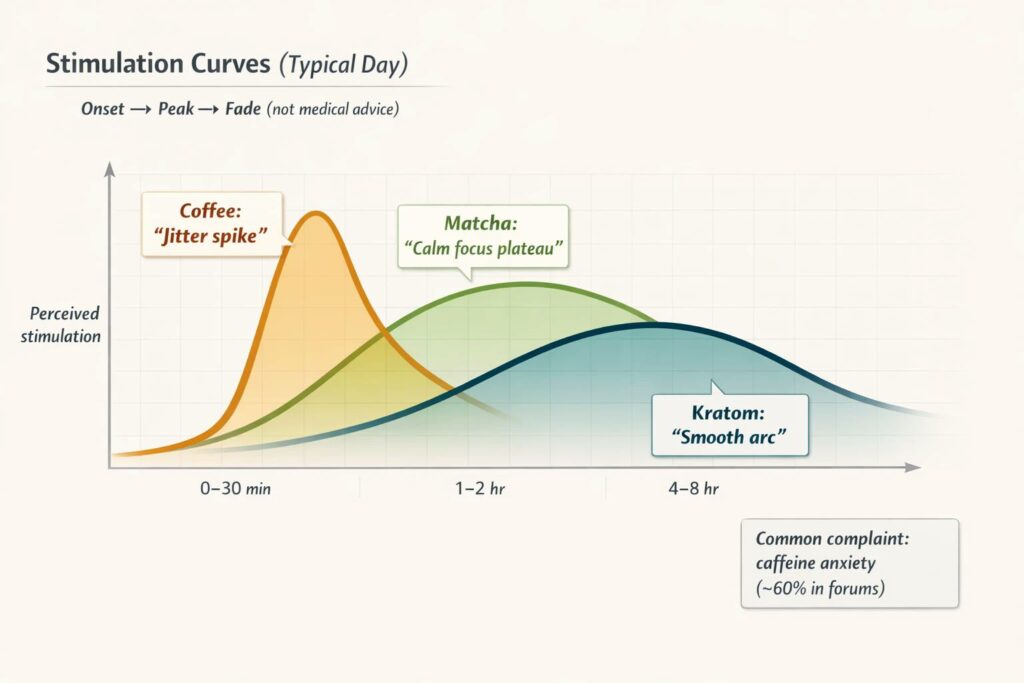
To truly evaluate which botanical fits your performance needs, you have to look past the initial onset and examine the “Stimulation Curve.”
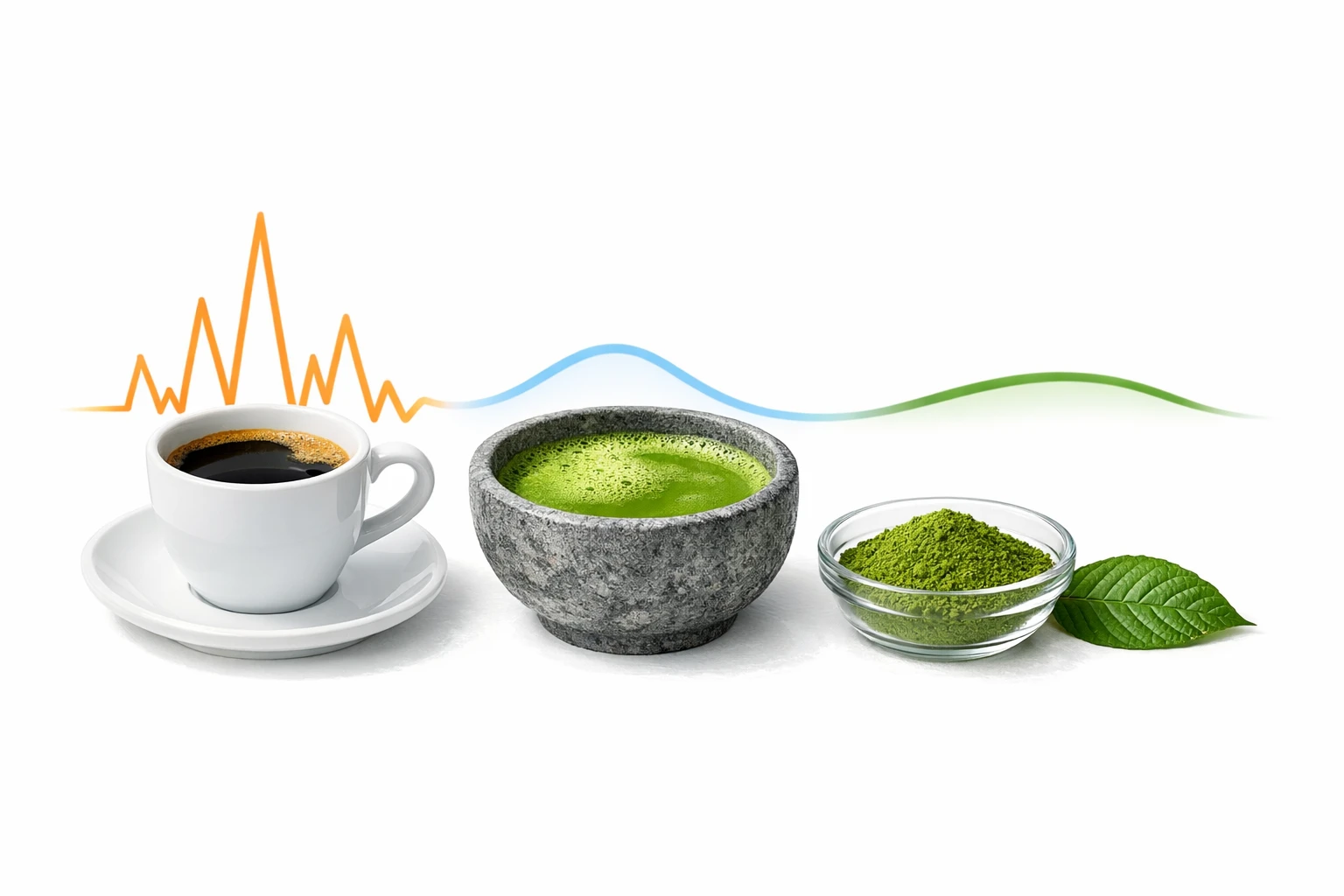
- Coffee (The Sharp Spike): Hits hard and fast. Caffeine has a biological half-life of about six hours, but its primary “buzz” is notoriously short-lived. This rapid peak invariably leads to a steep, exhausting drop, leaving you reaching for another cup.
- Matcha/Green Tea (The L-Theanine Plateau): Provides a gentler incline. The natural presence of L-theanine tempers caffeine’s aggressive edge, creating a smooth, albeit milder, baseline of focus without the severe crash.
- Stimulating Kratom (The Smooth Arc): White and green vein kratom strains operate on a longer, highly stable trajectory. Rather than spiking your nervous system, a moderate dose provides a steady wave of alertness that users often report lasting up to 8 hours, featuring a much shallower tapering off.
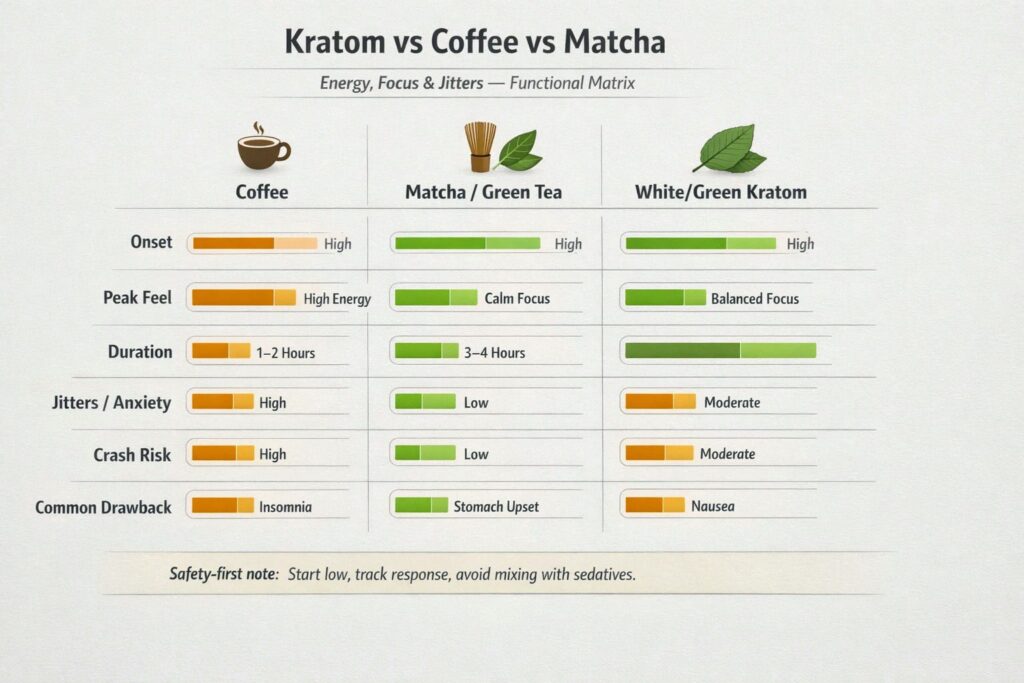
Coffee vs Matcha vs Kratom at a Glance
Looking at these three botanicals side by side highlights why they are often compared by professionals, students, entrepreneurs, and anyone seeking consistent daytime performance. Each offers a different balance between stimulation, duration, and overall comfort.
| Feature | Coffee | Matcha | Kratom |
|---|---|---|---|
| Primary Compound | Caffeine | Caffeine + L-theanine | Mitragynine |
| Typical Onset | Fast | Moderate | Moderate |
| Typical Duration | 2–4 hours | 3–4 hours | 5–8 hours* |
| Energy Profile | Sharp increase | Smooth, gradual | Sustained, gradual |
| Common Complaint | Jitters and crashes | Mild stimulation | Dose-sensitive effects |
| Popular Use | Morning energy | Calm productivity | Extended focus sessions |
*Duration varies depending on serving size, metabolism, and product quality.
This comparison illustrates that choosing between kratom, coffee, and matcha isn’t simply about maximizing stimulation. Instead, it’s about selecting the energy profile that best supports your schedule, workload, and individual response to botanical compounds.
Pharmacology 101: Blocking Sleep vs. Boosting Arousal
Understanding why these botanicals feel so completely different comes down to chemical synergy and mechanism dissonance.
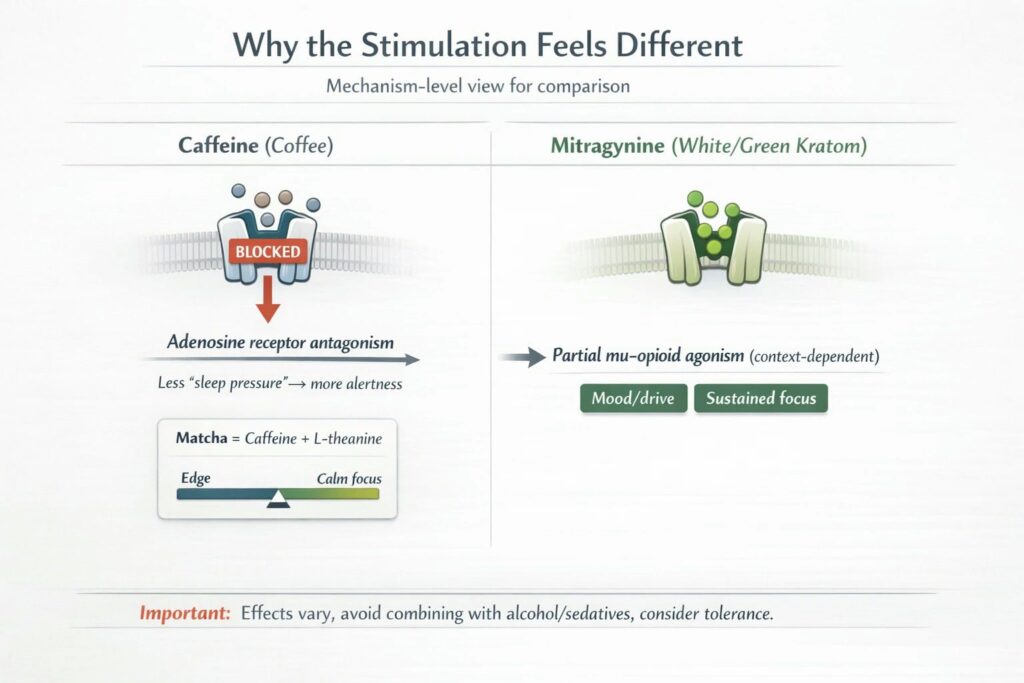
Caffeine works through Adenosine Antagonism. Think of adenosine as a neurotransmitter that tells your brain it’s time to rest. Caffeine doesn’t actually give you genuine energy; it simply blocks your brain’s sleep receptors. When the caffeine wears off, all that accumulated adenosine rushes in at once—which is exactly why you hit a wall in the afternoon.
Mitragynine, the primary active alkaloid in kratom, takes a fundamentally different path. It acts primarily as a partial mu-opioid agonist. According to recent 2024 pharmacological phase 1 trials examining low-dose mitragynine, this pathway directly influences cognitive arousal and mood. Instead of just tricking your brain into ignoring fatigue, stimulating kratom strains actively promote a sense of clear-headed drive and motivation.
Choosing Between Coffee, Matcha & Kratom
After understanding how each botanical works, the next question becomes practical: which one best fits your daily routine?
For people who need an immediate burst of alertness before a short meeting or commute, coffee may provide the quickest response. However, individuals who are sensitive to caffeine sometimes find that the rapid onset also increases nervousness or produces an afternoon energy crash.
Matcha often appeals to those looking for a calmer workday experience. The combination of caffeine and L-theanine creates a steadier level of concentration that many students, writers, and office professionals appreciate during extended periods of reading, studying, or creative work.
When comparing kratom vs coffee & matcha, some consumers choose white or green vein kratom because they are seeking longer-lasting productivity with fewer interruptions from repeated caffeine consumption. Rather than repeatedly reaching for another cup of coffee, many users report preferring a more sustained energy profile throughout longer work sessions.
Ultimately, the best choice depends on your goals, individual metabolism, sensitivity to stimulants, and preferred work style rather than any single botanical being universally superior.
Finding Your Productivity Sweet Spot
When you’re comparing your options, dosage is everything. With caffeine, more usually just means more anxiety. With kratom, the golden rule of biohacking is “less is more.”
The Flow State Dose
For those seeking a highly functional alternative to morning coffee, a low dose of fresh, third-party tested kratom is ideal. If you are exploring white vein kratom for focus, the 1 to 3-gram range is where the most profound, jitter-free concentration occurs. Pushing the dose higher shifts the effect from stimulating to relaxing, which defeats the purpose of a midday productivity boost (and introduces the risk of nausea, the number one deterrent for new switchers).
The Hybrid Stack
Many modern professionals utilize a “stacking” approach rather than relying on one substance. Pairing a cup of L-theanine-rich matcha with a low dose (1g) of green vein kratom creates a chemical synergy that maximizes mental clarity without stressing the central nervous system.
The Anti-Crash Protocol
Regardless of which botanical you choose, you have to support your body’s baseline. Maintaining deep hydration and pairing your botanicals with a high-protein breakfast stabilizes blood sugar, effectively eliminating the physical factors that contribute to afternoon slumps.
Who Should Avoid Mixing Stimulants?
Although some experienced users combine coffee, matcha, and kratom, doing so isn’t appropriate for everyone. Individuals who are particularly sensitive to caffeine or other stimulants may experience increased nervousness, rapid heart rate, digestive discomfort, or difficulty sleeping when multiple stimulating products are consumed together.
If you’re exploring kratom vs coffee & matcha for the first time, it’s generally easier to evaluate each botanical separately before experimenting with combinations. This approach allows you to identify how your body responds to each product without introducing unnecessary variables.
People taking prescription medications, managing cardiovascular conditions, or addressing other health concerns should also consult a qualified healthcare professional before combining multiple botanicals or dietary supplements.
The Jitter-Free Transition: A 7-Day Protocol
If you’re using kratom to bridge your way off a heavy caffeine dependency to avoid withdrawal headaches, you need a structured transition. Going “cold turkey” on a 4-cup-a-day coffee habit can disrupt your whole week. Instead, follow this safety-first taper guide.
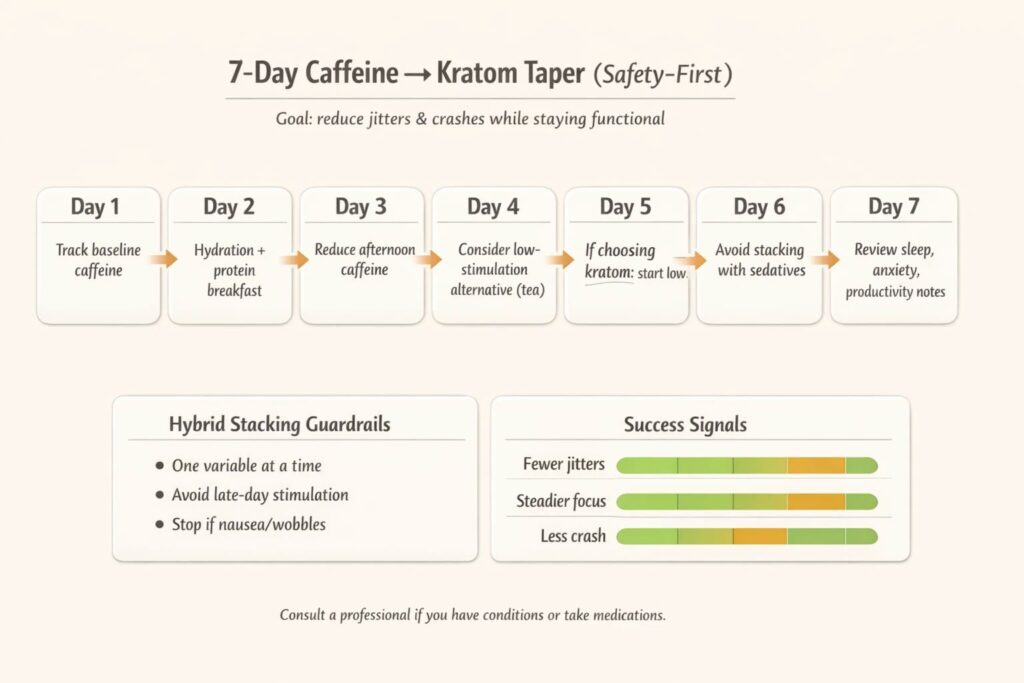
- Days 1-2 (The Bridge): Cut your total daily coffee intake by 25%. Introduce 1 to 1.5 grams of white or green vein kratom in the early afternoon to bridge the energy gap and maintain your workflow.
- Days 3-4 (The Swap): Cut coffee to 50%. Swap your afternoon coffee entirely for a cup of matcha. Keep kratom at a stable 1 to 2 grams in the morning alongside your reduced coffee.
- Days 5-6 (The Shift): Move to purely green tea or matcha for your light caffeine source. Utilize kratom as your primary cognitive driver for deep work sessions.
- Day 7 (The New Baseline): Evaluate how you feel. Most users find that by day seven, their baseline anxiety has dropped significantly, replaced by a smooth, sustained flow state that carries them comfortably through a standard 8-hour workday.
Common Mistakes When Switching from Coffee to Kratom
Consumers exploring kratom vs coffee & matcha often make similar mistakes during the transition process. One of the most common is assuming that stronger stimulation automatically leads to greater productivity. In reality, excessive serving sizes may reduce focus instead of improving it.
Another frequent mistake is changing too many variables simultaneously—for example, eliminating coffee completely while introducing multiple new botanical products. A gradual transition makes it much easier to understand what is contributing to positive or negative changes.
Hydration and nutrition are also commonly overlooked. Coffee, matcha, and kratom all perform best when supported by adequate fluid intake, balanced meals, and consistent sleep habits. Building these fundamentals into your routine often improves productivity more effectively than simply increasing botanical consumption.
Frequently Asked Questions (FAQ)
Will stimulating kratom strains give me the same “racing heart” as coffee?
No. Because mitragynine interacts with entirely different receptors than caffeine, it does not trigger the same aggressive central nervous system spike. Most users describe the energy as a “clean, grounded drive” rather than a jittery rush.
How long do the focus effects of kratom actually last compared to matcha?
While a premium cup of matcha provides a steady, calm burn for about 3 to 4 hours, a moderate dose of green or white vein kratom typically sustains focus for 5 to 8 hours. This heavily depends on your individual metabolism and the specific alkaloid profile of the product you are using.
Can I mix coffee and kratom at the same time?
While some experienced users do, it is generally recommended to separate them if your primary goal is avoiding jitters. Combining two strong stimulants can overwhelm your system. If you want to stack botanicals, combining a low dose of kratom with a lower-caffeine option like green tea is a much smoother approach to cognitive performance.
Your Next Steps for Sustained Focus
Escaping the daily cycle of caffeine spikes and crashes doesn’t mean sacrificing your edge or your productivity. By understanding the distinct stimulation profiles of coffee, matcha, and kratom, you can intentionally curate your daily fuel to match your exact performance needs.
At Kratom-Online, we believe that optimizing your routine starts with transparency, direct-from-farm purity, and rigorous third-party testing. If you’re ready to evaluate a smoother, longer-lasting alternative to your morning cup, start with our premium, carefully sourced white and green vein powders—designed to deliver the clean focus you need to command your day without the crash.