
How to Choose a High-Quality Kratom Extract: Debunking Potency Claims & Spotting the Best Value
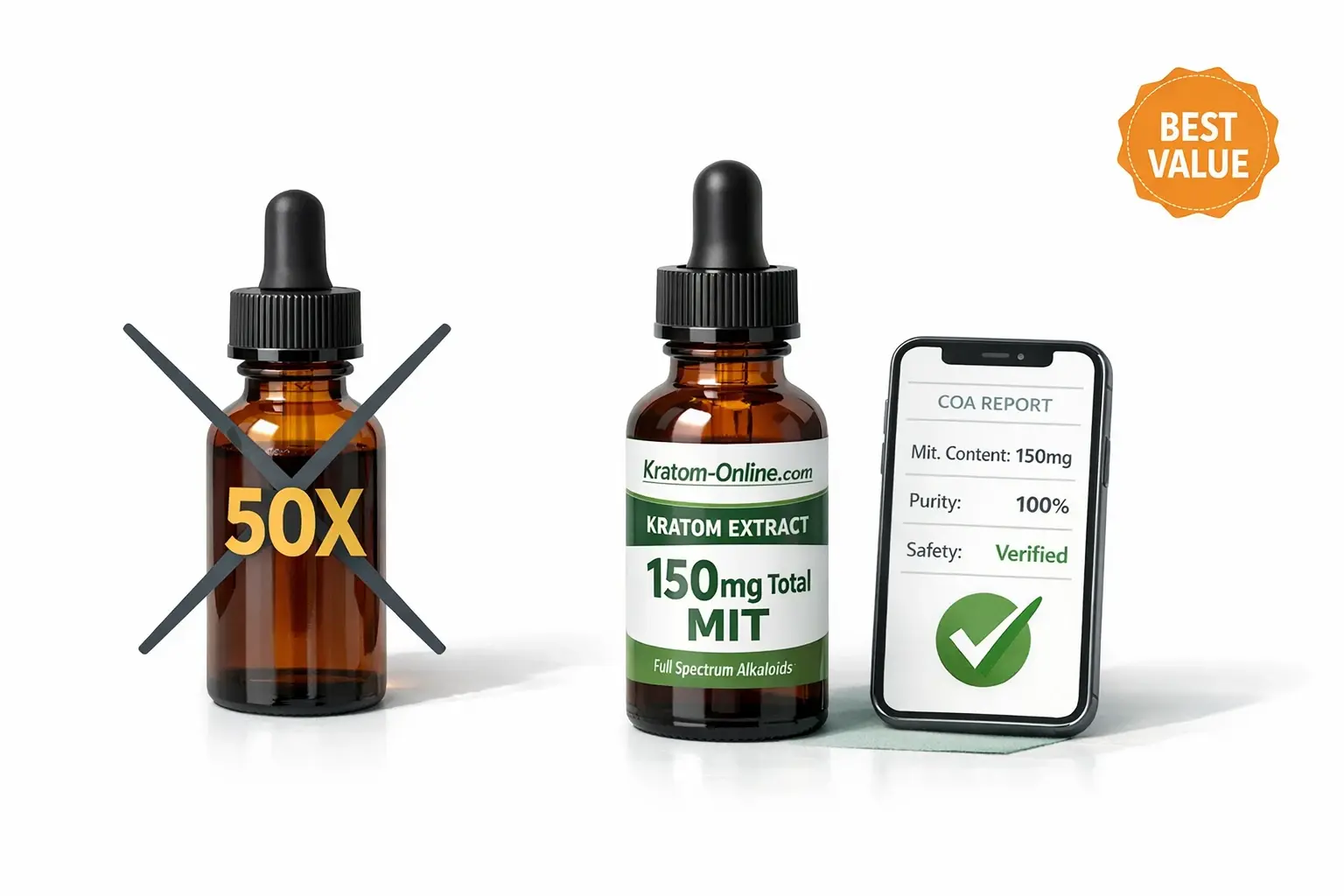
If you have spent any time comparing kratom extracts, you have likely encountered the “label fatigue” that plagues our industry. You pick up one bottle labeled “50x Potency,” click on another claiming “Gold Standard,” and find a third boasting a “Proprietary Blend.”
Yet, when you try to determine which one offers the best value or the most consistent experience, the math doesn’t add up.
Here is the reality: The kratom market is currently in a transition phase. We are moving away from vague marketing buzzwords toward pharmaceutical-grade transparency. As a consumer, you shouldn’t have to guess what is in your product. You need a reliable framework to evaluate quality, verify safety, and calculate true cost.
This guide moves beyond the marketing hype to provide you with an objective method for auditing extract quality—ensuring you get a product that is unaltered, safe, and worth your investment.
The Death of the ‘X’ Factor
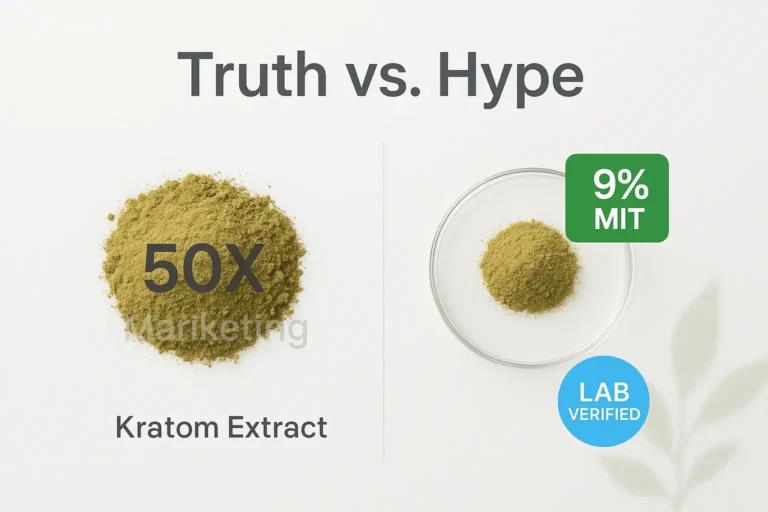
For years, the industry standard for marketing extracts was the “multiplier” label—10x, 20x, 50x. On the surface, this seems logical. A “50x” extract implies that 50 kilograms of raw leaf were used to make 1 kilogram of extract.
However, this metric is mathematically meaningless regarding potency. Here is why:
The strength of the final product depends entirely on the strength of the starting material.
- Scenario A: A 50x extract made from low-quality leaf (0.5% Mitragynine) results in a final product with 25% potency.
- Scenario B: A 10x extract made from premium leaf (1.5% Mitragynine) results in a final product with 15% potency.
In this scenario, the “50x” product is supposedly five times stronger based on the label, but chemically, it’s not even double the strength of the “10x” product. This ambiguity allows low-quality producers to hide behind high “X” numbers while delivering weak effects.
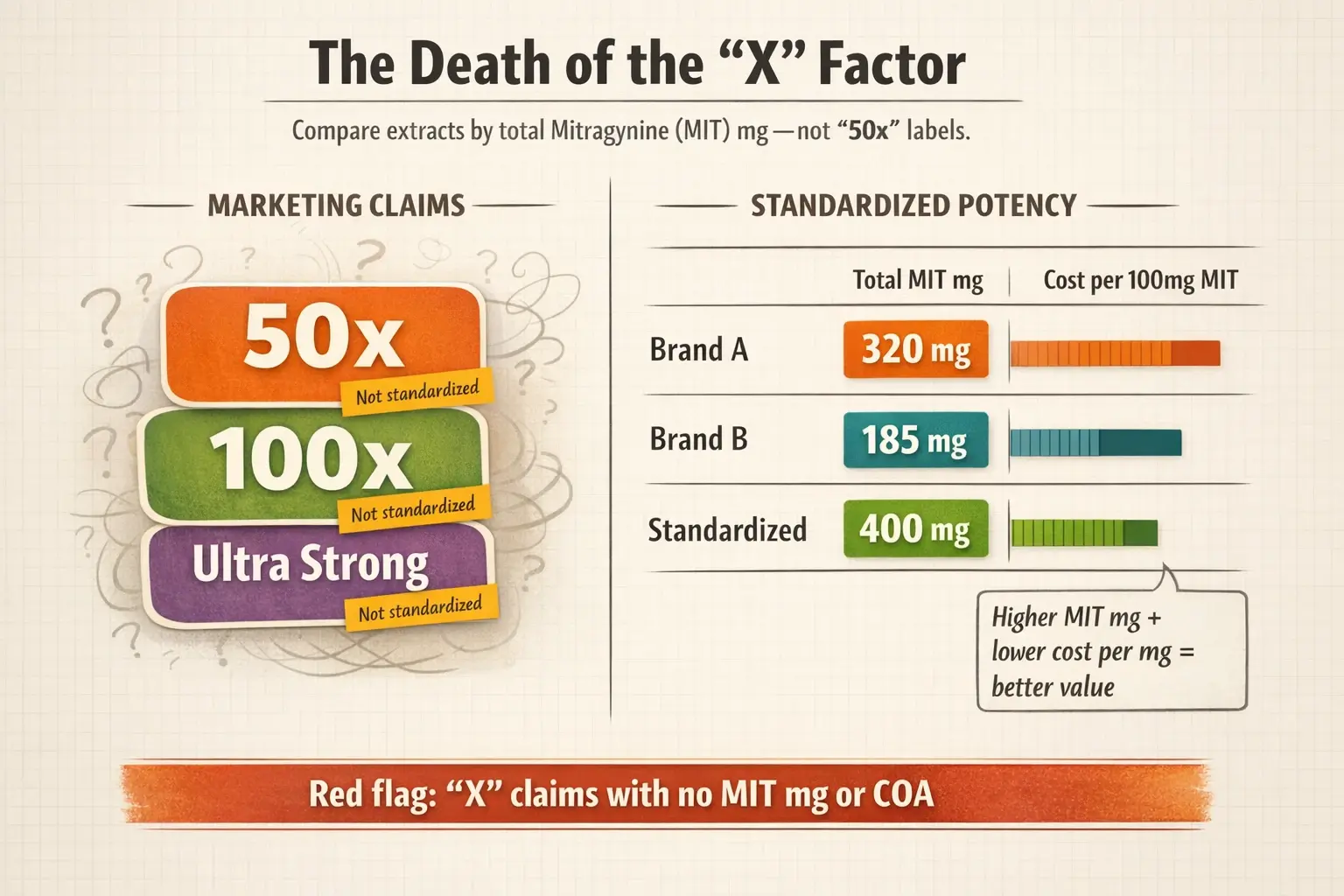
The Solution: Ignore the multiplier. To truly evaluate a product, you must look for the Total Mitragynine (MIT) content, usually listed in milligrams (mg) or percentage. This is the only metric that tells you exactly how much active alkaloid you are purchasing.
The 3 Pillars of Extract Quality
Once you stop looking at the “X” and start looking at the data, you can separate premium vendors from gas station brands using three specific pillars of quality.
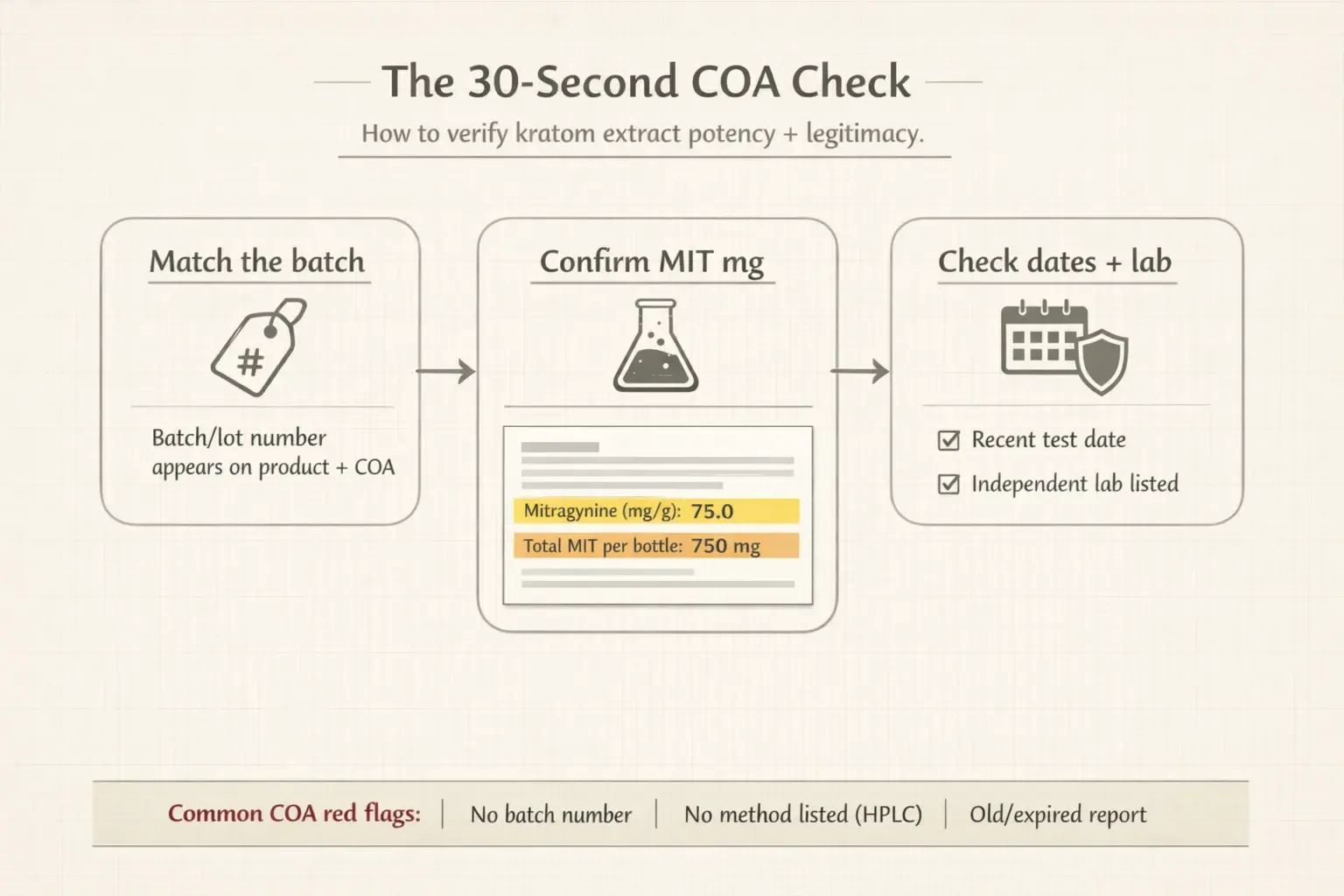
Pillar 1: Transparency (The 30-Second COA Check)
Legitimate vendors do not ask you to trust them; they provide proof. This proof comes in the form of a Certificate of Analysis (COA) from an accredited, third-party laboratory.
However, simply having a link to a lab result isn’t enough. Many substandard vendors reuse old labs or post generic results. When you are evaluating a brand like Kratom Online or others, perform this 30-second audit:
- Check the Batch Number: Does the batch number on the bottle match the batch number on the COA? If not, the test results are irrelevant to the product in your hand.
- Verify the Date: Is the test recent? Kratom degrades over time. A COA from 2021 is a red flag for inventory that has been sitting in a warehouse.
- Look for Contaminants: A full-panel COA doesn’t just test potency; it tests for heavy metals (lead, arsenic) and biological contaminants (salmonella, E. coli).
Pillar 2: Potency (Total MIT vs. Percentage)
When reading the label, context is key. You will typically see potency expressed in two ways:
- Percentage (%): This refers to the purity of the extract itself. For example, a “45% MIT extract” means 45% of the powder’s weight is pure Mitragynine.
- Milligrams (mg): This refers to the total yield in the container.
Why this matters: A small bottle of liquid extract might boast “45% purity” but only contain 30mg of total alkaloids because the volume is tiny. Always look for the Total MIT mg per serving and per container. This allows you to dose accurately and avoid the surprise of a product that is much weaker—or significantly stronger—than you anticipated.
Pillar 3: The Full-Spectrum Ratio
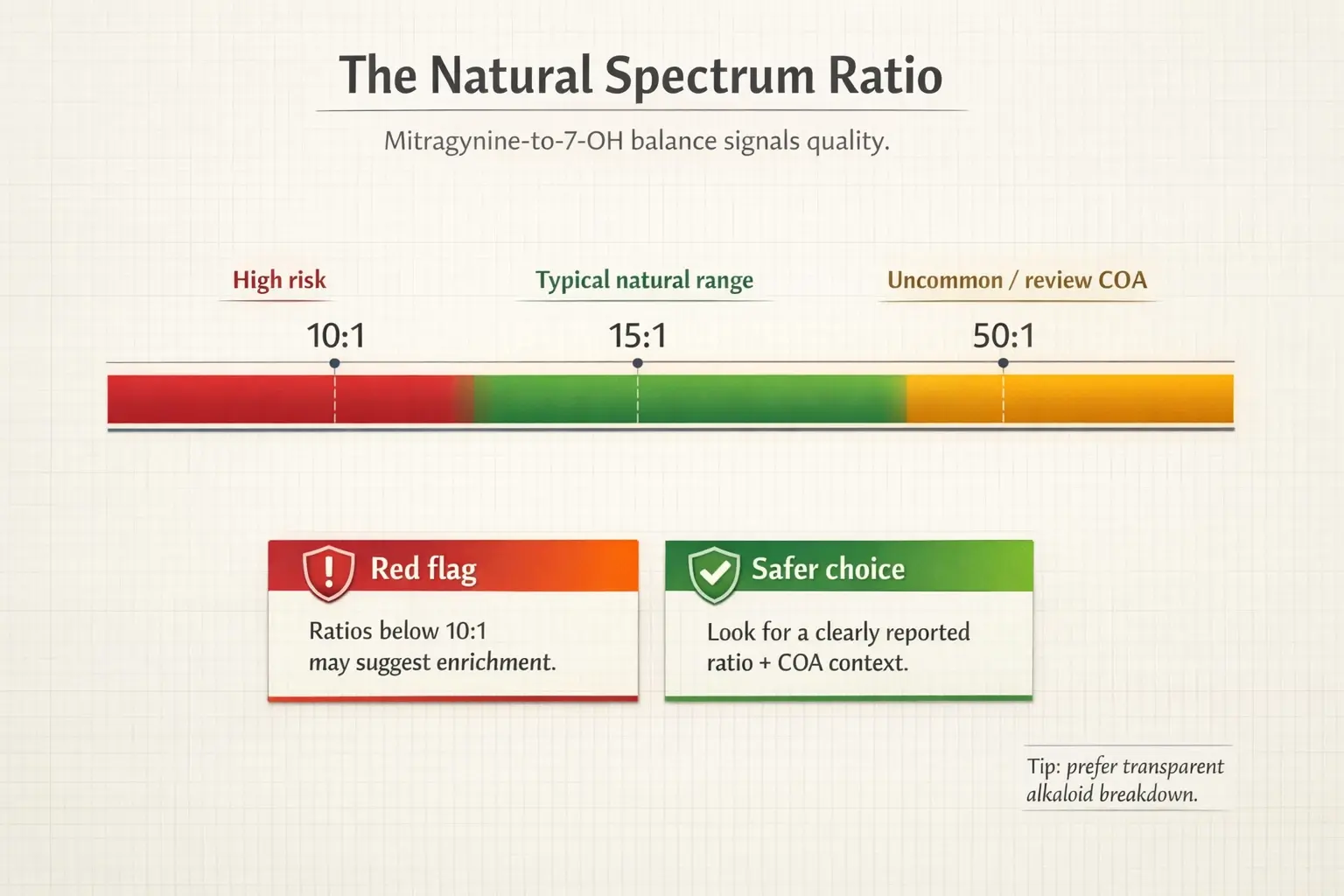
This is the most advanced metric for evaluation, and it is where safety meets science. Kratom contains over 40 alkaloids, but the two primary players are Mitragynine (MIT) and 7-Hydroxymitragynine (7-OH).
In natural kratom leaf, the ratio of MIT to 7-OH typically sits between 15:1 and 50:1. This balance is crucial because 7-OH is significantly more potent.
Some disreputable manufacturers artificially “spike” their products with synthetic 7-OH to increase potency, throwing this ratio out of balance (often dropping below 10:1). This not only creates an unnatural experience but also invites regulatory scrutiny.
The Golden Rule: Look for Full Spectrum extracts that maintain natural alkaloid ratios. This ensures you are getting an uncompromised product that aligns with the plant’s natural profile, rather than a chemistry experiment.
The “True Value” Calculator
Price is often the most confusing factor for buyers. You might see a bottle of liquid kratom for $12.99 and another for $19.99. The cheaper option seems like the better deal, right? Not necessarily.
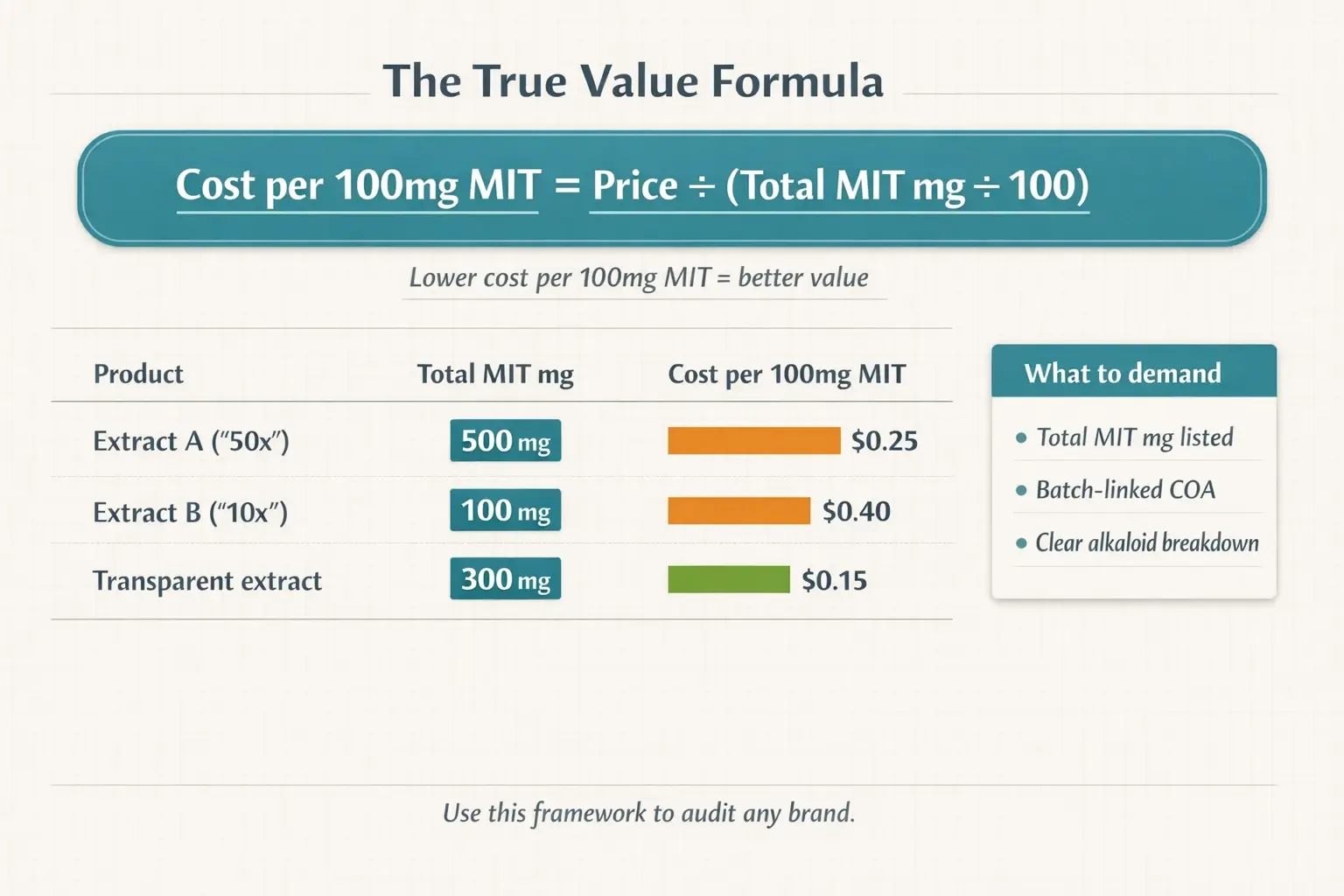
To find the true value, you need to calculate the Cost per 100mg of Mitragynine. This standardizes the price regardless of the bottle size or liquid volume.
The Formula:(Product Price) ÷ (Total MIT mg in Bottle) × 100 = Cost per 100mg MIT
Let’s look at a real-world comparison:
- Brand A: Costs $12.99. Contains 45mg of MIT.
- $12.99 ÷ 45 = $0.28 per mg -> $28.86 per 100mg
- Brand B: Costs $19.99. Contains 150mg of MIT.
- $19.99 ÷ 150 = $0.13 per mg -> $13.32 per 100mg
In this example, the “expensive” bottle (Brand B) is actually half the price of the “cheap” bottle when you calculate based on active ingredients. By using this framework, you can stretch your budget further without compromising on quality.
Red Flag Checklist
Before you finalize your purchase decision, run your chosen product through this quick elimination checklist. If a product triggers these red flags, it is best to avoid it.
- No Batch Number: If the bottle lacks a lot number or expiration date, there is no traceability.
- Health Claims: FDA regulations strictly prohibit kratom vendors from making medical claims (e.g., “Cures Pain,” “Treats Anxiety”). Vendors who violate this are non-compliant and likely cutting corners elsewhere.
- “Proprietary Blends” without Detail: While blends are common, the label should still disclose the total alkaloid content. Hidden math usually favors the seller, not the buyer.
- Suspiciously High 7-OH: If the lab report shows 7-OH levels exceeding 2% of the total alkaloid fraction, the product may be synthetically enhanced.
Frequently Asked Questions
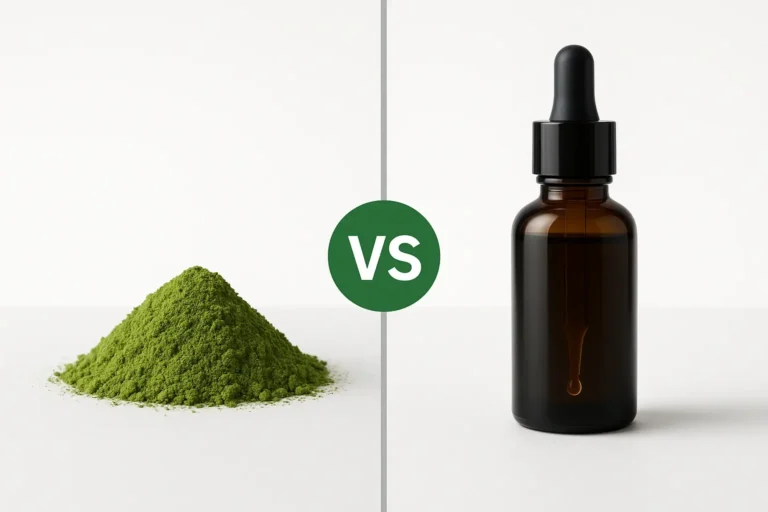
Q: Are liquid extracts stronger than powder extracts?A: Not inherently. Liquid extracts are often faster-acting because the alkaloids are already dissolved, which can aid absorption. However, “strength” is strictly determined by the milligram count of Mitragynine. A 100mg MIT powder dose is functionally the same amount of alkaloid as a 100mg MIT liquid shot.
Q: What is “Nano” kratom, and is it worth the premium?A: Nano-milling reduces the particle size of the kratom, which increases the surface area. This can lead to faster absorption and higher bioavailability (meaning your body uses more of the alkaloid). If you are looking for rapid onset, nano-products can offer legitimate value.
Q: Why do some extracts look dark and others clear?A: This depends on the extraction method. Ethanol-based extractions often result in darker, resinous liquids, while CO2 extraction or acid-base extractions can produce lighter, cleaner-looking fluids. Neither color guarantees quality; only the COA does.
Q: How do I know if an extract is “unaltered”?A: Focus on the ratio. An unaltered product will reflect the natural balance of the leaf, usually with high Mitragynine and very low 7-OH. At Kratom Online, our philosophy is “unaltered, untouched, uncompromised,” ensuring that the extracts you receive maintain the integrity of the original plant profile.
Making Your Decision
Choosing a kratom extract doesn’t have to be a gamble. By shifting your focus from flashy “50x” labels to concrete data—Total MIT, COA verification, and Price-per-MG value—you take control of your wellness journey.
Whether you are exploring liquid shots or potent extract powders, apply this framework to ensure you are getting exactly what you pay for: pure, potent, and tested products.