
How to Choose a High-Quality Kratom Vendor: A Checklist for Purity, Potency & Transparency
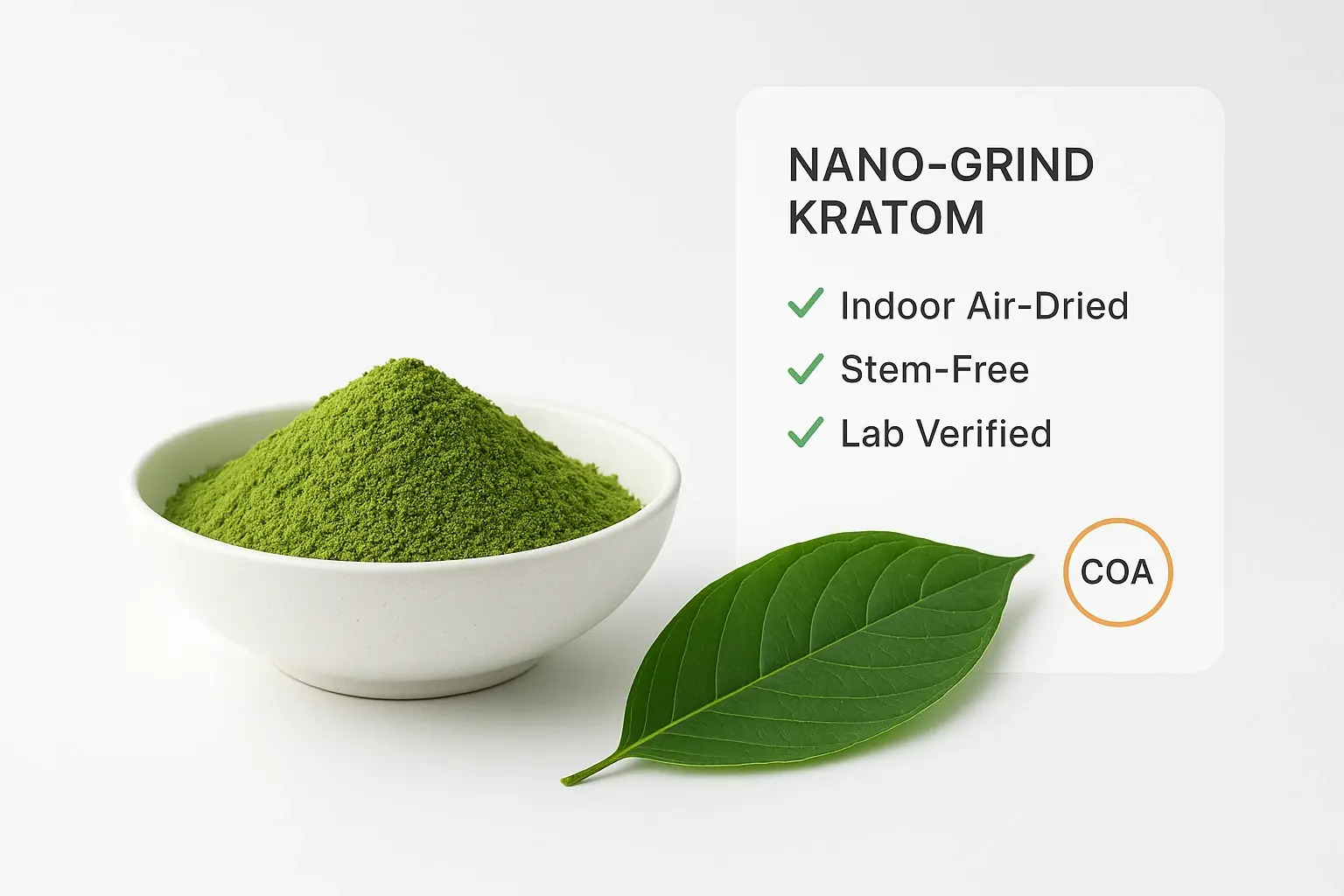
The kratom market is currently in a “Trust Transition.” A few years ago, the primary concern for most buyers was simply safety: “Is this product legal, and is it free from Salmonella?” While those baseline safety questions remain vital, the conversation among experienced users has shifted. You aren’t just looking for a product that is “certified safe”—you are looking for a product that actually works.
There is a massive difference between “Grade A” kratom that meets minimum safety standards and premium leaf that delivers the potency you expect. The gap often lies in technical processes that most vendors don’t talk about: UV degradation during drying, stem-to-leaf ratios, and micronization levels.
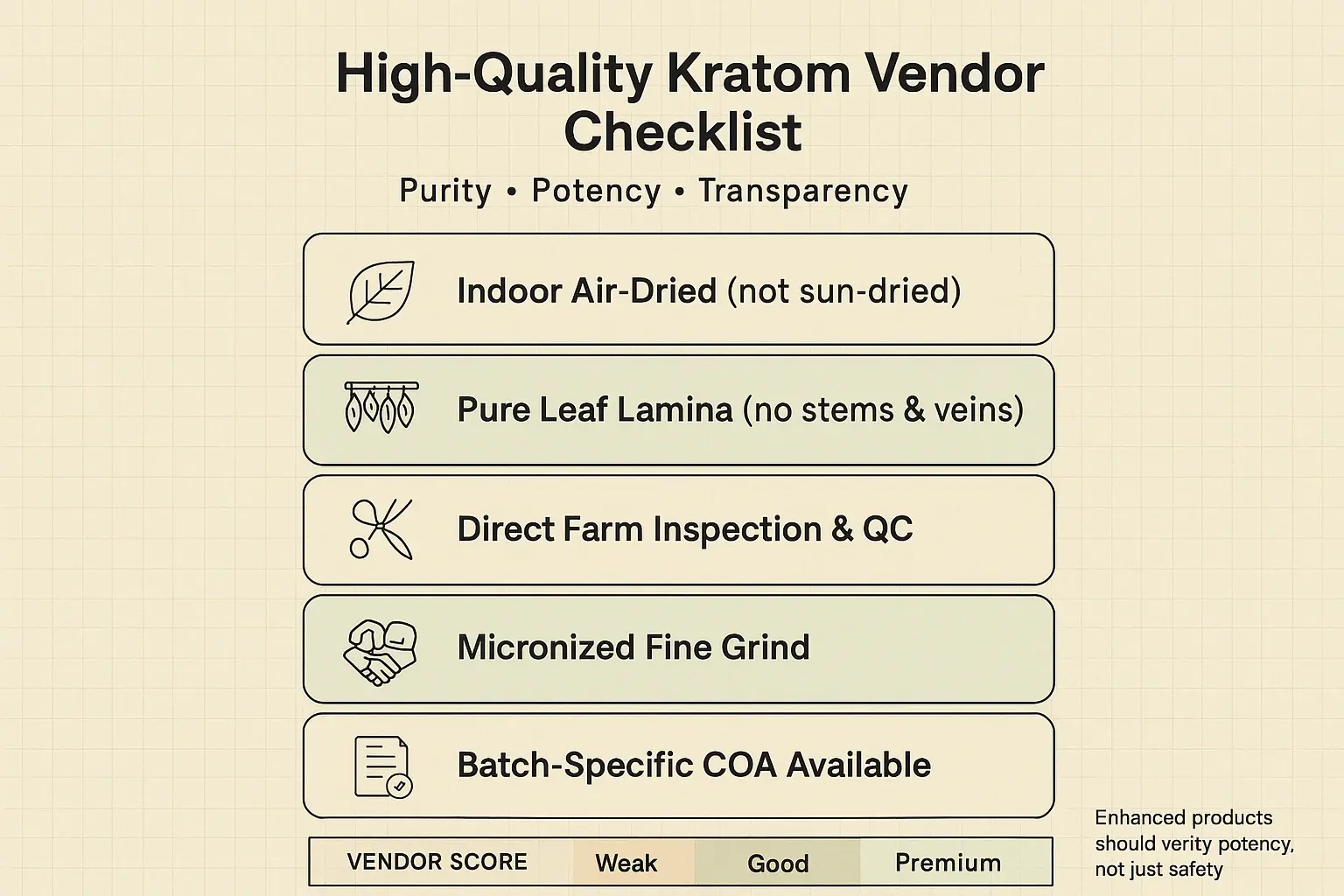
If you are evaluating vendors—especially for enhanced products where precision matters—you need to look beyond the packaging. You need a technical framework to separate mass-market exports from meticulously crafted botanicals.
The Potency Gap: Why “Grade A” Can Be Misleading
Have you ever purchased a strain you usually love, only to find the effects were weak or short-lived? The issue likely wasn’t the strain itself, but how it was handled before it ever reached the United States.
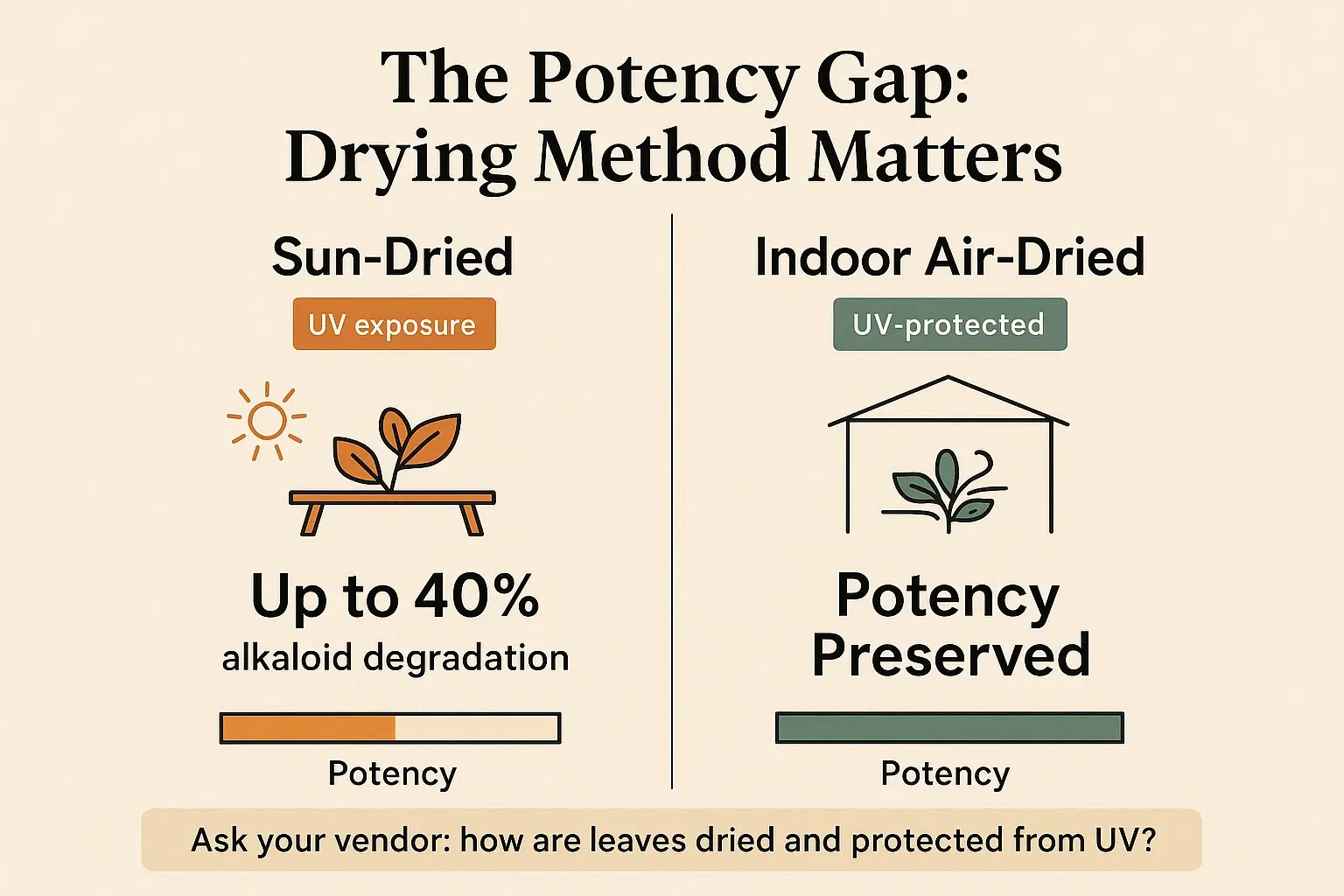
The biggest hidden killer of kratom potency is ultraviolet (UV) light. In Southeast Asia, the cheapest way to cure kratom leaves is to spread them out on tarps in the sun. It’s fast and cost-effective for the farmer. However, research indicates that direct UV exposure can degrade Mitragynine content by up to 40% per leaf dry mass.
When evaluating a vendor, the first question shouldn’t be about the price—it should be about the drying protocol.
Evaluation Criteria 1: Indoor Air-Drying vs. Sun-Curing
High-quality vendors utilize indoor air-drying techniques. This process takes longer and requires controlled environments (to prevent mold), but it shields the alkaloids from UV radiation. When a vendor claims their product is “unaltered” or “untouched,” this is what they should refer to—preservation of the plant’s natural profile without solar degradation. If a vendor cannot confirm their drying method, you must assume you are losing a significant percentage of potency before you even open the bag.
The “Pure Lamina” Standard: Eliminating Organic Filler
Potency isn’t just about chemistry; it’s about physics. The kratom leaf consists of two main parts: the lamina (the soft tissue of the leaf) and the veins/stems (the structural transport system).
The alkaloids responsible for kratom’s effects are concentrated in the lamina. The stems and veins contain very few active alkaloids. In mass-market processing, the whole leaf is ground up—stems and all. This acts as “organic filler,” increasing the weight of the batch while diluting its potency.
Evaluation Criteria 2: Verification of Stem Removal
Top-tier sourcing involves hand-selection where the stems and veins are manually removed before grinding. This is often referred to as “de-stemming” or “pure lamina” processing.
- The Test: Look closely at the powder. If you see small, fibrous sticks or a “sawdust” texture, the stems were likely ground into the mix.
- The Result: A de-stemmed powder is chemically purer by weight, meaning you need less material to achieve the desired effect.
The Micronization Factor: Texture and Bioavailability
For many users, the barrier to enjoying kratom is the consumption experience itself—specifically the texture and the digestive upset (nausea) that can follow. This is often caused by a coarse grind. Large plant particles are harder for the stomach to break down and have a smaller surface area for alkaloid absorption.
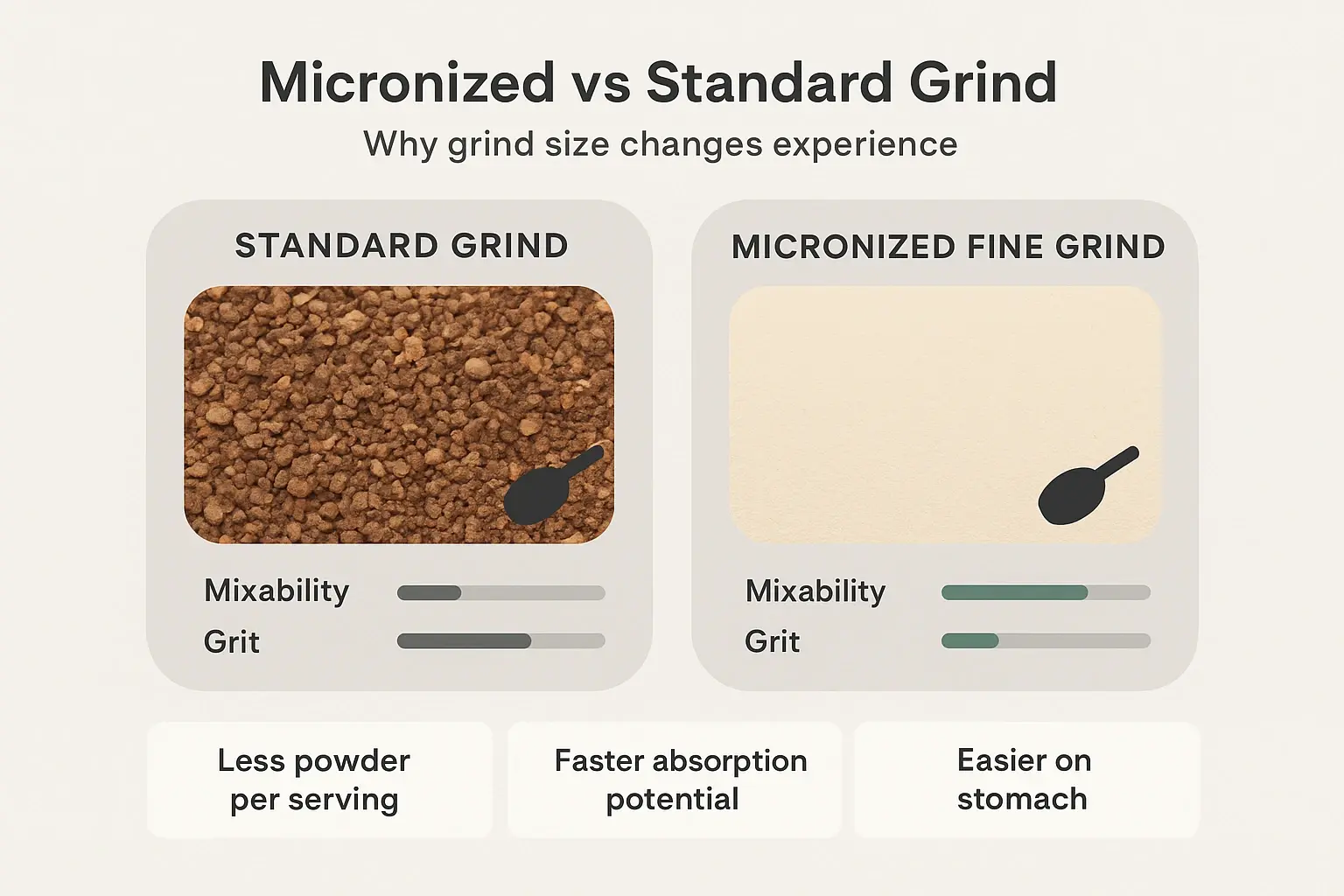
Evaluation Criteria 3: Micronized Sizing
Premium vendors process their leaves into a micronized or “nano” grind.
- Absorption: A finer grind increases the surface area, potentially allowing for faster onset of effects.
- Digestion: “Flour-like” consistency mixes easier into liquids and is gentler on the stomach compared to coarse, sandy grinds.
When looking at product descriptions, look for terms regarding “fineness” or specific mesh sizes. This is a key differentiator between a commodity product and a crafted botanical.
Sourcing Intimacy: Farm vs. Consolidator
Where does the vendor get their leaf? This seems like a simple question, but the answer is usually complex. Many vendors buy from “consolidators”—middlemen in Indonesia who buy leaves from hundreds of different small farmers, mix them into a massive pile, and ship them out.
The problem with consolidation is inconsistency. You might get a great batch one month and a weak one the next because the source farms have changed.
Evaluation Criteria 4: Direct-to-Farm Relationships
The gold standard is a vendor who sources directly from a meticulously inspected farm. This “single-origin” approach ensures:
- Consistency: The soil, weather, and harvesting techniques are the same every time.
- Quality Control: It is easier to enforce “no pesticide” rules and organic growing practices on one partner farm than on a network of anonymous suppliers.
Trust Verification: Reading the COA Correctly
We have established that safety is the baseline, but how do you verify it? Every legitimate vendor will mention Third-Party Lab Testing, but not all consumers know how to read a Certificate of Analysis (COA).
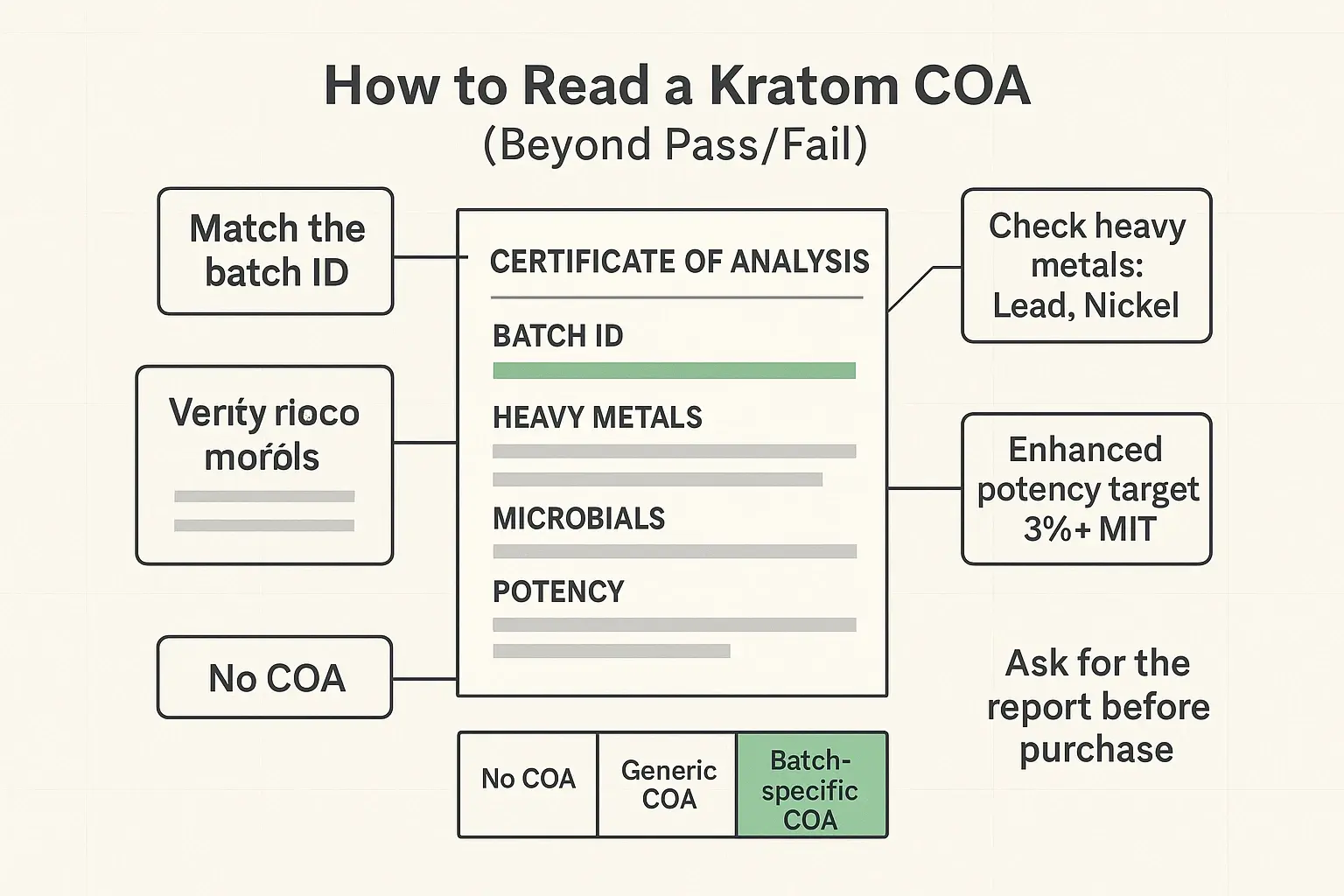
Evaluation Criteria 5: Comprehensive Lab Transparency
Don’t just look for a “PASS” stamp.
- Heavy Metals: Look specifically for Lead and Nickel levels. These are naturally occurring in some Southeast Asian soils, but rigorous testing ensures they are well below safe limits.
- Alkaloid Content: For enhanced products or premium powders, check the Mitragynine percentage. Standard leaf varies, but if you are paying for “Enhanced” or “Premium,” the lab numbers should reflect a higher concentration than standard market averages.
FAQ: Common Concerns When Evaluating Vendors
Why is “Air Dried” so important if I’m buying an extract?
Even for extracts or enhanced powders, the starting material matters. If the base leaves were sun-dried and degraded by UV light before extraction, the resulting profile will be less robust. Superior extracts start with superior, air-dried leaf.
Is “Organic” sourcing really necessary for Kratom?
Yes. Because you are consuming the raw plant matter (unlike tea where you discard the leaves), any pesticides used during growing end up in your body. Vendors who specify “organically grown” or “pesticide-free” are addressing a critical health vector.
What is the difference between “Enhanced” and regular powder?
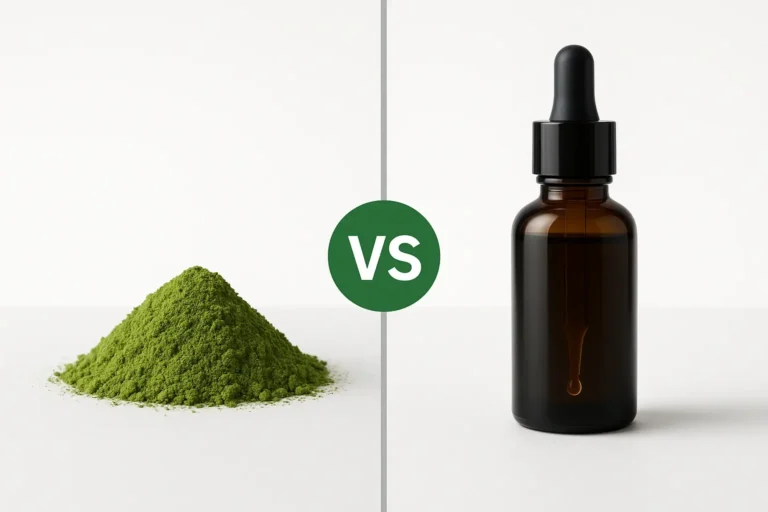
Regular powder is the raw leaf ground up. “Enhanced” powder is typically raw leaf that has been fortified with a pure kratom extract. This bridges the gap between raw powder and full extracts, offering a higher potency-to-weight ratio. This is ideal for those who want strong effects but want to consume less plant material.
The Verdict: Quality is a Process, Not a Label
As you finalize your decision on a vendor, remember that high-quality kratom isn’t an accident. It is the result of a deliberate supply chain designed to protect the plant’s natural alkaloids from the farm to your doorstep.
When you find a product that checks every box—organically grown, indoor air-dried to prevent UV damage, hand-selected to remove stems, and micronized for smooth consumption—you aren’t just buying kratom; you are investing in a consistent, uncompromised experience.
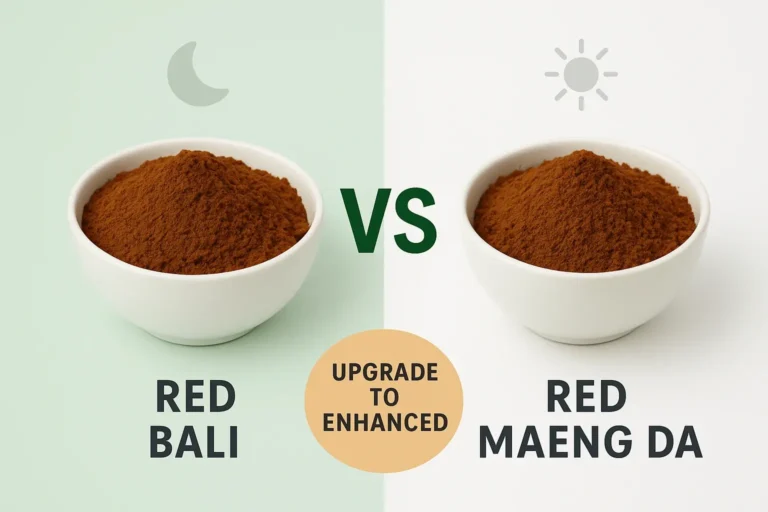
For those evaluating options right now, products like Super Red Bali Enhanced Kratom Powder serve as a benchmark for this level of quality. By strictly adhering to these processing standards, you ensure that the product you receive is pure, potent, and safe.