
Decoding Kratom Quality: What ‘Pure’ Really Means for Your Buying Decision
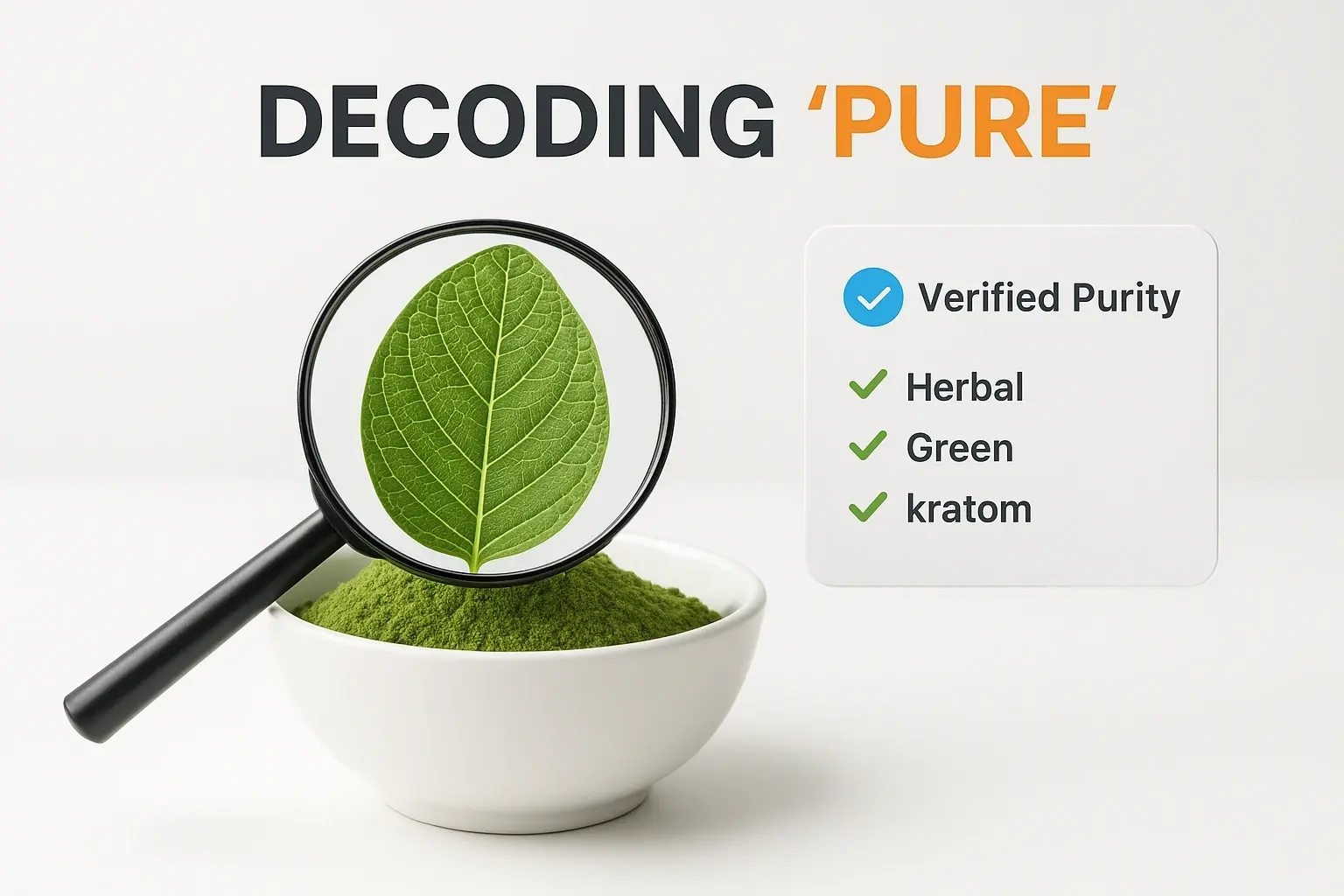
You’ve likely seen the word “pure” stamped on every kratom package you’ve researched. It’s the industry’s favorite buzzword. But if every vendor claims their product is 100% pure, why is there such a massive variance in potency, aroma, and safety across the market?
Here is the uncomfortable truth: In the kratom industry, a “pure” label often just means the powder doesn’t contain other botanical species. It doesn’t tell you if the leaves were dried on a dirty tarp in the sun, if the stems were ground up with the veins, or if the final product was pasteurized with high heat to kill off bacteria that shouldn’t have been there in the first place.
As you evaluate your options, you need to look beyond the sticker on the bag. Real quality isn’t a marketing slogan; it’s a measurable result of rigorous processing standards. To make a confident decision, you need to understand the mechanical and chemical differences between “commodity” kratom and a product that is truly unaltered, untouched, and uncompromised.
The “Purity” Paradox: Why Labels Can Be Misleading
The kratom market is currently navigating a “Crisis of Trust.” Between 2023 and 2024, the industry saw a surge in consumer concerns regarding heavy metal contamination and biological impurities. This has created a landscape where vendors are desperate to prove safety, often waving a Certificate of Analysis (COA) as the ultimate proof of quality.
While a lab test is essential, it is a snapshot in time—a lagging indicator. It tells you what happened after the product was made. A far better predictor of quality is the process.
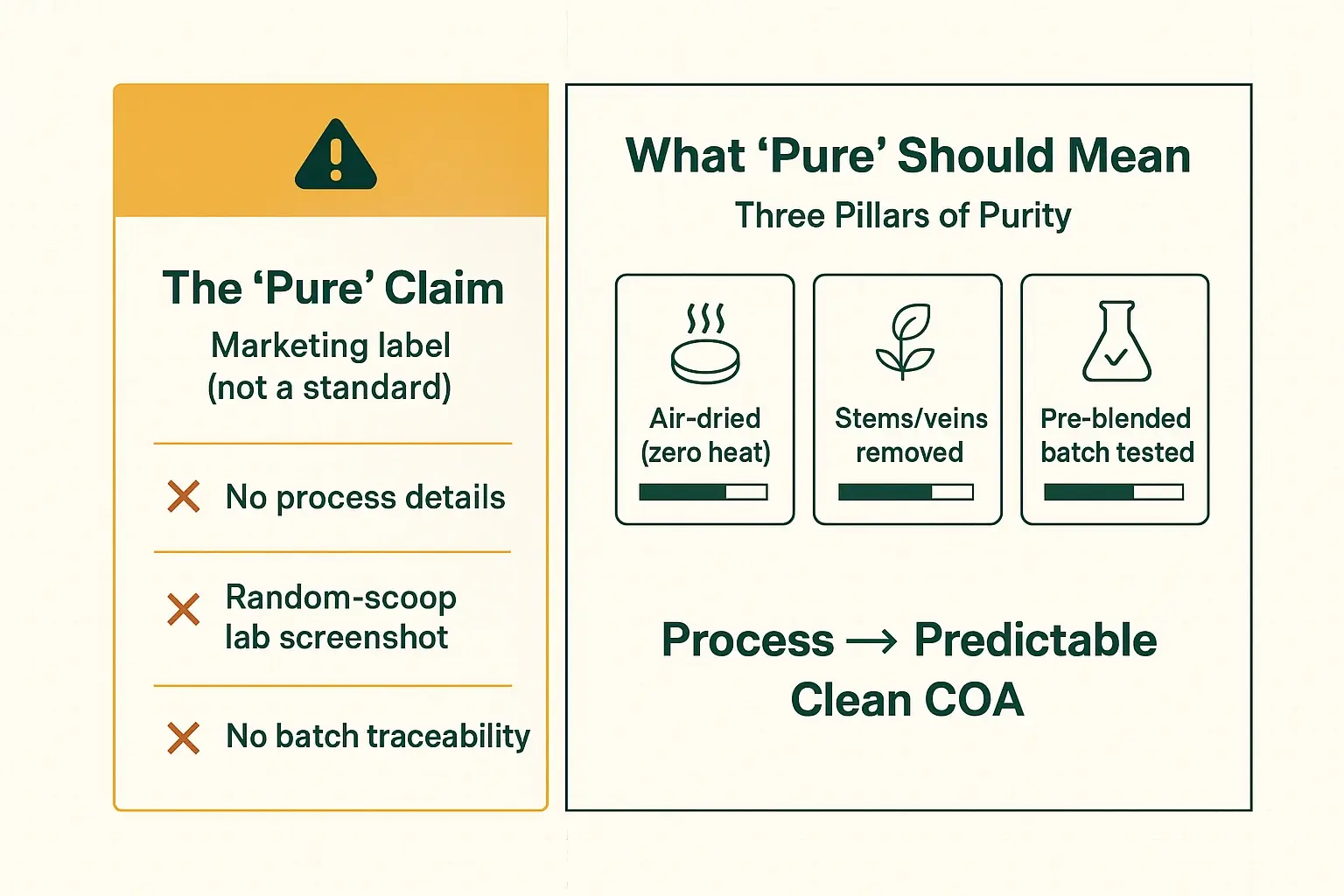
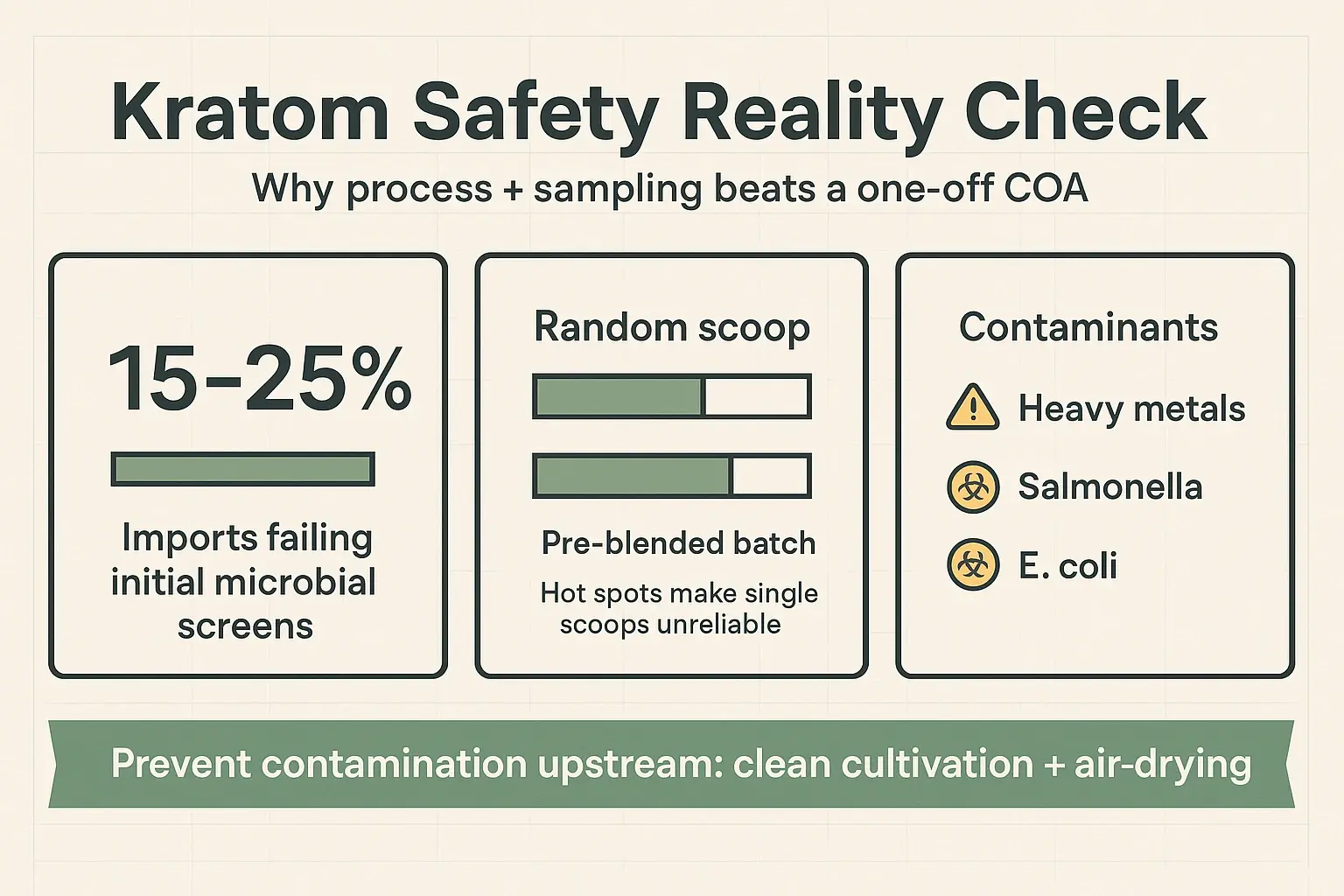
Most mass-market vendors source from bulk brokers where leaves from hundreds of different small farms are mixed together. This creates “hot spots”—pockets of contamination where a single bad batch ruins the whole supply. A clean lab test from a random scoop of this bulk powder is statistically unreliable.
To guarantee safety and potency, you must demand a vendor who controls the process before the lab gets involved.
The Science of Safety: The Invisible Killers
Why is strict sourcing so critical? Industry data and import analyses suggest that approximately 15% to 25% of raw botanical imports fail initial microbial or heavy metal testing.
When kratom leaves are grown in uncontrolled environments or near industrial runoff, the trees—which are bio-accumulators—can soak up heavy metals like lead and nickel from the soil. Furthermore, improper drying methods in humid, tropical environments create a breeding ground for Salmonella and E. coli.
The “Pasteurization” Trap
Many vendors solve this problem by “cooking” the data. They take dirty kratom and subject it to high-heat pasteurization or radiation to kill the bacteria. While this might pass a safety test, it comes at a cost. Heat degrades alkaloids.
At Kratom Online, our philosophy is different. We believe in prevention, not remediation. By using organically grown leaves from a meticulously inspected farm, we ensure the raw material is clean from the start. We don’t need to “fix” our kratom with heat because we don’t allow it to get contaminated in the first place.
Anatomy of Quality: From Leaf to Powder
If you want to distinguish premium kratom from generic powder, you need to ask three specific questions about how the product was handled.
1. The Drying Method: Air vs. Sun
The drying phase is where the alkaloid profile is either locked in or lost.
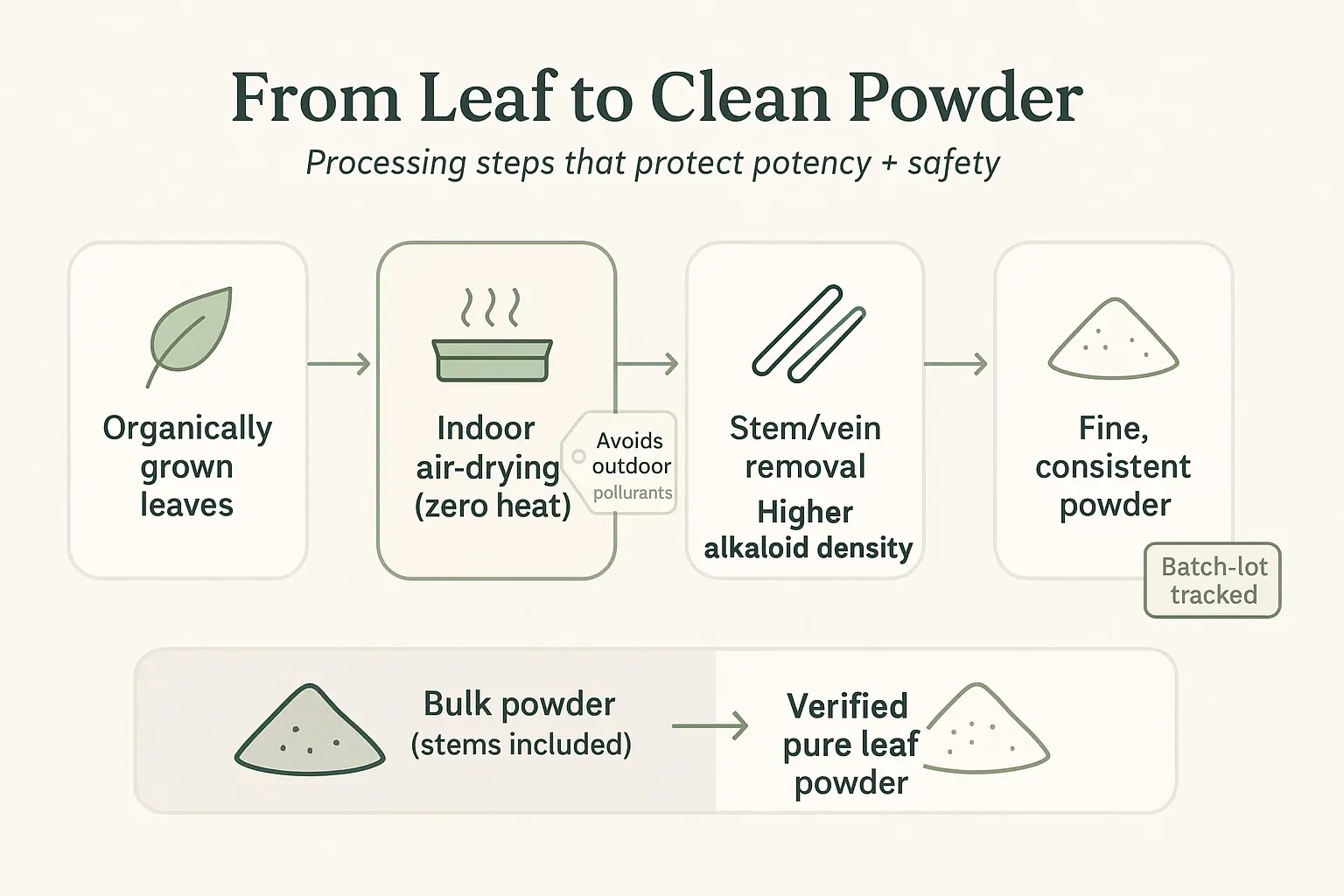
- Sun-Drying: The cheapest method. Leaves are spread on tarps in the sun. While fast, UV radiation breaks down Mitragynine, and open-air exposure invites dust and pests.
- Oven-Drying: Used to speed up production, but high heat destroys delicate alkaloids.
- Air-Drying (The Gold Standard): Research indicates that air-drying at controlled low temperatures (around 25°C) preserves alkaloid profiles significantly better than other methods. This is why we insist on air-drying our leaves. It prevents the inclusion of pollutants and maintains the chemical integrity of the plant.
2. The Stem and Vein Secret
The kratom leaf consists of the blade (the soft material) and the stem/vein (the skeletal structure). The alkaloids responsible for the effects you want are concentrated in the blade. The stems contain very little Mitragynine but contribute significantly to the weight of the product.
Most bulk grinders throw the whole leaf—stems and all—into the machine. This “waters down” the potency. A truly premium product involves mechanical separation, where stems and veins are removed before grinding. This results in verified pure kratom leaves with no stems, offering a denser concentration of alkaloids per gram.
3. Proprietary Processing
Moving from raw leaf to standardized powder requires precision. Whether it is our fine-grind powders or our specific extracts like the 80% Platinum Kratom Extract, consistency is key. We utilize proprietary processing methods that blend batches thoroughly to eliminate “hot spots,” ensuring that the scoop you take today feels exactly like the scoop you take next month.
The 4-Point Lab Result Checklist
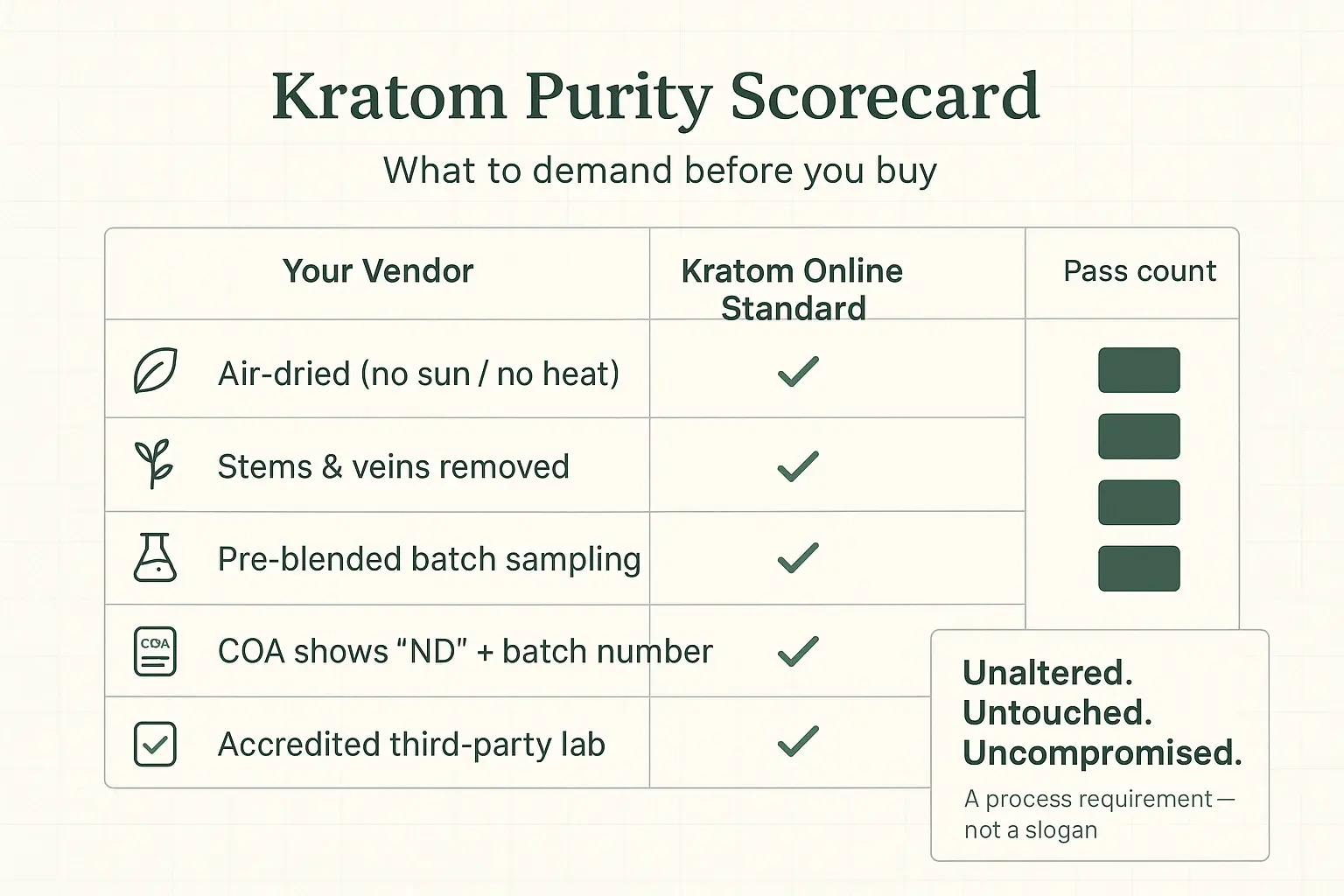
When you are ready to buy, don’t just look for a “Pass” on a lab test. You are looking for evidence of the process we just discussed. Use this framework to evaluate any vendor:
- Heavy Metals Status: Look for “ND” (Non-Detected) or levels significantly below USP limits for Lead, Arsenic, Cadmium, and Mercury.
- Microbial Analysis: Ensure the report covers Salmonella, E. Coli, and Mold/Yeast. A missing test here is a major red flag.
- Alkaloid Content: Does the Mitragynine percentage match the product claims? If a vendor claims “Premium Maeng Da” but the lab shows <1.0% Mitragynine, the stems likely weren’t removed.
- Batch Consistency: Can you link the bag in your hand to a specific test? Generic labs that are six months old are useless.
Frequently Asked Questions
Q: Does “organic” really make a difference in kratom?A: Absolutely. Kratom trees absorb nutrients—and toxins—from their soil. Organic cultivation ensures that no synthetic pesticides or fertilizers make their way into the leaf structure. Since you are consuming the raw plant material, organic sourcing is a safety necessity, not just a luxury.
Q: Why is stem-free powder more expensive?A: It’s a matter of yield. Removing stems and veins reduces the total volume of product a farmer can sell from a harvest. However, it increases the potency per gram. You might pay slightly more for stem-free powder, but you often need to use less product to achieve the same result.
Q: How do I know if my current brand uses heat drying?A: Color and smell are indicators. Heat-dried or “toasted” kratom often has a brownish hue and a smoky or burnt aroma. High-quality air-dried kratom should smell fresh, earthy, and like vibrant green tea.
Making the Decision
The difference between an average experience and a great one often comes down to what isn’t in your kratom. By removing the stems, the pollutants, and the uncertainty, you are left with a product that honors the plant’s natural potential.
At Kratom Online, we don’t rely on luck. We rely on a process that keeps our products unaltered, untouched, and uncompromised. Whether you are exploring our powders or capsules, you can trust that the purity you see on the label was engineered into the product from the moment the seed was planted.