
Mitragynine and 7-Hydroxymitragynine: Chemistry & Pharmacology
When you are actively evaluating botanical options, you quickly outgrow marketing buzzwords. If you want to accurately understand the chemical differences between kratom products—whether you are comparing a standard leaf or a potent kratom extract powder—you need to look under the hood. You need to understand the chemistry.
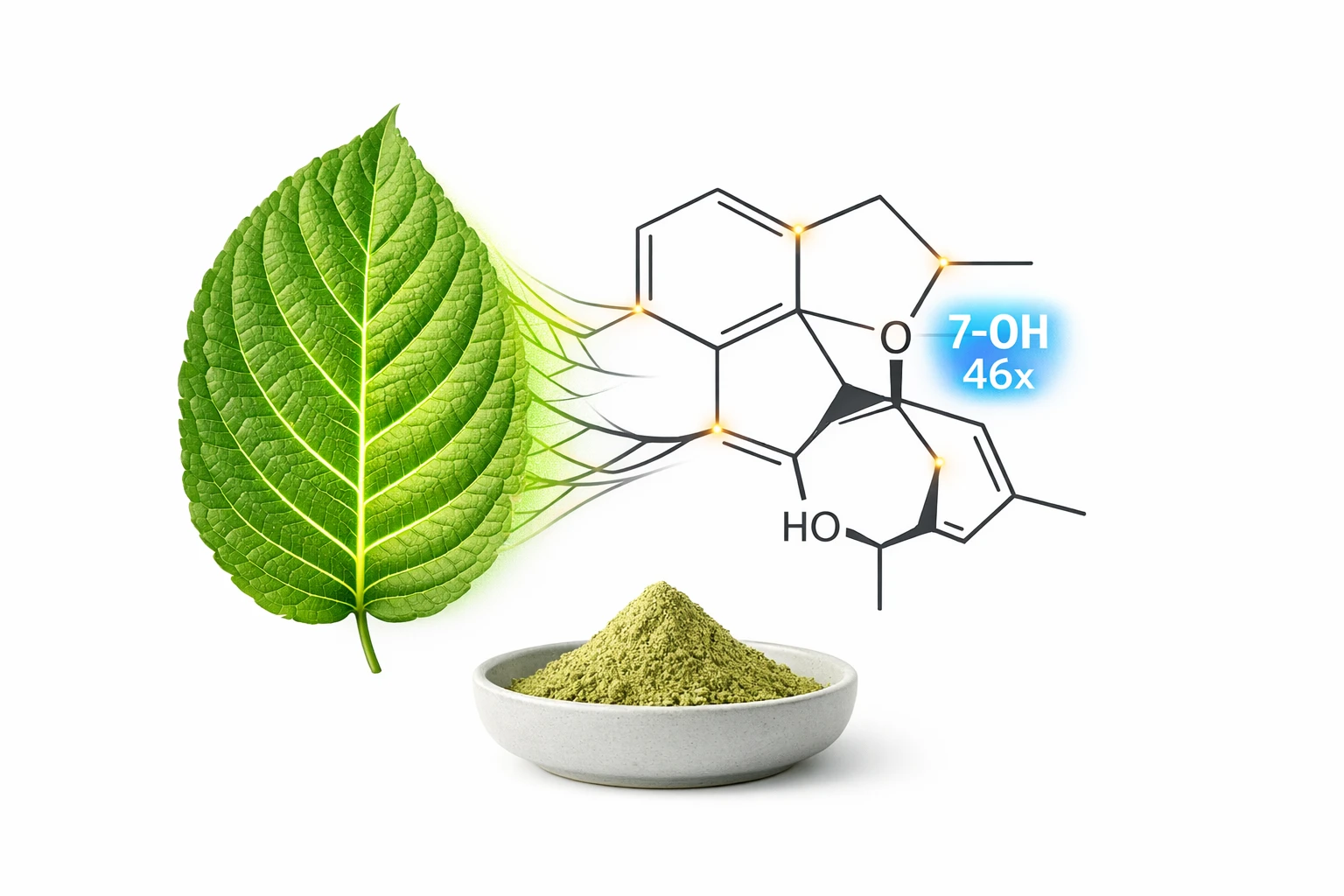
At the heart of the Mitragyna speciosa tree are two of its most pharmacologically important alkaloids: mitragynine (MG) and 7-hydroxymitragynine (7-OH). Mitragynine is generally the predominant alkaloid in traditional kratom leaf, while 7-OH occurs at substantially lower levels and can also be formed in the body through the metabolism of mitragynine.
By translating the dense pharmacological data surrounding mitragynine and 7-hydroxymitragynine into practical insights, you can bridge the gap between raw science and a more accurate understanding of kratom’s alkaloid profile.
Here is the foundational chemical knowledge you need to understand these two compounds and how their chemistry relates to kratom pharmacology.
What Are Mitragynine and 7-Hydroxymitragynine?
Mitragynine and 7-hydroxymitragynine are indole alkaloids associated with Mitragyna speciosa, but they are not interchangeable. They differ in abundance, chemical structure, receptor pharmacology, and the way they appear in the body following kratom exposure.
Mitragynine is generally the most abundant alkaloid in traditional kratom leaf and consequently accounts for a substantial portion of research into the plant’s pharmacology. 7-OH is structurally related to mitragynine but is usually found at much lower concentrations in unprocessed plant material. Importantly, 7-OH is also a metabolite of mitragynine, meaning the amount measured in the original product does not necessarily represent the total 7-OH exposure that may occur after ingestion.
That relationship makes the chemistry of mitragynine and 7-OH particularly important: understanding the finished product requires considering both what is present before consumption and what may subsequently be formed through metabolism.
The Molecular Blueprint and Biosynthesis
To understand how these alkaloids work, we have to look at how the plant builds them. Kratom’s alkaloids belong to the broader family of monoterpene indole alkaloids, with their biosynthesis involving pathways that ultimately contribute to the indole-containing molecular framework characteristic of compounds such as mitragynine.
Mitragynine makes up a substantial proportion of the total alkaloid content reported in many kratom leaf samples, although its exact percentage varies considerably with plant material, geography, maturity, processing, and analytical method. Its molecular structure features an indole-based framework that contributes to its physicochemical and pharmacological properties.
7-Hydroxymitragynine is closely related structurally to mitragynine, with hydroxylation at the 7-position producing an important change in molecular pharmacology. Although this structural modification appears relatively small on paper, small changes in molecular structure can substantially alter receptor affinity, efficacy, metabolism, and biological activity.
This is one reason alkaloid percentage alone cannot completely describe how a kratom product may differ chemically from another.
Physicochemical Properties: The Numbers That Dictate Bioavailability
If you have ever weighed the pros and cons of kratom powder vs extract, you are fundamentally evaluating physicochemical properties. How a compound dissolves, ionizes, survives gastrointestinal conditions, and becomes available for absorption relies on properties including its solubility, pH sensitivity, and partition behavior.
pKa and LogP Variables
According to established peer-reviewed models, Mitragynine has reported physicochemical values that help explain its pH-dependent solubility and ability to interact with biological membranes. Exact experimental values can vary according to methodology and conditions, so pKa and LogP figures are best interpreted as chemical descriptors rather than direct predictions of human effects.
LogP describes the tendency of a compound to partition between lipid-like and aqueous environments. Mitragynine’s lipophilic characteristics are relevant to membrane permeability, although LogP alone cannot establish its absorption rate or onset in humans.
pKa, meanwhile, helps explain how the ionization state of mitragynine changes with environmental pH. As the surrounding pH changes, so does the proportion of ionized and unionized molecules, influencing properties such as aqueous solubility and membrane partitioning.
The Acid Labile Factor
This is where the environment of the human stomach comes into play. Experimental stability studies have reported that mitragynine can be less stable under strongly acidic conditions than under more neutral intestinal conditions.
That does not mean a fixed percentage of every kratom serving is destroyed in the stomach. Simulated gastric-fluid experiments are controlled laboratory models, and actual gastrointestinal exposure is influenced by formulation, gastric emptying, food, residence time, concentration, and other physiological variables.
The broader takeaway is that pH, formulation, dissolution, and gastrointestinal stability can all influence how much alkaloid ultimately becomes available for absorption. This helps explain why raw powder, extracts, and other formulations should not be assumed to have identical pharmacokinetic profiles simply because their labels report similar amounts of an alkaloid.
Mitragynine vs. 7-Hydroxymitragynine
The most important distinction between mitragynine and 7-hydroxymitragynine is not simply which compound is “stronger.” They occupy different positions within kratom’s chemistry and pharmacology.
| Characteristic | Mitragynine | 7-Hydroxymitragynine (7-OH) |
|---|---|---|
| Presence in traditional kratom leaf | Generally the predominant alkaloid | Usually present at substantially lower levels |
| Chemical relationship | Parent alkaloid and metabolic precursor | Hydroxylated analogue and metabolite of mitragynine |
| Receptor relevance | Interacts with opioid and additional receptor systems | Shows strong mu-opioid receptor activity in experimental models |
| Formation in the body | Absorbed and metabolized through several pathways | Can be formed through oxidative metabolism of mitragynine |
| Research significance | Central compound in kratom pharmacology | Important for understanding downstream opioid-receptor activity |
These distinctions also demonstrate why comparing products solely by “total alkaloids” can obscure meaningful chemical differences. Two products could theoretically contain similar total alkaloid concentrations while differing substantially in their mitragynine-to-7-OH relationship and wider minor-alkaloid profile.
The “Potency Switch” and Diastereomers
Why does a product with a nearly identical milligram weight have the potential to differ chemically from another formulation? One factor is the relative concentration of mitragynine, 7-OH, and other alkaloids, although formulation and pharmacokinetics also matter.
7-OH: The Minor Alkaloid with Major Impact
7-OH naturally occurs in relatively low concentrations in traditional kratom leaf. Despite its lower abundance, experimental pharmacology indicates that it can display substantially greater activity than mitragynine at certain opioid-receptor endpoints.
Published potency comparisons between 7-OH, mitragynine, and morphine depend heavily on the experimental model, receptor endpoint, route of administration, and measurement being used. For that reason, figures such as “13 times” or “46 times” should not be interpreted as universal human potency conversions.
When consumers compare raw leaf with an enhanced kratom powder, the useful analytical question is therefore not simply whether the product is “stronger,” but how much mitragynine, 7-OH, and other relevant alkaloids it actually contains.
Diastereomers: A Simple Inversion
The chemistry gets even more fascinating when looking at diastereomers like Speciociliatine. Diastereomers can share the same molecular formula and broad structural framework while differing in the three-dimensional orientation of particular atoms. Those stereochemical differences can meaningfully change how a molecule interacts with a biological target.
Speciociliatine is therefore scientifically relevant not because it proves that a particular commercial “strain” will produce a specific effect, but because it demonstrates how small structural differences among kratom alkaloids can produce different pharmacological properties.
This also means that a kratom strain chart should be interpreted cautiously. Commercial strain names and vein colors do not provide a complete chemical analysis of a product. Alkaloid profiles can vary according to plant material, processing, storage, formulation, and other variables, making batch-specific laboratory analysis a more direct measure of chemical composition.
How Mitragynine Is Metabolized Into 7-Hydroxymitragynine
One of the most important connections between mitragynine and 7-hydroxymitragynine occurs after mitragynine enters the body. Mitragynine is not pharmacologically static: it undergoes hepatic metabolism, producing several metabolites.
Research has identified CYP3A-mediated oxidative metabolism as an important pathway involved in converting a portion of mitragynine into 7-OH. This means 7-OH can be pharmacologically relevant even when only a small amount was initially present in the consumed plant material.
This parent-compound-to-metabolite relationship also helps explain why product chemistry and human exposure are not identical concepts. A laboratory report tells you what was measured in the product before consumption; pharmacokinetics determines what compounds and concentrations are subsequently present in the body.
The distinction is particularly important when comparing traditional leaf with concentrated products. Extract composition, alkaloid concentration, formulation, and metabolism can all affect exposure, so the mitragynine percentage printed on a label cannot by itself predict the resulting pharmacological response.
How Mitragynine and 7-OH Interact With Opioid Receptors
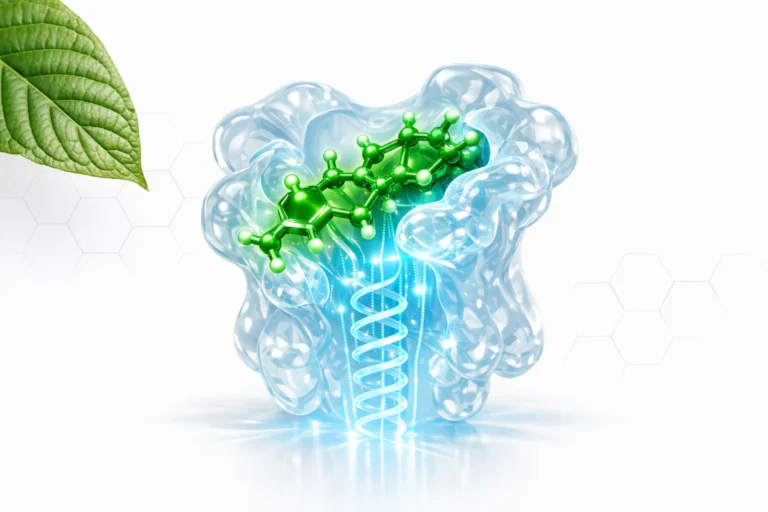
The pharmacology of mitragynine and 7-OH is closely associated with the mu-opioid receptor (MOR), although kratom’s wider pharmacology is more complex than a single receptor interaction.
Experimental studies indicate that mitragynine and 7-OH differ in their affinity and functional activity at opioid receptors. 7-OH generally displays stronger MOR activity in experimental systems, while mitragynine has a broader pharmacological profile and also serves as the metabolic precursor from which some 7-OH is formed.
Binding affinity should not be confused with the magnitude of a human effect. Receptor occupancy, intrinsic efficacy, concentration at the target tissue, metabolism, pharmacokinetics, and interactions with other compounds all contribute to the biological response.
For readers who want to go deeper into receptor-level mechanisms, this chemistry connects directly with kratom pharmacodynamics: the study of what these alkaloids do after reaching their biological targets.
Why Alkaloid Ratios Matter
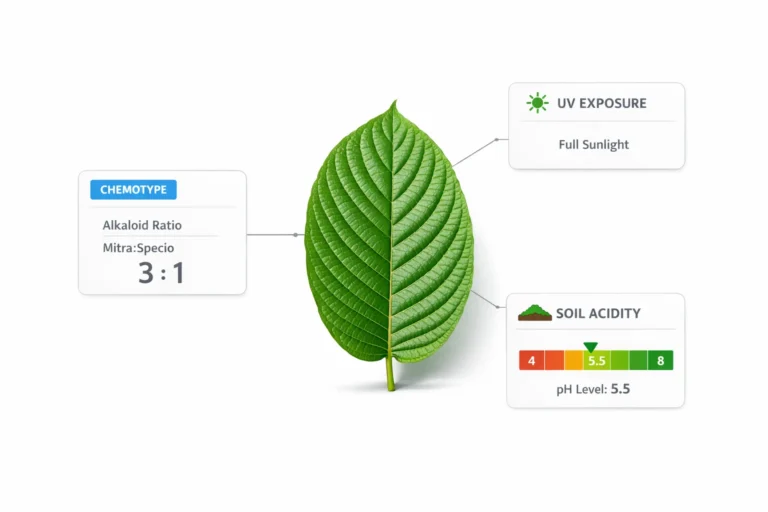
Mitragynine and 7-OH do not exist in chemical isolation within traditional kratom leaf. Mitragyna speciosa contains numerous minor and trace alkaloids, including compounds such as speciociliatine, speciogynine, paynantheine, and corynantheidine.
Their presence does not prove that any particular ratio produces a predictable human effect. However, the wider alkaloid matrix is important when chemically characterizing whole-leaf and broader-spectrum products because different compounds can have different receptor affinities, efficacy profiles, and pharmacokinetic behavior.
Consequently, “15% mitragynine” and “15% total alkaloids” are not equivalent descriptions. The first identifies the concentration of a specific compound; the second describes a broader measurement whose practical meaning depends on which alkaloids were included in the analysis.
How Processing Can Change Mitragynine and 7-OH Levels
The alkaloid profile measured in the finished product is influenced not only by the original plant but also by what happens after harvesting. Drying conditions, storage, oxidation, extraction, concentration, and formulation can alter the chemical profile reaching the consumer.
This becomes particularly important for 7-OH. Traditional leaf, a mitragynine-rich extract, a broad-spectrum extract, and a formulation containing elevated 7-OH should not be treated as chemically interchangeable simply because each is marketed under the kratom category.
For product evaluation, a current, batch-specific Certificate of Analysis therefore provides more useful evidence than assumptions based on strain name, color, extraction terminology, or marketing descriptors alone.
How to Read a Kratom Alkaloid Lab Report
A laboratory report should allow you to connect the chemistry discussed above with the actual product. At minimum, look for clearly reported mitragynine and 7-OH concentrations and verify that the report corresponds to the batch being sold.
More comprehensive alkaloid profiling may include minor compounds such as speciociliatine, paynantheine, and speciogynine. The report should also distinguish percentages from milligrams per serving or unit where relevant, since these measurements answer different questions.
Analytical transparency becomes increasingly important as concentration increases. Terms such as “premium,” “enhanced,” “full spectrum,” and “high potency” are marketing descriptions unless supported by measurable composition.
Chemistry FAQ
What is mitragynine?
Mitragynine is generally the predominant alkaloid found in traditional Mitragyna speciosa leaf. It has become the principal chemical marker used to characterize many kratom products and is also pharmacologically important because it interacts with several receptor systems and can be metabolized into 7-OH.
What is 7-hydroxymitragynine?
7-Hydroxymitragynine, commonly abbreviated 7-OH, is a hydroxylated kratom alkaloid with significant mu-opioid receptor activity in experimental research. It may occur at relatively low concentrations in traditional leaf and can also be produced through metabolism of mitragynine.
What is the difference between mitragynine and 7-hydroxymitragynine?
Mitragynine is typically much more abundant in traditional kratom leaf, while 7-OH generally occurs at substantially lower concentrations but demonstrates stronger activity at certain opioid-receptor endpoints in experimental studies. Mitragynine can also function as a metabolic precursor to 7-OH.
Does mitragynine convert to 7-hydroxymitragynine?
Yes. Research indicates that a portion of mitragynine can undergo oxidative metabolism to form 7-OH, with CYP3A enzymes playing an important role in this pathway.
Is 7-hydroxymitragynine naturally present in kratom?
7-OH can occur in kratom plant material, although generally at much lower concentrations than mitragynine. Finished-product concentrations may also be affected by processing, oxidation, extraction, formulation, and other manufacturing variables.
Does higher mitragynine mean better kratom?
Not necessarily. A higher percentage establishes that the product contains more mitragynine, but it does not by itself establish overall quality, safety, consistency, or a particular effect. Product assessment should also consider the wider alkaloid profile, batch-specific testing, contaminants, formulation, and manufacturing quality.
How do kratom alkaloids dissolve compared to over-the-counter tablets?
A common user query compares dissolving kratom to dropping a standard Disprin (aspirin) tablet in water. Commercial tablets may contain formulation ingredients specifically selected to change dissolution behavior, whereas naturally occurring kratom alkaloids have their own pH-dependent solubility characteristics.
Acidifying an aqueous environment can alter the ionization and apparent solubility of basic alkaloids such as mitragynine, but this should not be interpreted as proof that a particular household preparation method increases human bioavailability by a predictable amount.
Is chlorine used to make kratom extracts?
When evaluating products, users sometimes see the term “Hydrochloride” (HCl) and mistakenly worry about toxic chlorine gas. Hydrochloride salts are widely used in chemistry and pharmaceutical formulation. Creating a hydrochloride salt involves associating a basic compound with hydrochloric acid to produce an ionic salt; it is not equivalent to adding chlorine gas to a product.
Whether a particular kratom extract uses a salt form, however, should be established through manufacturer documentation and analytical information rather than assumed from general chemistry.
Confident Decision Making
When evaluating your options, raw botanical data is your greatest asset. Understanding the relationship between mitragynine and 7-hydroxymitragynine gives you a much stronger framework than relying on potency labels or strain terminology alone. Mitragynine is typically the dominant alkaloid in traditional leaf, 7-OH is pharmacologically important despite its lower natural abundance, and metabolism creates a direct biological link between the two.
The central lesson is that product chemistry, metabolism, and pharmacology are related but not interchangeable. The percentage measured in a package tells you about product composition; it does not independently predict receptor exposure or an individual’s response.
Whether you are looking for traditional leaf, an enhanced formulation, or a concentrated extract, prioritize batch-specific analytical data that clearly reports mitragynine, 7-OH, and other relevant constituents.
When chemistry is the basis of the comparison, measurable alkaloid composition and transparent laboratory documentation provide a more defensible way to evaluate Mitragyna speciosa products than marketing claims alone.