
Kratom Pharmacokinetics Decoded: How Your Body Processes Alkaloids (ADME)
If you’ve spent any time evaluating kratom products in 2026, you’ve likely experienced this common frustration: you find a product that works perfectly for your daily body aches, but when you switch brands or try a different batch, the experience completely changes.
For years, the online kratom industry has relied on subjective “vibes” and marketing myths to explain these differences, claiming that “reds are for relaxing” and “greens are for energy.” But when you are evaluating a wellness product to support your daily routine, vague marketing isn’t enough. You need the underlying science.
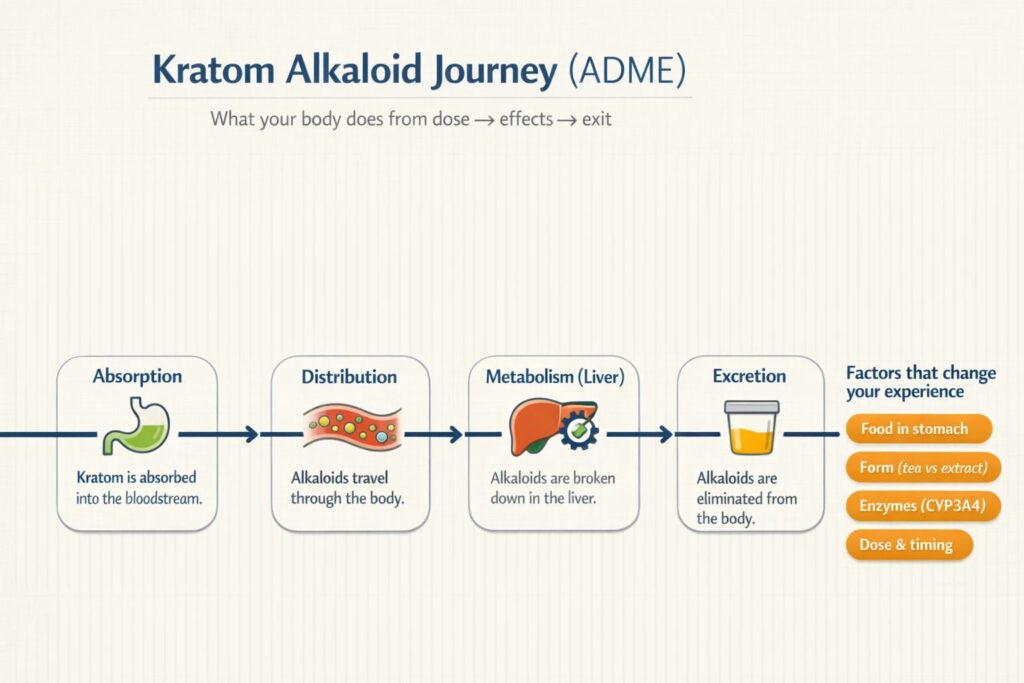
The real reason your experience fluctuates isn’t about the color of the packaging—it’s about biology. Specifically, it comes down to pharmacokinetics, or how your body absorbs, distributes, metabolizes, and excretes (ADME) kratom’s active alkaloids.
By understanding the journey mitragynine takes through your system, you can strip away the guesswork, optimize your dosing schedule, and make highly informed decisions about which products deserve your trust.
The Journey Begins: Absorption and Bioavailability
The moment you consume kratom, the absorption phase begins. But not all kratom enters your bloodstream at the same rate or with the same efficiency. The primary factor here is bioavailability—the proportion of the active alkaloids that actually makes it into your systemic circulation to have an active effect.
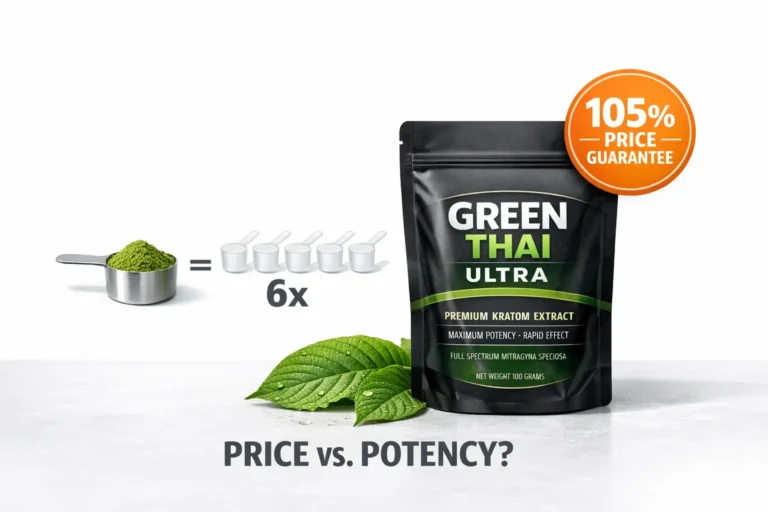
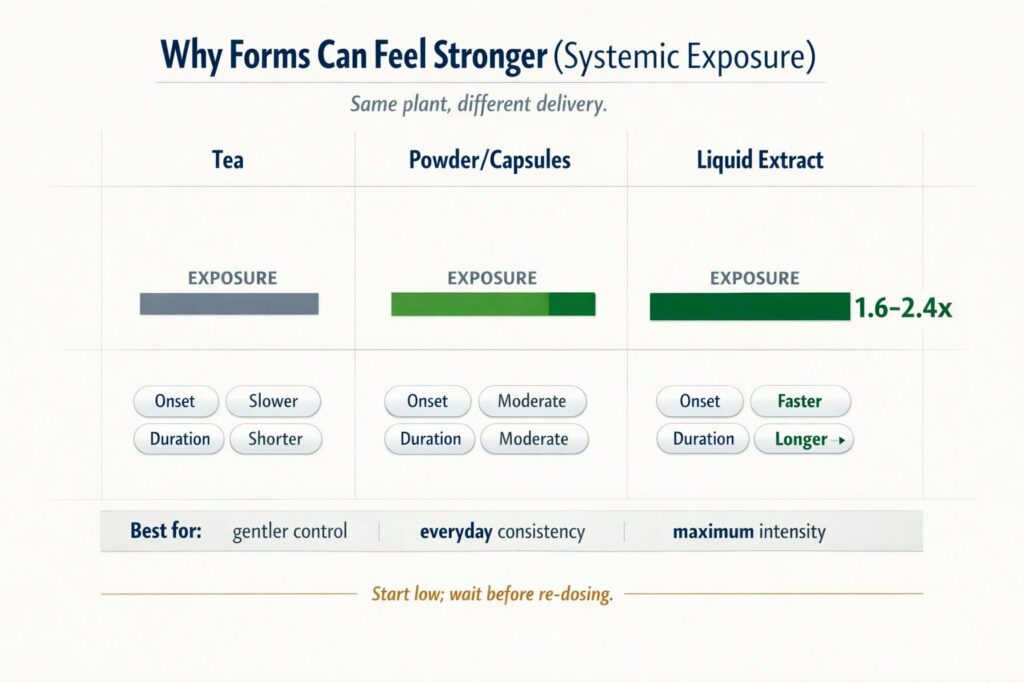
Recent pharmacological data reveals a significant “bioavailability gap” depending on how kratom is processed and consumed. For example, clinical models show that commercial liquid extracts can deliver 1.6 to 2.4 times higher systemic exposure to mitragynine compared to traditional brewed kratom tea.
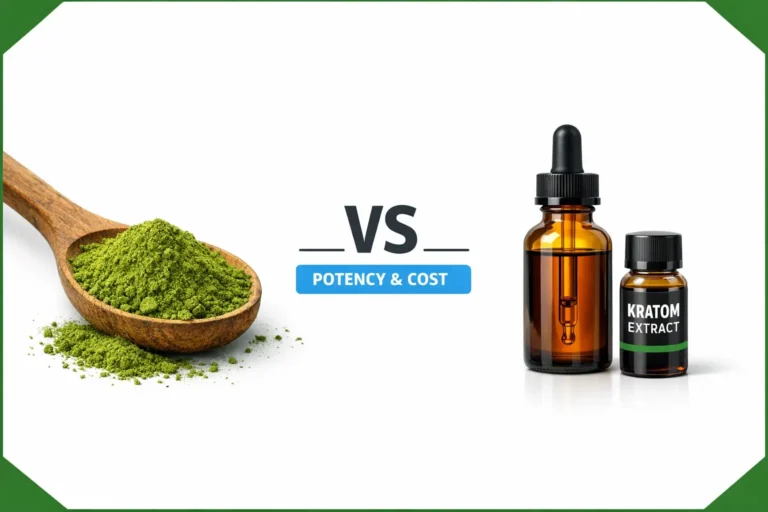
When you evaluate kratom powder vs extract products, you aren’t just choosing a different format; you are choosing an entirely different absorption profile. Powders require your digestive system to break down raw plant fiber to extract the alkaloids, leading to a slower, more gradual onset. High-quality extracts bypass this mechanical breakdown, allowing the alkaloids to cross the intestinal barrier much faster. This is exactly why a premium product sourced directly from a trusted farm provides a cleaner, more predictable onset than older, unstandardized retail batches.
Distribution and The “Half-Life Trap”
Once absorbed, the alkaloids are distributed through your bloodstream to your tissues and central nervous system. This is where most consumers experience a critical disconnect between what they feel and what is actually happening inside their bodies.
Most people notice the physical relief or energetic lift from kratom wearing off after 4 to 6 hours. Naturally, the instinct is to take another dose. However, peer-reviewed pharmacokinetic studies indicate that mitragynine has a terminal half-life of 23 to 45 hours.
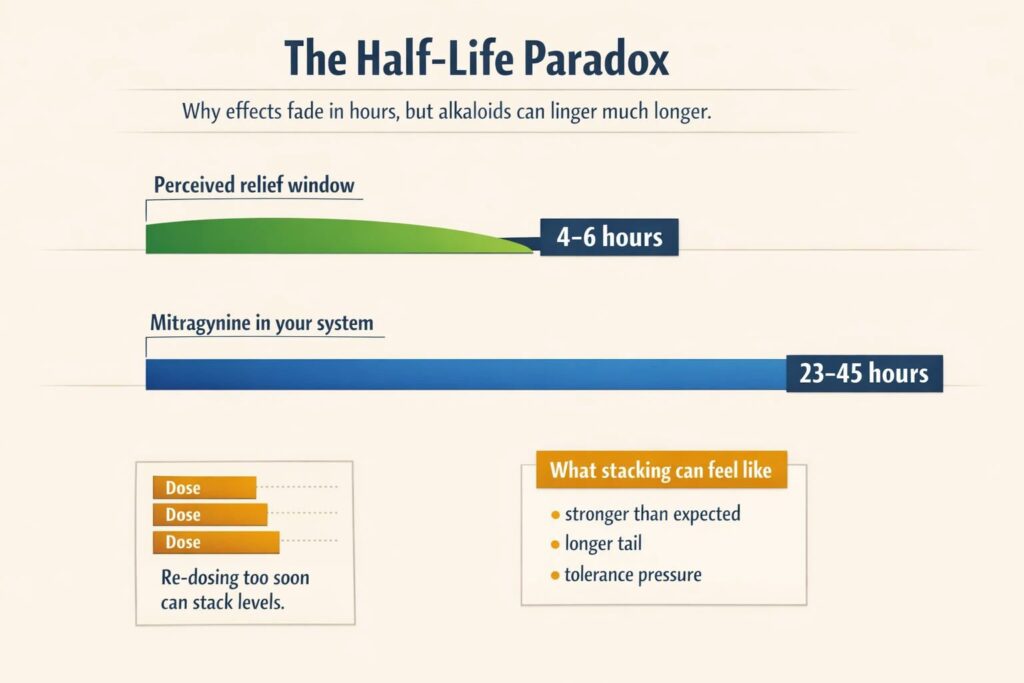
This creates what we call the “Half-Life Trap.”
If your body takes over a day to clear half of the mitragynine, but the noticeable effects fade in just a few hours, re-dosing too frequently leads to alkaloid stacking. The new dose piles on top of the residual alkaloids still circulating in your tissues. Over time, this stacking effect is the primary driver behind built-up tolerance. Understanding this prolonged half-life is the secret to managing your intake effectively, maximizing your product’s value, and avoiding the trap of diminishing returns.
Metabolism: Why Your Liver Controls the Experience
If there is one biological mechanism that explains why “different brands feel different,” it is liver metabolism.
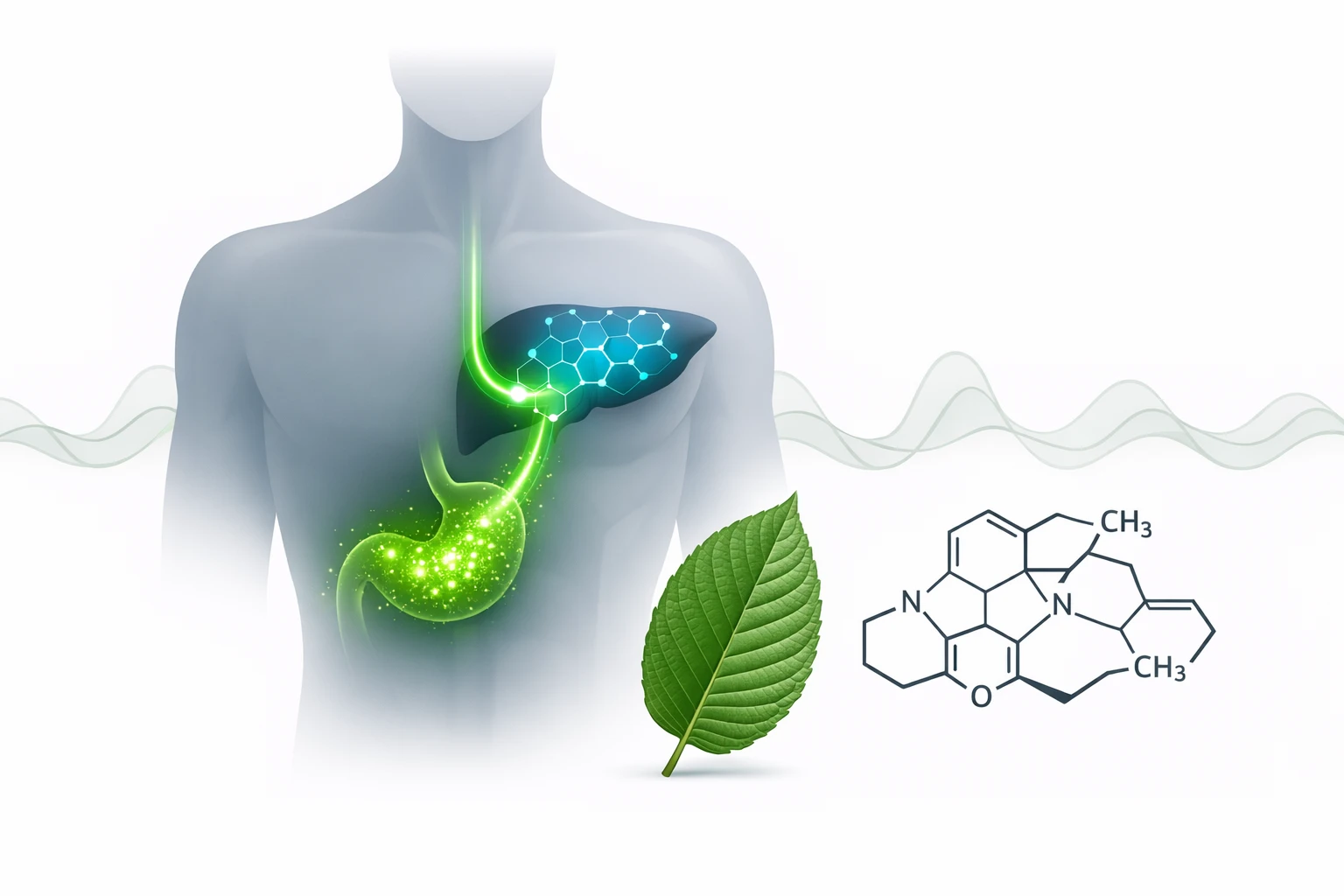
When you ingest kratom, mitragynine passes through your liver before it fully hits your systemic circulation. Here, a specific liver enzyme known as CYP3A4 performs a process called enzymatic biotransformation. This enzyme converts a portion of the mitragynine into 7-hydroxymitragynine (7-OH), an alkaloid that is significantly more potent at binding to target receptors.
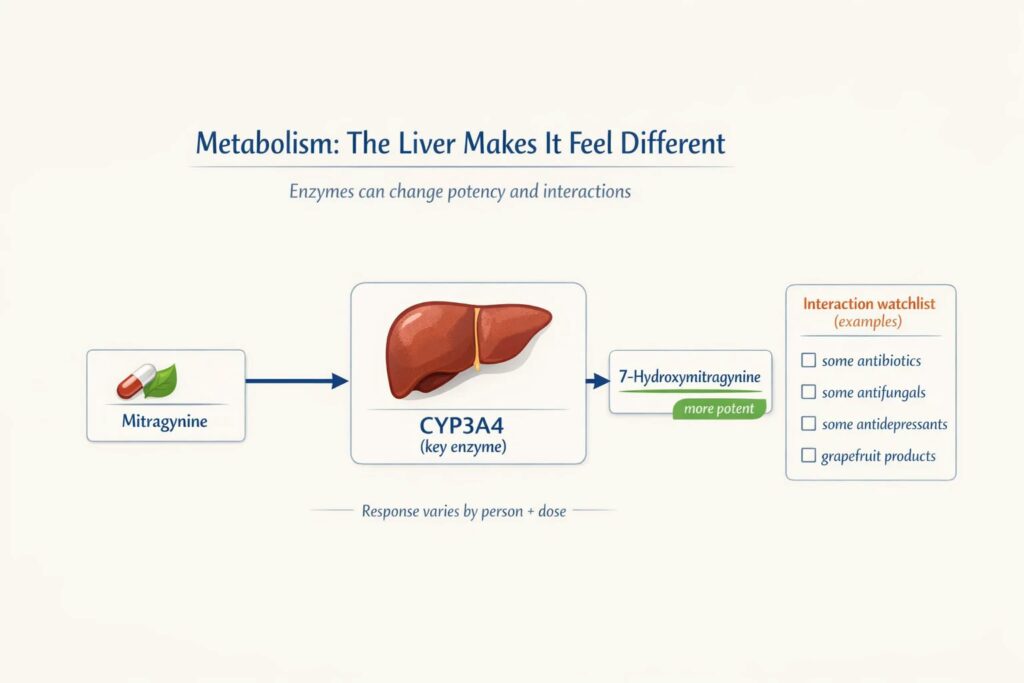
Your individual liver enzyme expression is entirely unique to you. Because of this, two people can take the exact same batch of kratom and have drastically different responses based on how efficiently their CYP3A4 enzymes convert mitragynine to 7-OH.
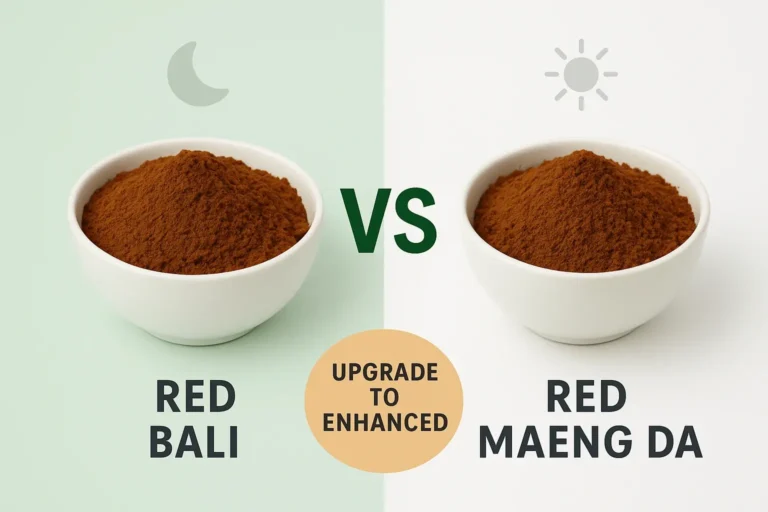
Furthermore, this explains why relying on a colorful kratom strain chart is an outdated approach to evaluating kratom. The perceived differences between a “White Maeng Da” and a “Red Bali” have less to do with the leaf vein color and everything to do with the specific ratio of raw alkaloids present in that batch, and how your liver processes that unique ratio.
This metabolic pathway is also why transparency and direct farm-to-consumer sourcing matter. When kratom sits in middleman warehouses for months, the natural alkaloid profiles degrade inconsistently. Fresh, lab-tested kratom ensures that your liver is processing the alkaloid ratio nature intended, yielding a more reliable and consistent outcome.
Elimination, Safety, and the CYP3A4 Pathway
The final stage of ADME is excretion, primarily handled by the kidneys once the liver has metabolized the compounds. This brings us to a critical discussion regarding safety and regulatory concerns.
Much of the pushback and safety warnings surrounding kratom (including FDA concerns about liver toxicity) stem directly from an incomplete public understanding of metabolic pathways. Because kratom relies heavily on the CYP3A4 and CYP2D6 enzymes for processing, combining kratom with other medications that inhibit or compete for these exact same enzymes can cause complications.
If an enzyme is “busy” processing a prescription medication, the kratom alkaloids cannot be metabolized properly, leading to elevated concentrations in the blood. Safety isn’t just about the purity of the plant—though third-party testing is non-negotiable—it’s about understanding how your body processes it.
Decoding Product Forms Based on Science
Equipped with the science of ADME, you can now evaluate kratom products based on objective data rather than marketing fluff.
If you are looking for rapid absorption and high systemic exposure, a potent kratom extract powder bypasses the plant fiber digestion stage. Because of the 2.4x bioavailability gap, extracts offer exceptional value-per-dose for experienced users trying to maximize kratom potency efficiently.
Conversely, if you are establishing a baseline, standard raw powder forces a slower digestion process. This staggers the absorption rate, giving you a gentler onset that allows you to accurately measure how your liver metabolizes the alkaloids without overwhelming your receptors. Determining a proper kratom dosage for beginners relies heavily on starting with this slower absorption profile before moving on to advanced, highly concentrated extracts.
Frequently Asked Questions (FAQ)
Why do I need to take kratom every 4-6 hours if the half-life is up to 45 hours?
The effects you “feel” (like energy or physical relief) depend on peak plasma concentrations in your bloodstream. Those peak levels drop after a few hours, causing the primary effects to fade. However, a sub-perceptual amount of mitragynine remains in your system for up to two days.
Does eating food change how kratom is absorbed?
Yes. Taking kratom on an empty stomach allows for faster gastric emptying, meaning the alkaloids reach your intestines (where absorption occurs) much faster. Eating a heavy meal delays this process, often blunting the peak concentration and spreading the effects out over a longer, less intense duration.
Why do some brands make me feel energized while others don’t, even at the same dose?
It comes down to alkaloid ratios and your CYP3A4 enzymes. Different farms have different soil compositions and harvesting methods, altering the baseline mitragynine levels. When you buy from vendors who use middle-men, those batches are often mixed inconsistently. Choosing a vendor that sources directly from specific, trusted Southeast Asian farms ensures you get a consistent alkaloid profile every time.
Making an Informed Decision
Understanding the pharmacokinetics of kratom transforms you from a passive consumer into an empowered buyer. You now know that the longevity of your dose is dictated by a 23-45 hour half-life, that your liver’s CYP3A4 enzymes are the real drivers of your experience, and that the bioavailability of a product directly dictates its value and efficiency.
When you evaluate where to purchase your kratom, look for a partner that respects this science. Vague claims and flashy packaging are relics of the past. Today, true quality is defined by transparent product information, direct-from-farm sourcing to protect alkaloid integrity, and a commitment to delivering clean, premium Mitragyna speciosa without compromise.
Your biology is complex. The kratom you choose to support it should be nothing short of exceptional.