
Kratom Pharmacodynamics: Receptors, Alkaloids & Mechanisms
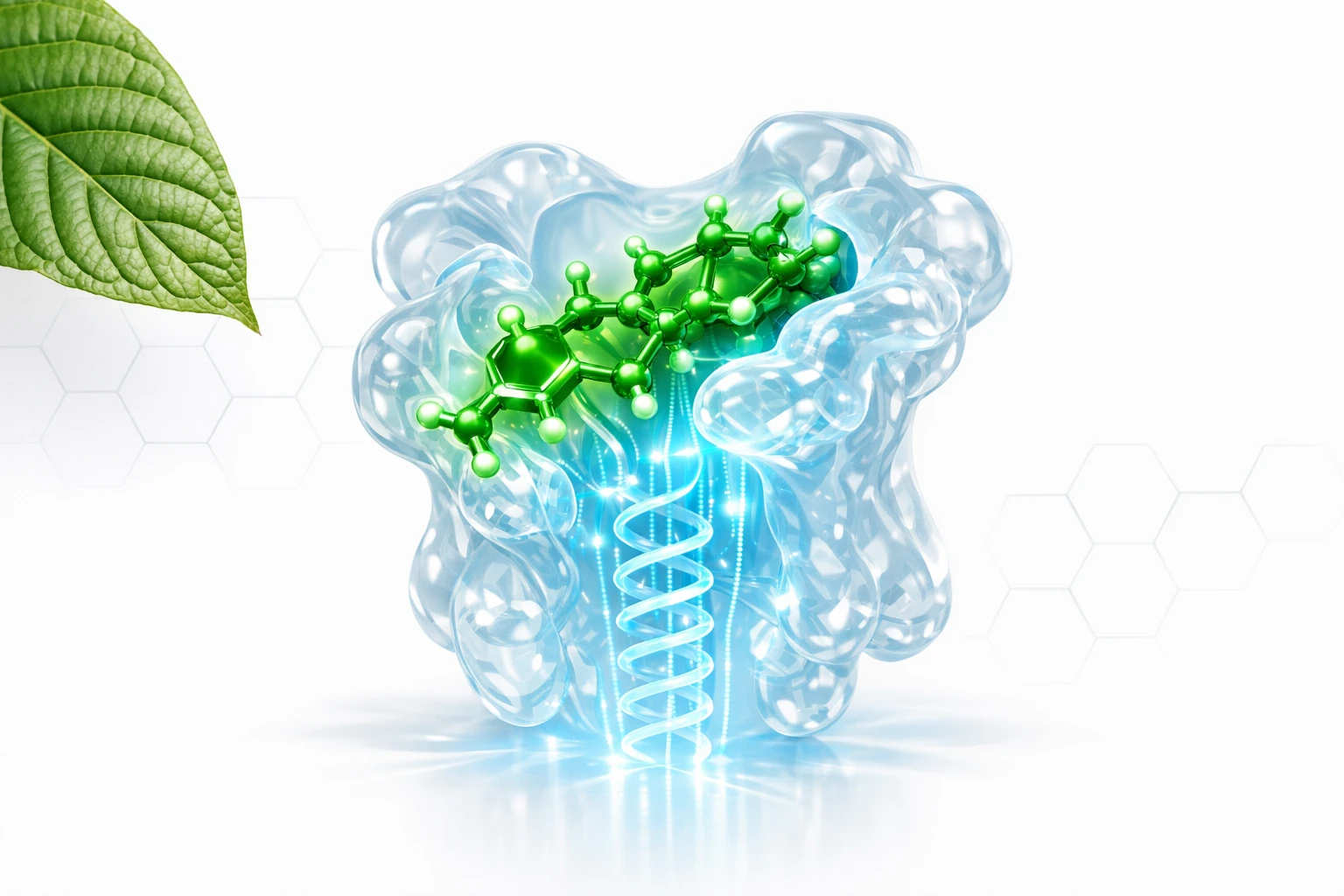
Kratom pharmacodynamics explains what kratom’s active alkaloids do to the body after they reach their biological targets. It covers how compounds such as mitragynine and 7-hydroxymitragynine (7-OH) interact with receptors, how those receptors transmit cellular signals, and how those mechanisms may contribute to kratom’s complex effects.
For anyone researching Mitragyna speciosa, this is an important distinction. Knowing that kratom contains dozens of alkaloids tells you what is present. Pharmacodynamics helps explain what those compounds may actually do once they encounter receptors and signaling systems in the body.
The science is also considerably more complicated than the common idea that kratom simply “acts like an opioid.” Its alkaloids have been investigated across opioid and non-opioid targets, and mitragynine can also be metabolized into pharmacologically important 7-OH. That creates an interconnected system involving alkaloid composition, receptor affinity, efficacy, metabolism, and downstream cellular signaling.
This guide breaks those relationships down from the beginning, starting with what kratom pharmacodynamics actually means.
What Is Kratom Pharmacodynamics?
Kratom pharmacodynamics is the study of how the chemical constituents of Mitragyna speciosa interact with biological targets to produce responses in the body.
Put simply, pharmacodynamics asks: “What does kratom do to the body?”
Researchers examine several interconnected factors when answering that question. These include which receptors an alkaloid binds to, how strongly it binds, whether it activates or inhibits that receptor, what intracellular signaling follows, and how those mechanisms change as exposure increases.
This is particularly important with kratom because the plant is not pharmacologically equivalent to one purified molecule. Whole-leaf kratom contains mitragynine alongside numerous minor alkaloids, while concentrated products may have substantially different chemical profiles.
The pharmacodynamic profile of a kratom product can therefore depend on both the individual compounds present and their relative concentrations.
What Is the Kratom Mechanism of Action?
The kratom mechanism of action describes the molecular processes through which kratom alkaloids interact with the body and produce biological effects.
Research has focused particularly on mitragynine and 7-OH and their interactions with opioid receptors, especially the mu-opioid receptor (MOR). However, kratom pharmacology extends beyond a single receptor family. Research has also investigated adrenergic, serotonergic, and other targets.
A simplified mechanism looks like this:
Kratom consumption → alkaloid exposure → receptor interaction → intracellular signaling → physiological response
There is another layer, however. Mitragynine can undergo metabolism, including CYP3A-mediated conversion to 7-OH. Consequently, the compound consumed and the compounds eventually interacting with receptors are not necessarily identical.
That makes kratom’s mechanism of action a combination of direct alkaloid activity, metabolism, and downstream receptor signaling rather than one simple lock-and-key reaction.
What Are the Main Active Alkaloids in Kratom?
Mitragynine is generally the predominant alkaloid in kratom leaf and is consequently the central compound in much of the pharmacological literature.
7-hydroxymitragynine is normally present at substantially lower natural concentrations, but it has strong pharmacological activity and is also relevant because mitragynine can be metabolically converted into 7-OH.
The plant also contains numerous minor alkaloids, including speciogynine, speciociliatine and paynantheine. Researchers continue to investigate how these constituents contribute individually and collectively to kratom pharmacology.
This distinction matters when comparing whole-leaf products and concentrated extracts. “Total alkaloids” alone does not completely describe pharmacodynamic behavior. Two products could contain different proportions of mitragynine, 7-OH, and minor constituents despite both being sold as kratom.
The Molecular Lock and Key: Understanding Kratom’s Receptor Interactions
Kratom’s pharmacology is frequently described through the concept of polypharmacology.
Polypharmacology means that a substance or mixture can interact with multiple biological targets rather than producing all of its activity through one receptor. Kratom is particularly relevant to this concept because Mitragyna speciosa contains a chemically diverse alkaloid mixture.
The opioid receptor family is among the most important areas of investigation. It consists primarily of mu-opioid (MOR), delta-opioid (DOR), and kappa-opioid (KOR) receptors. Mitragynine and 7-OH have demonstrated opioid-receptor activity, with MOR receiving particular research attention.
The familiar “lock and key” analogy helps explain receptor binding, but it is incomplete. Binding to a receptor does not necessarily mean fully activating it. Different ligands can behave as full agonists, partial agonists, antagonists, or produce different patterns of intracellular signaling.
That distinction is fundamental to understanding kratom pharmacodynamics.
What Receptors Does Kratom Affect?
The mu-opioid receptor is the most prominently discussed target in kratom research, particularly for mitragynine and 7-OH. However, kratom alkaloids have also been studied in relation to delta- and kappa-opioid receptors.
Research into kratom’s non-opioid pharmacology has additionally examined adrenergic and serotonergic receptor systems. These pathways provide plausible mechanisms for some of kratom’s complex pharmacological observations, although the strength of evidence differs considerably among individual alkaloids, receptor targets, experimental models, and human outcomes.
This is an important limitation. A compound demonstrating affinity for a receptor in vitro does not automatically prove that the receptor causes a particular real-world effect in humans. Exposure, metabolism, receptor occupancy, intrinsic efficacy, and concentration all matter.
The safest scientific interpretation is therefore that kratom has a multi-target pharmacological profile whose human significance is still being characterized.
The Biased Agonism Question: G-Protein vs. Beta-Arrestin
One of the most interesting areas of kratom pharmacodynamics involves functional selectivity, commonly called biased agonism.
A receptor is not simply an on/off switch. After a ligand binds, the receptor can activate different intracellular pathways. At MOR, two frequently discussed signaling mechanisms involve G proteins and β-arrestin pathways.
Preclinical research has reported G-protein-biased signaling for certain kratom alkaloids, meaning their receptor activation may favor some signaling pathways over others. This has generated considerable scientific interest because signaling bias could contribute to pharmacological differences between kratom alkaloids and conventional opioid agonists.
However, an important correction is needed to a common online claim: β-arrestin-2 should not simply be described as “the pathway responsible for respiratory depression,” nor does reduced β-arrestin recruitment establish that kratom avoids opioid-related respiratory risk. The relationship between signaling bias and respiratory safety is more complicated, and findings from cellular or animal models cannot automatically be translated into a guarantee of human safety.
Biased agonism is therefore best understood as a mechanistic research question—not proof that kratom is risk-free.
The Polypharmacology Ecosystem: Beyond the Opioid Receptors
Opioid-receptor activity alone cannot adequately describe the entire kratom alkaloid matrix. Researchers have investigated interactions involving adrenergic, serotonergic, and other receptor systems, creating a broader pharmacological network.
Adrenergic receptors regulate functions including sympathetic nervous system activity, vascular tone, alertness, and several aspects of autonomic signaling. Serotonergic receptors are similarly involved in numerous neurological processes.
These additional targets matter because a botanical containing multiple active constituents can potentially produce overlapping or even opposing pharmacological signals.
This is also why simplistic rules such as “one receptor equals one effect” should be avoided. The experienced effect of a multi-alkaloid botanical may emerge from several simultaneous mechanisms rather than one isolated receptor interaction.
The Alkaloid Matrix: Mitragynine, 7-OH, and Minor Modulators
Understanding the alkaloid matrix requires distinguishing three concepts: abundance, affinity, and efficacy.
Abundance describes how much of an alkaloid is present. Affinity describes how readily a compound binds to a target, often represented experimentally by measurements such as Ki. Efficacy describes what the ligand does after binding.
A lower Ki generally represents greater measured binding affinity under the specific experimental conditions used, but Ki values should not be treated as direct measures of how “strong” a product will feel. Different assays and biological systems can generate different results, and receptor affinity is only one component of pharmacological activity.
What Is Mitragynine?
Mitragynine is the principal alkaloid associated with Mitragyna speciosa and the most extensively investigated constituent of traditional kratom leaf.
Its importance comes not only from its own receptor activity but also from its role as a metabolic precursor to 7-OH. Consequently, mitragynine sits at the intersection of kratom pharmacodynamics and pharmacokinetics: it can interact with biological targets directly while also undergoing metabolism into another active compound.
For consumers evaluating laboratory reports, mitragynine concentration is useful information—but it should not be interpreted as a complete measurement of product quality, safety, or expected effects.
What Is 7-Hydroxymitragynine (7-OH)?
7-hydroxymitragynine is a kratom alkaloid and metabolite with substantial activity at MOR in experimental research. It can exist in kratom material at low levels and can also be formed in the body from mitragynine.
This distinction has become increasingly important as concentrated 7-OH products have appeared in the marketplace. A highly concentrated or modified product should not automatically be treated as pharmacologically equivalent to traditional whole-leaf kratom simply because both originate from the same botanical.
Consumers should therefore look beyond product names and examine independently verified alkaloid composition when such data is available.
Paynantheine, Speciogynine, and Other Minor Alkaloids
Paynantheine, speciogynine, speciociliatine, and other minor constituents broaden the pharmacological picture beyond mitragynine and 7-OH. Experimental studies have investigated several of these compounds at opioid and non-opioid targets.
Their precise contribution to the subjective and physiological effects of whole-leaf kratom in humans, however, remains an active research question.
Claims that one specific minor alkaloid definitively produces a particular mood, anxiety, stimulation, or relaxation effect should therefore be treated cautiously unless supported by appropriate human evidence.
Kratom Pharmacodynamics vs. Pharmacokinetics: What’s the Difference?
Pharmacodynamics and pharmacokinetics answer complementary questions.
Kratom pharmacodynamics asks what kratom alkaloids do to the body. Kratom pharmacokinetics asks what the body does to those alkaloids.
Absorption, distribution, metabolism, and elimination—often abbreviated ADME—belong to pharmacokinetics. Receptor binding, agonism, antagonism, efficacy, and downstream cellular signaling belong primarily to pharmacodynamics.
For example:
Mitragynine → CYP-mediated metabolism → 7-OH formation is primarily a pharmacokinetic process.
7-OH → MOR interaction → intracellular signaling is primarily a pharmacodynamic process.
Understanding both is essential because pharmacokinetics determines which compounds reach a biological target and at what concentrations, while pharmacodynamics determines what happens when they get there.
Metabolic Crossroads: How Your Liver Changes the Pharmacological Picture
Mitragynine metabolism provides one of the clearest examples of the relationship between pharmacokinetics and pharmacodynamics.
Research has identified CYP3A enzymes as important contributors to the conversion of mitragynine into 7-OH. Because 7-OH has substantial MOR activity, metabolic conversion can influence the pharmacological response produced after mitragynine exposure.
This does not mean that the liver simply “unlocks” kratom or that one enzyme determines an individual’s entire experience. Human metabolism involves multiple enzymes and variables, while dose, formulation, concurrent substances, individual physiology, and other factors can influence exposure.
This metabolic complexity also creates a safety consideration. Substances that affect drug-metabolizing enzymes can potentially alter exposure to kratom alkaloids, making interactions with medications or other substances an important issue to discuss with an appropriate healthcare professional.
Dose-Response Relationships: Why More Does Not Simply Mean More Effect
Pharmacodynamics also examines dose-response relationships: how biological responses change as exposure increases.
Kratom is often described online as “biphasic,” with lower amounts associated anecdotally with more stimulating effects and larger amounts associated with more sedating effects. However, this should not be converted into universal gram-based rules.
Commercial products vary in alkaloid composition, and individual responses differ. A gram of one powder or extract is not necessarily pharmacologically equivalent to a gram of another.
Dose-response behavior may also involve multiple receptors, changing alkaloid concentrations, metabolism, and competing pharmacological actions. The resulting response is therefore more complicated than a simple linear relationship where twice the quantity produces twice the effect.
The Ceiling Effect Hypothesis: Are There Built-In Pharmacological Brakes?
The idea that kratom has a predictable “ceiling effect” deserves more cautious treatment than it often receives online.
Partial agonism and competing receptor interactions can theoretically produce nonlinear dose-response relationships, and some kratom constituents may exhibit different functional activities at different targets. However, this should not be interpreted as a proven natural safeguard against overdose or serious adverse effects.
Experiencing nausea, dizziness, vomiting, or other unpleasant effects after increasing exposure is not evidence that a botanical safety mechanism has prevented harm.
From a pharmacodynamic perspective, the more defensible conclusion is that kratom’s multi-compound, multi-receptor activity may produce complex and nonlinear responses. More research is needed before a clinically meaningful “ceiling effect” can be characterized in humans.
Whole-Leaf Kratom vs. Extracts: Why Alkaloid Ratios Matter
Whole-leaf kratom and concentrated extracts should not automatically be expected to produce identical pharmacodynamic profiles.
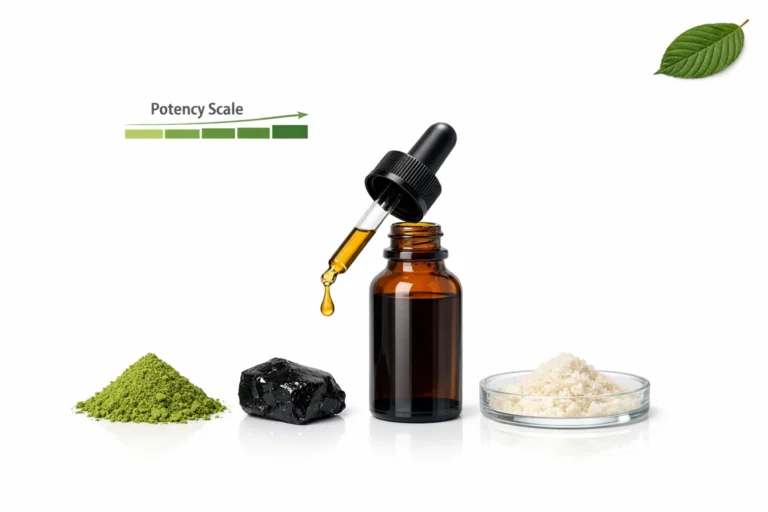
Traditional leaf contains a naturally occurring mixture of alkaloids. Extraction and concentration can substantially change the amount and relative proportion of those compounds. Some products may concentrate mitragynine, while others may have substantially different profiles.
This means concentration is not merely a question of getting “more kratom.” Changing the alkaloid ratio can change the pharmacological exposure itself.
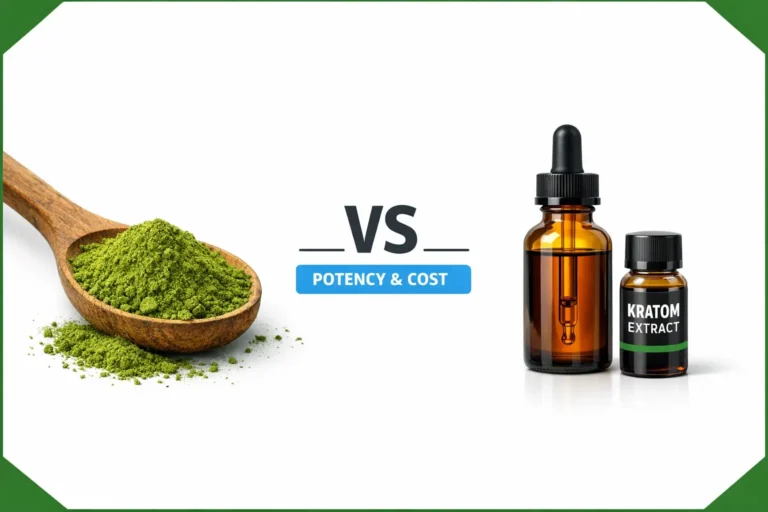
When comparing kratom powder vs extract, the most useful information is therefore not simply the product’s weight. Verified alkaloid concentration, serving information, formulation, and laboratory testing provide considerably more context.
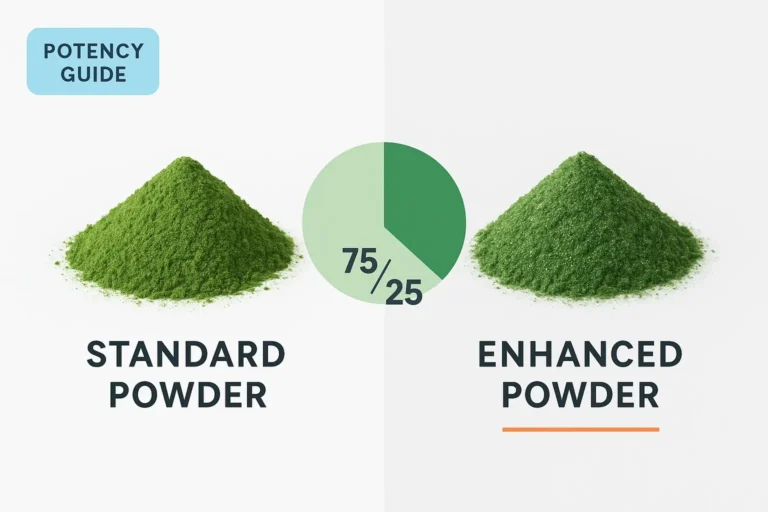
Likewise, an enhanced kratom powder should be evaluated according to its measured composition rather than assuming it behaves exactly like ordinary leaf powder.
What Determines Kratom’s Pharmacodynamic Effects?
There is no single variable that predicts an individual’s response. Product chemistry and human biology interact.
Important variables include the concentrations and ratios of alkaloids, formulation, receptor affinity and efficacy, metabolic conversion, individual physiology, exposure to other substances, and the amount consumed.
This is why strain names and colors alone are weak pharmacodynamic descriptors. A laboratory report showing relevant alkaloid concentrations provides more objective chemical information than marketing terminology such as “red,” “green,” or “white.”
What Kratom Pharmacodynamics Can—and Cannot—Tell Consumers
Pharmacodynamics can help consumers understand why chemical composition matters, why extracts may differ substantially from whole leaf, why receptor interactions are more complicated than simple strain labels suggest, and why laboratory data deserves attention.
What it cannot do is predict an exact personal outcome from a product name or alkaloid percentage. Laboratory receptor studies do not guarantee a particular subjective effect, and mechanistic evidence should not be converted into unsupported therapeutic or safety claims.
This distinction is particularly important when interpreting claims involving pain, anxiety, opioid withdrawal, mood, or other medical outcomes. Mechanistic plausibility is not the same thing as demonstrated clinical effectiveness.
Evaluating Kratom Products Through a Pharmacodynamic Lens
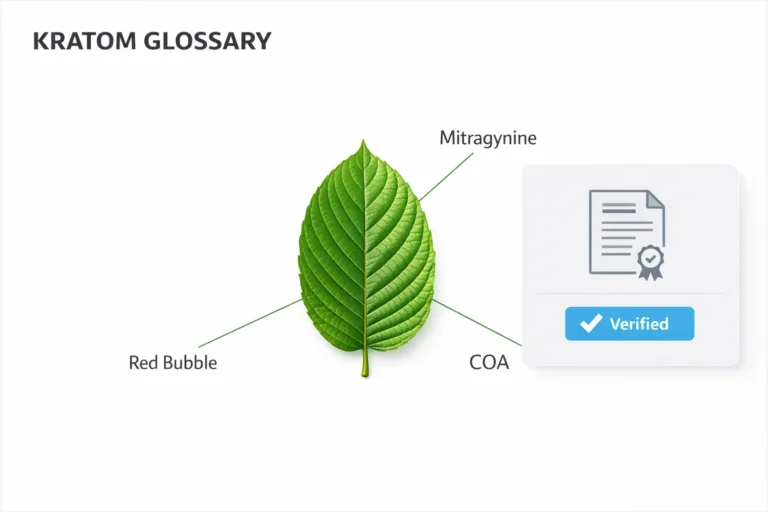
If you are comparing products, start with composition rather than marketing claims. Look for batch-specific third-party testing that identifies relevant alkaloid concentrations and screens for contaminants. The laboratory, testing method, batch identifier, and date should be clear enough to connect the report to the product being evaluated.
Be particularly careful when comparing concentrated products with traditional leaf. An extract’s alkaloid concentration can fundamentally change exposure, and products with unusually elevated 7-OH should not be treated as interchangeable with conventional whole-leaf kratom.
Transparent sourcing can provide useful supply-chain context, but geographic origin or “farm-direct” status does not itself prove pharmacological consistency. Batch-specific analytical testing is the stronger evidence for chemical composition.
Frequently Asked Questions
What is kratom pharmacodynamics?
Kratom pharmacodynamics is the study of how kratom alkaloids interact with receptors and cellular signaling systems to produce biological responses. It includes receptor affinity, efficacy, agonism, antagonism, signaling pathways, and dose-response relationships.
What is kratom’s primary mechanism of action?
Research has focused heavily on the interactions of mitragynine and 7-OH with opioid receptors, particularly MOR. Kratom contains multiple alkaloids, however, and research has also examined non-opioid targets. Its pharmacology is therefore better characterized as multi-target than as one isolated mechanism.
What receptor does mitragynine bind to?
Mitragynine has demonstrated activity involving opioid receptors, including MOR, while research has also investigated other receptor systems. Binding alone does not fully describe its pharmacology because functional activity and downstream signaling must also be considered.
What is biased agonism in kratom?
Biased agonism describes preferential activation of certain intracellular signaling pathways after receptor binding. Some kratom alkaloids have demonstrated G-protein-biased signaling in preclinical experiments. The clinical implications—including what this means for human safety—remain more complicated than simply saying one signaling pathway is “safe” and another is “dangerous.”
What is the difference between mitragynine and 7-OH?
Mitragynine is generally the predominant alkaloid in kratom leaf. 7-OH occurs at much lower natural levels but has substantial MOR activity and can also be produced through metabolism of mitragynine. Concentrated 7-OH products can therefore represent a very different exposure from traditional leaf.
Does CYP3A4 affect kratom?
CYP3A enzymes participate in mitragynine metabolism, including pathways that can produce 7-OH. Because metabolism influences which active compounds reach biological targets, enzyme activity and potential drug interactions are relevant to kratom pharmacology.
Why can kratom extracts differ from powder?
Extraction can alter both the absolute concentrations and relative ratios of kratom alkaloids. Consequently, an extract is not necessarily equivalent to ordinary leaf powder at a smaller volume. Comparing verified alkaloid composition provides more useful information than comparing product weight alone.
Is kratom pharmacodynamics the same as pharmacokinetics?
No. Pharmacodynamics describes what kratom’s compounds do to biological targets. Pharmacokinetics describes what the body does to those compounds through absorption, distribution, metabolism, and elimination. The two processes interact continuously.
Make Your Next Move with Better Information
Kratom pharmacodynamics reveals why Mitragyna speciosa cannot be accurately understood through strain names, colors, or a single alkaloid percentage. Its pharmacology involves mitragynine, 7-OH, minor alkaloids, multiple receptor systems, metabolic conversion, and downstream cellular signaling.
For consumers, the practical lesson is straightforward: prioritize measurable information over pharmacological marketing claims. Batch-specific laboratory testing, transparent alkaloid concentrations, contaminant screening, and clearly identified product formulations provide a stronger basis for comparison.
At Kratom-Online, consumers can use this framework when evaluating whole-leaf and concentrated products, including the potent kratom extract powder category. Compare the available laboratory information, understand how concentration changes exposure, and remember that receptor-level research does not guarantee a specific therapeutic outcome.
The better you understand the relationship between alkaloids, receptors, metabolism, and cellular signaling, the better equipped you are to distinguish meaningful pharmacological information from marketing language.