
Kratom Glossary: Essential Kratom Terms, Definitions & Quality Standards
If you are actively evaluating kratom products in 2026, you have likely encountered product descriptions that read like a confusing mix of botanical science, marketing buzzwords, and internet community slang. You are trying to make an informed decision, but when one vendor talks about “mu-opioid receptor affinity” and another insists you try the “Red Bubble method,” the evaluation process becomes unnecessarily complex.
To choose a safe, effective, and high-quality product, you don’t need a chemistry degree—but you do need a reliable translator. This master glossary bridges the gap between scientific nomenclature, commercial strain labels, and user-centric slang. By the end of this guide, you will know exactly how to read a Certificate of Analysis (COA), spot a premium product, and decode the terminology that actually matters to your experience.
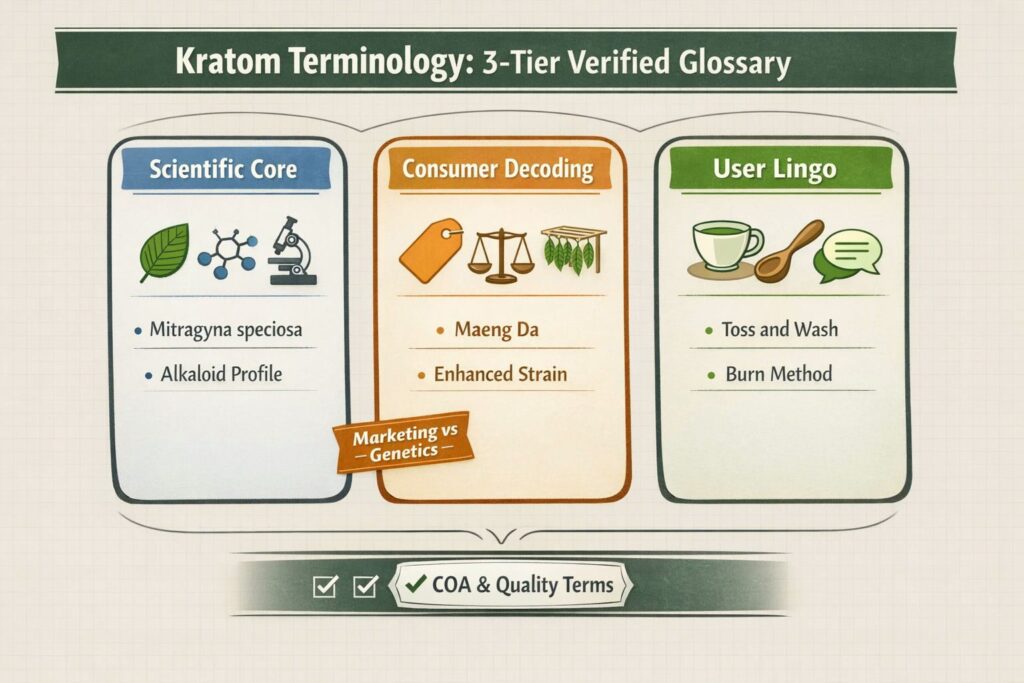
A quick visual map of kratom vocabulary—science, product language, and community slang—anchored by lab-report and quality terms for safer evaluation.
Why Understanding Kratom Terminology Matters
As the kratom industry has grown, so has the vocabulary surrounding it. Scientific publications, laboratory reports, advocacy organizations, vendors, and consumer communities often use different terminology to describe similar concepts. Without understanding these terms, comparing products or evaluating quality becomes unnecessarily difficult.
A comprehensive kratom glossary serves as more than a dictionary. It provides context for botanical science, manufacturing standards, laboratory testing, regulatory language, and community terminology, helping consumers interpret information with greater confidence.
Learning the language of kratom also helps distinguish measurable quality indicators—such as alkaloid percentages and Certificates of Analysis—from marketing phrases that may have little scientific significance.
How to Use This Kratom Glossary
This glossary is designed as both an educational guide and a practical purchasing reference. Some entries explain scientific concepts, while others decode industry jargon, community slang, and quality assurance terminology that commonly appears on product labels or laboratory reports.
Rather than memorizing every definition, use this glossary to understand unfamiliar terms as you compare products, review Certificates of Analysis (COAs), or evaluate vendor transparency. The more terminology you understand, the easier it becomes to identify trustworthy information and make confident purchasing decisions.
The Scientific Core: Understanding the Botanical Language
When comparing kratom vendors, the most trustworthy companies will use precise botanical and scientific language rather than relying solely on flashy names. Understanding these foundational terms helps you verify exactly what you are purchasing.
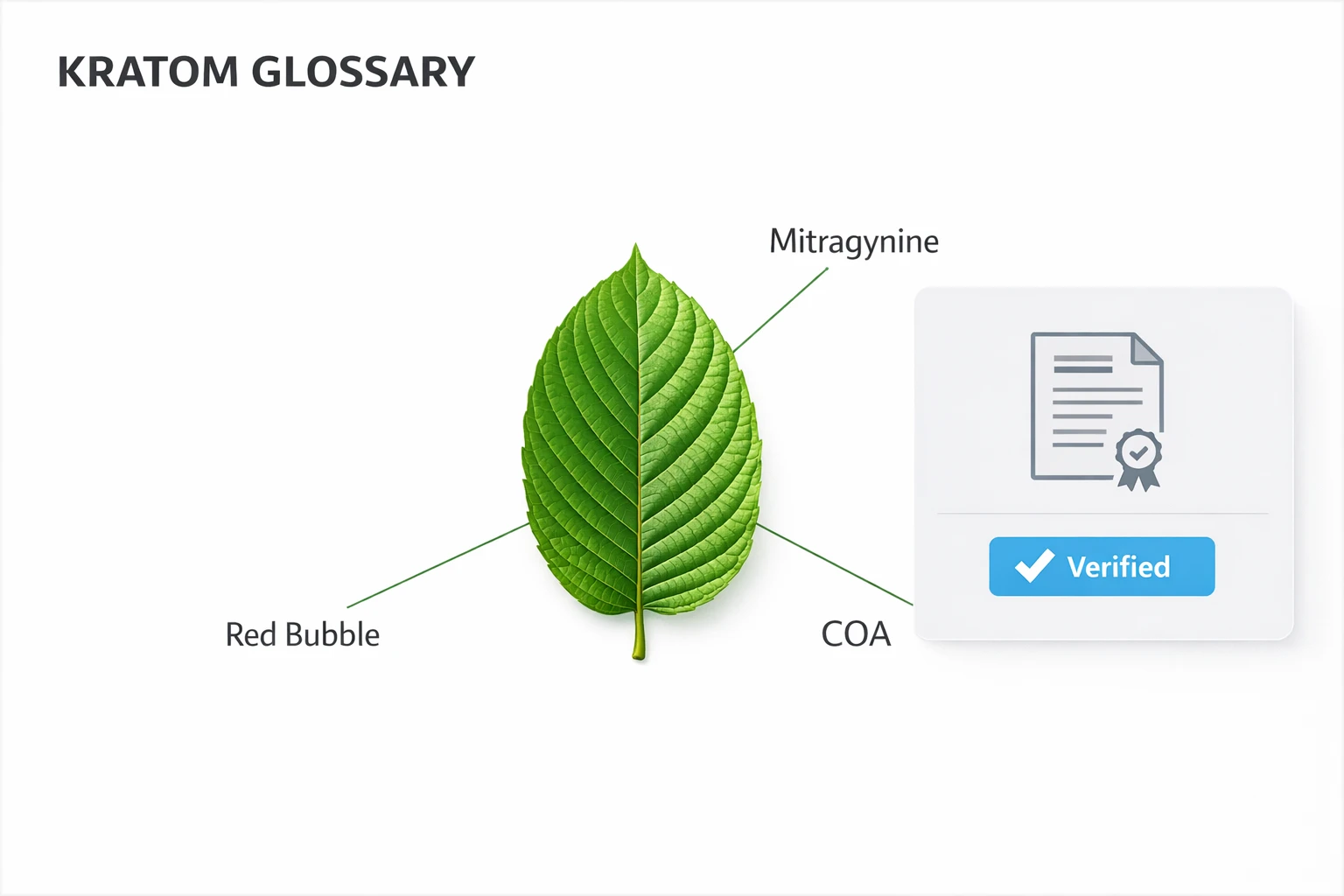
Mitragyna Speciosa
The official botanical nomenclature for the kratom tree, an evergreen native to Southeast Asia that belongs to the Rubiaceae (coffee) family. When evaluating a vendor, look for this specific term; reputable sellers will always identify their products by their proper botanical name to confirm authenticity.
Indole Alkaloids
Alkaloids are naturally occurring, nitrogen-bearing organic compounds that produce physiological effects in humans. While recent National Institutes of Health (NIH) data confirms there are between 40 to 54 identified alkaloids in the kratom leaf, an overwhelming 90% of consumer interest—and the bulk of a product’s effects—focuses on just two primary compounds:
- Mitragynine: The most abundant alkaloid in the leaf, typically making up 60% to 80% of the plant’s total alkaloid profile. It is the primary driver behind the botanical’s signature baseline effects.
- 7-Hydroxymitragynine (7-OH): A highly potent, secondary alkaloid present in trace amounts (usually less than 0.05% naturally). Oxidation during the drying process often converts a small percentage of Mitragynine into 7-OH, significantly altering the product’s profile.
Scientific Terms Every Consumer Should Know
Beyond alkaloids, several additional scientific terms frequently appear in educational materials, research papers, and laboratory reports. Understanding these concepts helps consumers interpret product information more accurately.
Bioavailability
Bioavailability refers to the proportion of active alkaloids that become available for absorption after consumption. Preparation methods, product formulation, and individual physiology may all influence bioavailability.
Phytochemicals
Phytochemicals are naturally occurring plant compounds that contribute to the overall chemical profile of Mitragyna speciosa. Alkaloids represent one category of phytochemicals present within the leaf.
Chemotype
A chemotype describes a plant’s chemical composition rather than its physical appearance. Differences in alkaloid profiles may result from cultivation practices, environmental conditions, harvesting methods, and post-harvest processing rather than genetically distinct “strains.”
Pharmacology
Pharmacology is the scientific study of how naturally occurring compounds and other substances interact with biological systems. Understanding basic pharmacological terminology allows consumers to better interpret research discussing kratom alkaloids and receptor interactions.
The Consumer Decoding Guide: Translating Strains, Veins, and Formats
Understanding how leaves are processed is arguably more important than where they were grown. Groundbreaking 2025 research in Frontiers in Plant Science confirmed a long-held industry secret: “strains” are not actually genetically distinct varieties. Instead, the final product is defined by phenotypic variations and highly controlled post-harvest processing techniques.
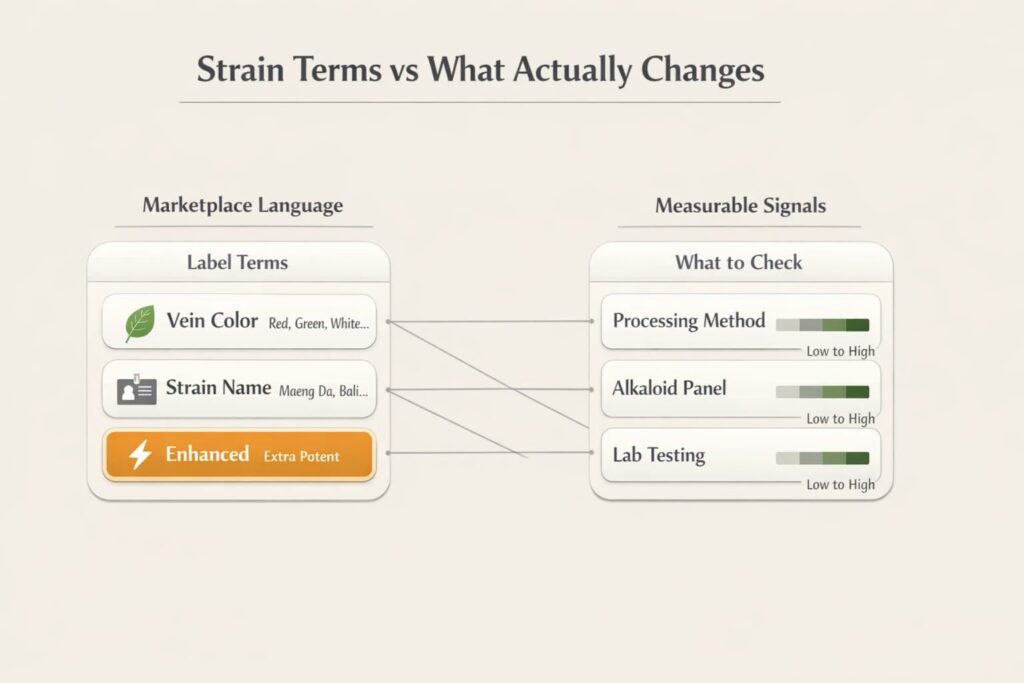
Use this decoder to translate strain and vein terminology into what you can actually verify—processing details, alkaloid results, and lab-testing evidence.
Vein Colors (Red, Green, White)
Rather than distinct species, vein colors primarily indicate the maturity of the leaf at harvest and the specific drying method used (e.g., indoor vs. outdoor, UV light exposure, fermentation). This directly manipulates the alkaloid ratios.
- White Vein: Typically harvested earlier and dried indoors without light, preserving a profile favored for daytime use.
- Green Vein: The middle ground, typically harvested at peak maturity and dried in a mix of indoor and outdoor environments.
- Red Vein: Often exposed to abundant sunlight or UV lamps during drying, which converts some Mitragynine into 7-OH for a vastly different chemical profile.
Maeng Da
Literally translating to “Pimp Grade” in Thai slang, Maeng Da is not a genetic strain but a historical marker of high quality. Originally, farmers would select only their most potent, pristine leaves for a “Maeng Da” batch. Today, it generally refers to a vendor’s premier, highly concentrated blend. If you want to understand what this means for your daily routine, exploring maeng da thai kratom effects will give you a clear picture of why this classification remains a top seller.
Bentuangie
This term identifies kratom that has undergone a specialized fermentation process prior to drying. Farmers place raw leaves in sealed bags to trap moisture, which alters the alkaloid profile and produces a notably darker powder with a milder, earthier aroma.
Formats: Powders vs. Extracts
Evaluating formats is a critical step in the buyer’s journey.
- Powder: The whole, crushed leaf containing the natural, full-spectrum alkaloid profile.
- Extract: A concentrated product where alkaloids have been isolated and extracted from the plant matter using solvents, resulting in a much more potent format. When deciding between the two, reviewing a deep dive on kratom extract vs powder is essential for matching your experience level to the right product.
Regulatory & Quality Lexicon: How to Read a Kratom Lab Report
A glossary is only as valuable as the protection it offers you. In 2026, third-party lab testing is the absolute baseline for quality. Here is the vocabulary you need to confidently read a Certificate of Analysis (COA).
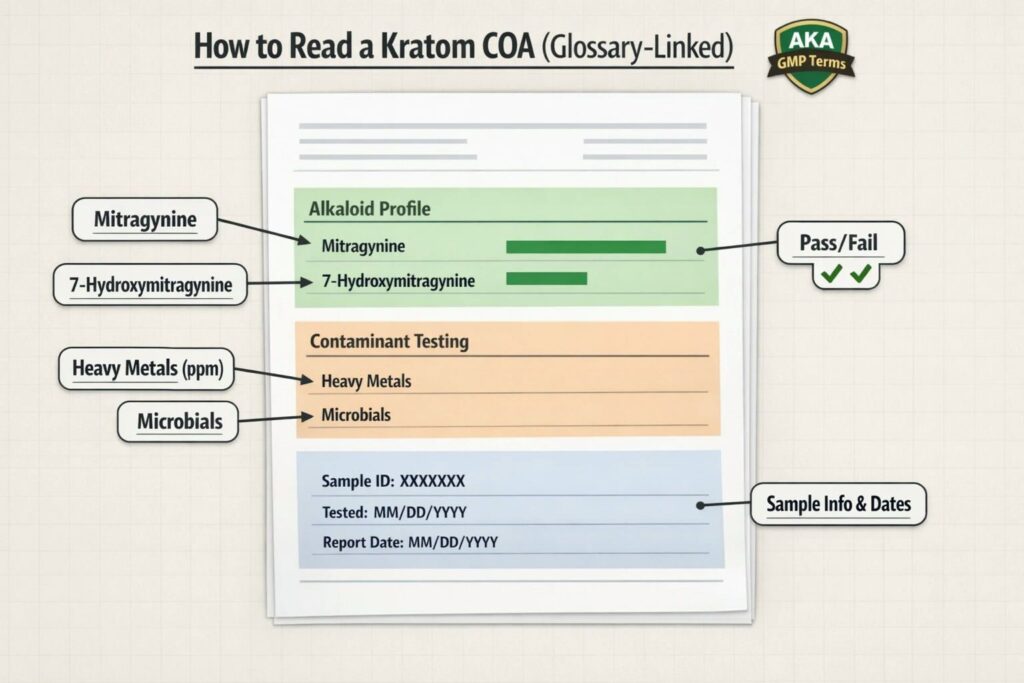
A glossary is only useful if it helps you verify quality. This COA map shows exactly where key alkaloid and contaminant terms appear on a lab report.
Certificate of Analysis (COA)
A verified document from an independent, accredited laboratory detailing the exact chemical composition of a specific batch of kratom. It confirms alkaloid percentages and tests for safety.
AKA GMP
The American Kratom Association’s Good Manufacturing Practices. This standard requires vendors to follow stringent operational guidelines regarding sanitation, batch tracking, and rigorous lab testing.
PPM (Parts Per Million)
The metric used on COAs to measure heavy metals (lead, arsenic, cadmium, mercury). Reputable vendors transparently publish these numbers to prove their products fall well below safe consumption thresholds.
Adulteration
The unethical practice of secretly adding synthetic compounds, cheaper botanicals, or concentrated alkaloids to a batch to falsely inflate its perceived potency. If you have ever searched krtmonline to verify our background, you already know that strict, multi-stage lab testing is our primary weapon against industry adulteration.
The “Lingo” Dictionary: Community Slang and Consumption Methods
As you navigate forums and product reviews, you will inevitably encounter consumer slang. Here is the science behind the street terms.
Toss and Wash (T&W)
The most common manual consumption method. A user measures their dose of dry powder, places it directly in their mouth, and washes it down with water or juice.
Red Bubble Method
A popular preparation technique involving freezing kratom powder mixed with an acid (like lemon juice) and water. The slang refers to the red, dome-like bubble that forms on top of the frozen mixture. The Science: The freezing process forces water to expand, which ruptures the rigid plant cell walls, theoretically making the alkaloids more bioavailable upon consumption.
Oblates (Oblate Discs/Pouches)
Edible, ultra-thin films made from potato starch or rice. Users wrap their kratom powder in these films to swallow the dose whole, bypassing the botanical’s inherently bitter taste without having to swallow dry powder or take multiple capsules.
Dosage Terminology and Risk Mitigation
Understanding safety terminology allows you to evaluate your own tolerance and mitigate unwanted side effects. The most crucial concept to grasp is the plant’s unique biphasic nature.
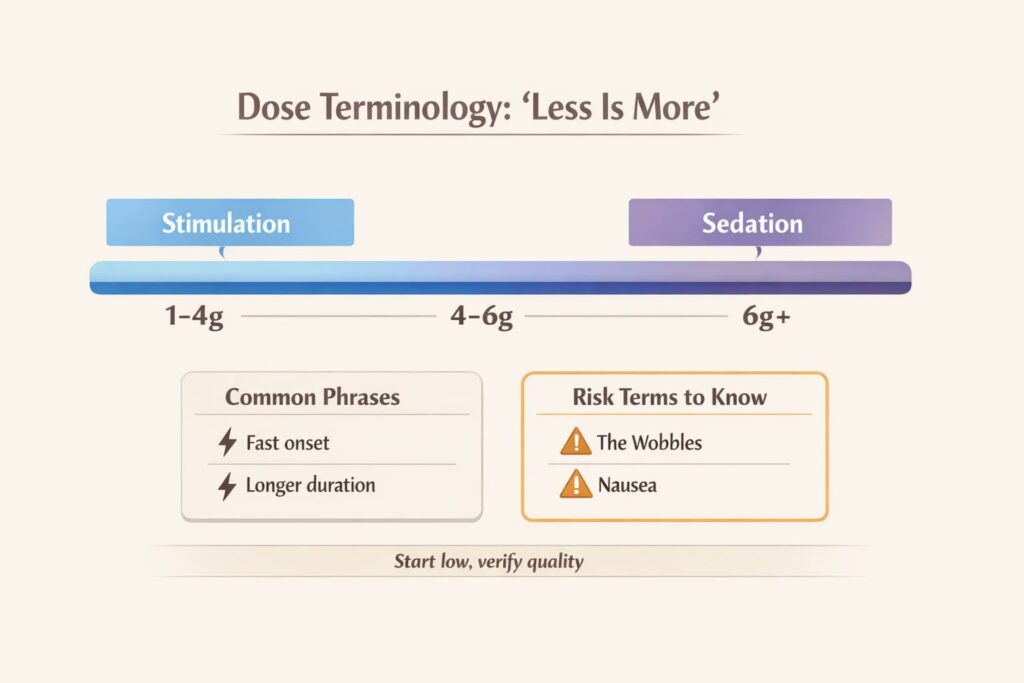
Readers often search effects by dose and slang. This visual links common dose ranges to plain-language terms and flags risk vocabulary to support safer, informed evaluation.
The “Less is More” Rule (Biphasic Effect)
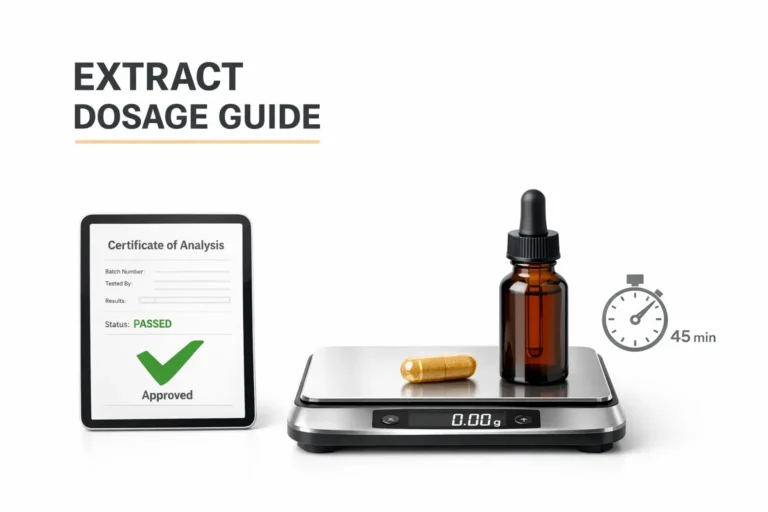
Because kratom is biphasic, it produces vastly different effects depending on the serving size. Research and historical data show that lower amounts (typically 1 to 4 grams) tend to yield more stimulating, energizing properties. Conversely, higher amounts (6 grams and above) shift the alkaloid response toward a more relaxing, soothing profile.
The Wobbles
A community slang term describing a specific set of unwanted side effects—usually involuntary eye movement (nystagmus), slight dizziness, and nausea—caused by taking too much kratom at once. Experiencing “the wobbles” is your body’s clear signal that you have exceeded your dosage threshold. To avoid this, we highly recommend consulting a structured resource like our green thai kratom guide to understand responsible usage parameters.
How Terminology Helps You Evaluate Products
Learning kratom terminology transforms product comparisons from marketing-based decisions into evidence-based evaluations. Instead of relying solely on strain names or promotional language, consumers can review Certificates of Analysis, alkaloid profiles, contaminant testing, sourcing information, and manufacturing standards with greater confidence.
Understanding scientific, regulatory, and community terminology also makes it easier to ask informed questions when evaluating vendors. Consumers who understand the language of kratom are better equipped to identify transparent companies, interpret laboratory reports, and recognize meaningful quality indicators before making a purchase.
Frequently Misunderstood Kratom Terms
Several kratom terms are frequently misunderstood because they are used differently by researchers, vendors, advocacy organizations, and consumers. Clarifying these definitions helps reduce confusion when comparing products or reading educational resources.
Strain
Despite widespread marketing, scientific evidence suggests that most commercial “strains” are not genetically distinct plant varieties. Instead, differences largely result from harvesting practices, drying methods, fermentation, and post-harvest processing.
Premium
The word “premium” has no universal scientific definition. It is primarily a marketing descriptor unless supported by objective quality indicators such as Certificates of Analysis (COAs), contaminant testing, and transparent sourcing.
Natural
Natural indicates botanical origin but does not automatically guarantee purity, potency, or manufacturing quality. Independent laboratory testing remains the most reliable method for verifying product quality.
Potency
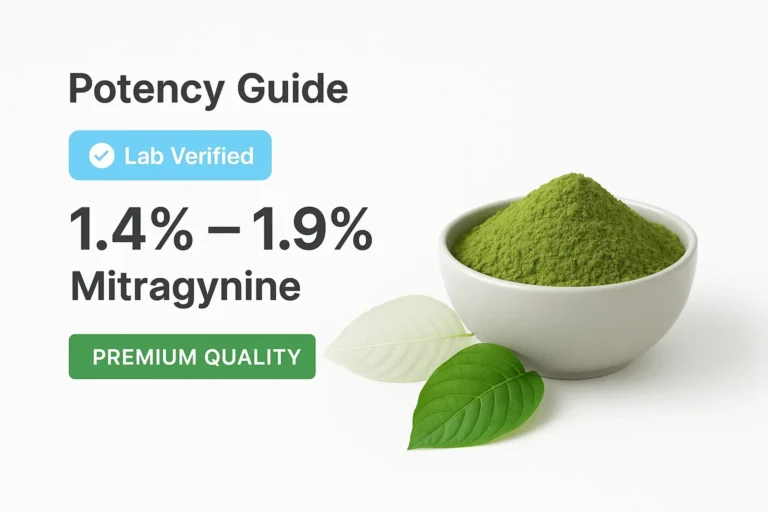
Potency refers to the concentration of active alkaloids within a product rather than its marketing name. Products with similar names may vary considerably in alkaloid composition depending on cultivation, processing, and manufacturing methods.
Extract
Extracts are concentrated preparations created by isolating alkaloids from plant material. They should not be assumed to have the same serving recommendations or alkaloid concentrations as traditional whole-leaf powders.
Frequently Asked Questions
Are kratom strains genetically different from one another?
No. Recent scientific studies demonstrate that the kratom tree’s genetics are remarkably uniform. The differences you see in terms like “Red Bali” or “White Thai” come from post-harvest techniques—such as how long the leaf matures, UV exposure, drying duration, and fermentation.
How do I use this glossary to choose a better vendor?
Use these terms as a checklist. If a vendor cannot provide a COA detailing Mitragynine and 7-OH percentages, or if they fail to publish PPM counts for heavy metals, they are not meeting 2026 industry standards. Transparency in terminology equates to transparency in quality.
What is the difference between an Enhanced Powder and an Extract?
Enhanced powder is regular kratom leaf powder that has been fortified with isolated kratom extract. An extract is purely the concentrated alkaloids removed from the plant matter. Both belong to advanced product categories that should only be evaluated by experienced users comfortable with calculating precise milligrams of Mitragynine.
Your Next Steps in Evaluating Premium Kratom
Equipped with this terminology, you are no longer just a passive shopper—you are an informed evaluator. You understand that “strains” are actually sophisticated processing recipes, you know the difference between standard leaf and potent extracts, and most importantly, you know exactly what to look for on a third-party lab report.
Your next step is to apply this knowledge. Explore our product collections knowing that Kratom-Online sources directly from trusted Southeast Asian farms, eliminates middlemen to ensure freshness, and backs every batch with the transparent lab data you just learned how to read. Compare the alkaloid profiles, evaluate the processing methods, and choose a product that confidently aligns with your needs.