
Why Choose Organically Grown & Pure Kratom? A Guide to Quality Standards & Vendor Transparency
If you’re currently evaluating kratom vendors, you already know the market is going through a massive “trust crisis.” In 2026, finding a supplier shouldn’t feel like a gamble. You’re likely tired of inflated marketing claims, hidden supply chains, and vendors gaslighting consumers with outdated or borrowed lab results.
When you are trying to figure out exactly how can one identify high quality kratom, a simple “GMP certified” badge is no longer enough. That has become the baseline. To genuinely protect your wellness and ensure you are getting an effective product, you need to understand the granular details of how your kratom is grown, processed, and tested.
This guide serves as your definitive evaluation tool. We are going to strip away the industry jargon and look at the biochemical and mechanical realities of what makes kratom truly pure, empowering you to make a confident, informed decision.
The Kratom Trust Crisis and the “2.0% Ceiling”
Many buyers make the mistake of hunting for the highest Mitragynine percentage they can find. Vendors know this, which is why some claim impossible numbers like 3% or even 4% Mitragynine in raw powder.
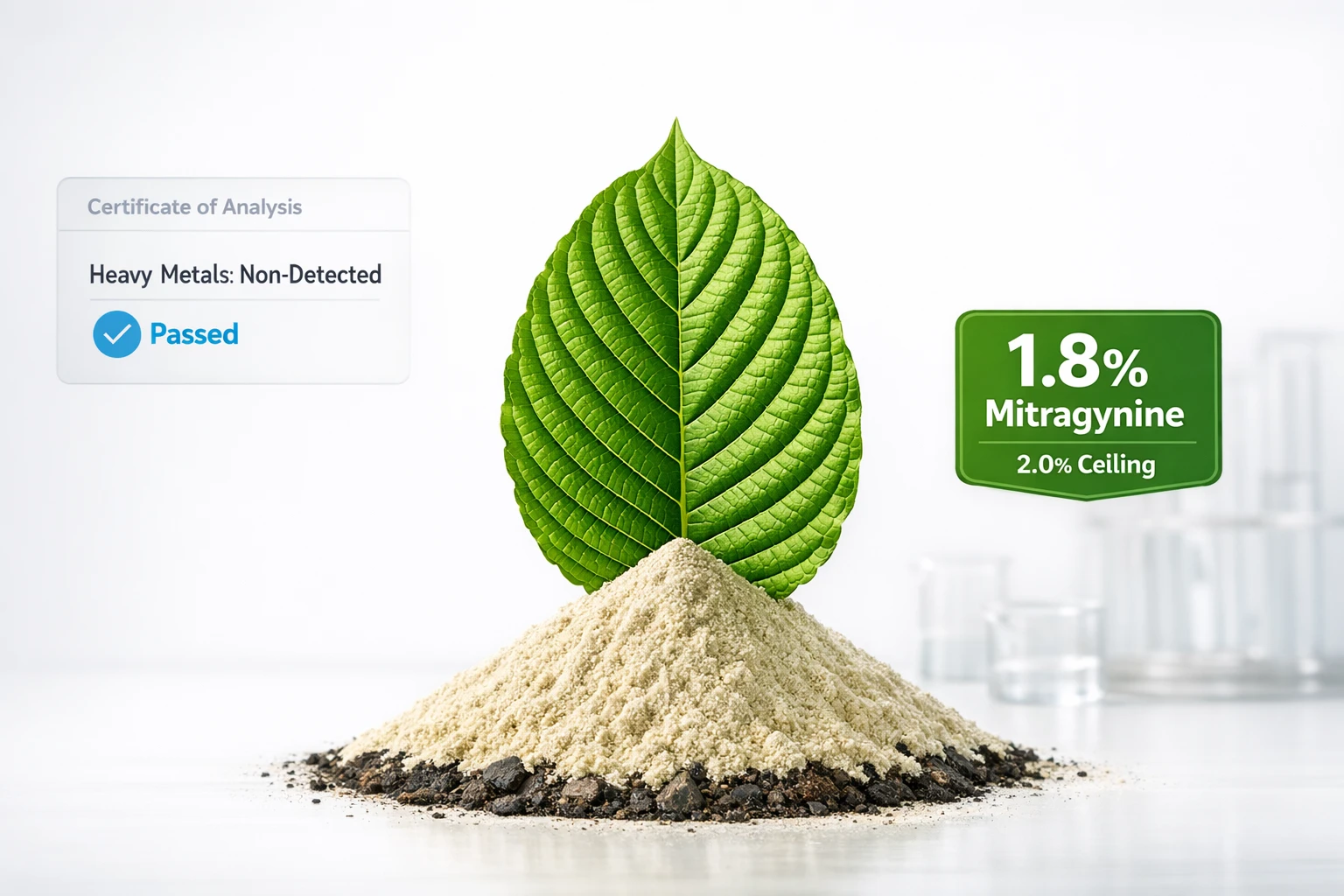
Here is the truth: Authentic, unadulterated kratom leaf rarely, if ever, exceeds a 2.0% Mitragynine ceiling. When you see numbers significantly higher than this on a raw powder, you are likely looking at either an adulterated product, a heavily manipulated lab result, or a batch spiked with a potent kratom extract powder being sold as raw leaf.
More importantly, chasing a single alkaloid misses the entire point of botanical wellness. Premium, organically grown leaves provide a full-spectrum entourage effect, where secondary alkaloids like Paynantheine and Speciogynine naturally modulate the effects, reducing the “jittery” feeling associated with synthetic or hyper-concentrated isolation.
What “Pure” Actually Means: Anatomy of a High-Quality Leaf
When evaluating what factors determine the quality of kratom, you must look directly at the soil and the anatomy of the leaf itself.
Volcanic Soil Chemistry vs. Depleted Plantations
There is a massive difference between mass-produced plantation kratom and kratom sourced from organically grown leaves. Industrial plantations often suffer from depleted soil and are located near heavy manufacturing zones. Today, the biggest contamination threat in botanicals isn’t Salmonella—it’s heavy metal accumulation. Plants grown in compromised environments absorb lead and nickel from the ground and water supply.
Conversely, our kratom is sourced directly from our own meticulously inspected and quality-controlled farm in Indonesia. Grown organically in mineral-rich volcanic soil along pristine riverbanks, these trees naturally develop the complex alkaloid profiles that make the plant so highly regarded.
The De-veining Factor: Why Pure Leaf Matters
Have you ever purchased kratom that felt gritty or caused immediate nausea? That is the result of bulk processing where the stems and veins are ground up alongside the leaf tissue.
Stems contain high amounts of insoluble fiber and very few beneficial alkaloids. Leaving them in dilutes the potency of the product and irritates the stomach. True premium standards dictate verified pure Kratom leaves with no stems. This mechanical de-veining process is what creates the ultra-fine, flour-like consistency found in top-tier powders.
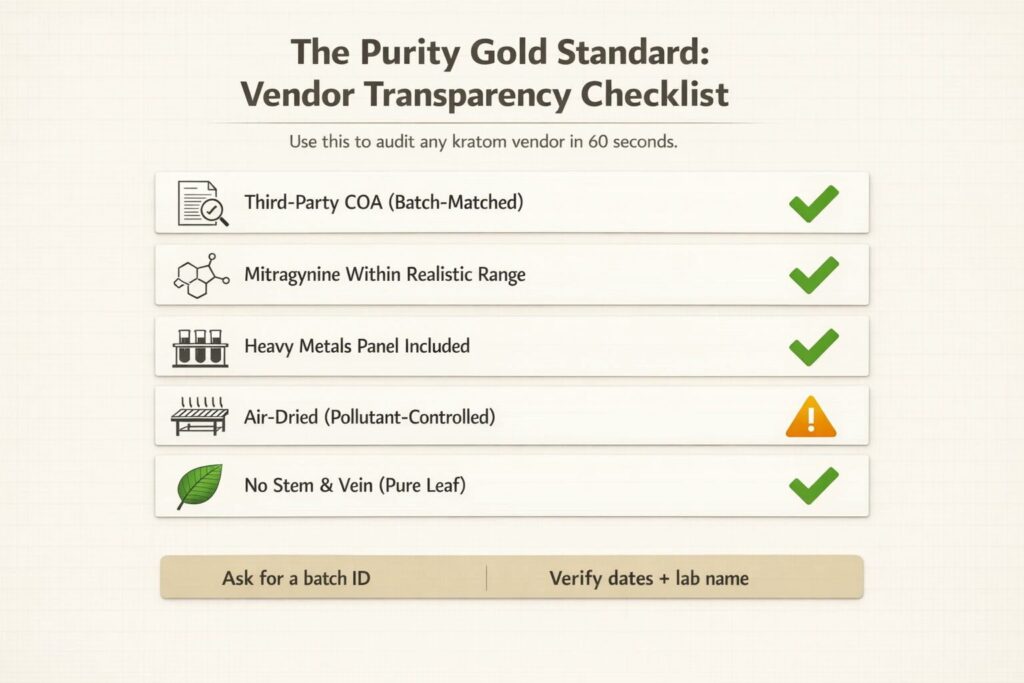
A quick 5-point audit to separate real purity standards from marketing claims—use it to compare vendors before you buy.
The Drying Disaster: How Processing Methods Dictate Purity
Perhaps the most overlooked step in kratom production is the drying process. Once harvested, the leaves must be dried to preserve their alkaloid content.
The vast majority of budget kratom is dried outdoors on large tarps. This exposes the wet leaves to bird droppings, insects, blowing dust, and even smoke from nearby agricultural fires. Other massive operations use industrial mechanical heat, which chemically degrades the fragile alkaloids.
Our standard is entirely different. Our leaves are exclusively air dried indoors in controlled environments to avoid the inclusion of pollutants. This specialized indoor air-drying prevents mold growth, eliminates environmental contamination, and preserves the vibrant green color and precise alkaloid profile of the leaf.
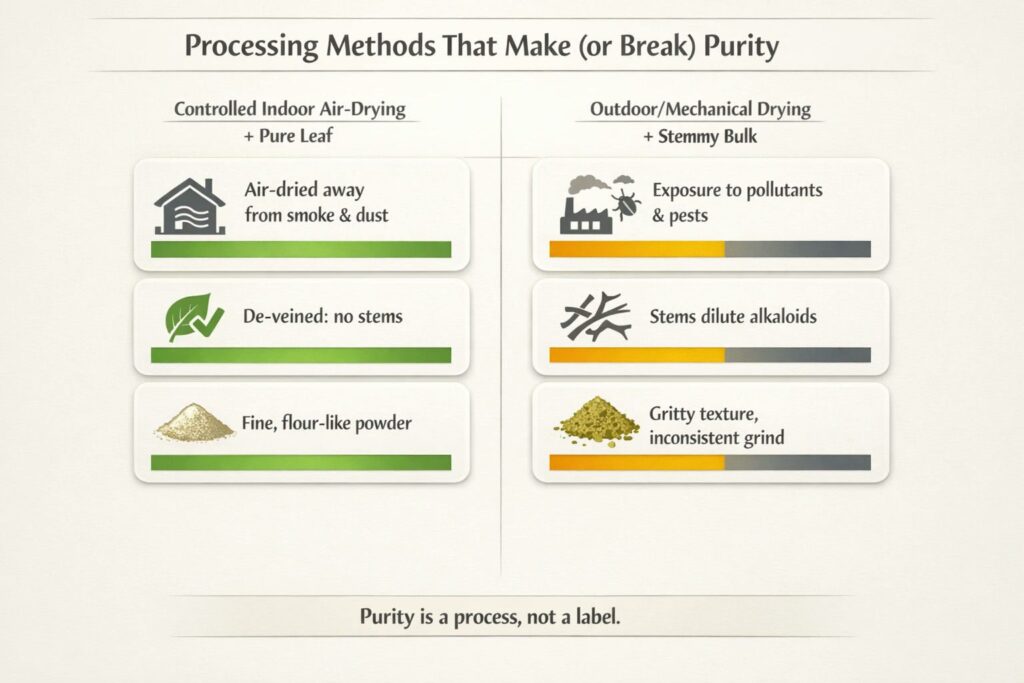
This visual shows why “air-dried” and “no stem & vein” aren’t buzzwords—they directly reduce contamination risk and improve consistency.
The Transparency Audit: Reading Lab Tests Like a Pro
Reputable sourcing means nothing without verifiable proof. You should demand transparency that traces the product from the specific farm blocks straight to your final batch. When you are looking at a Certificate of Analysis (COA), here is how to audit a vendor:
- Check the Date: A COA from three years ago does not represent the batch you are buying today.
- Look for Heavy Metals: Ensure the lab explicitly tests for Lead, Arsenic, Cadmium, and Mercury.
- Verify Alkaloid Ranges: Remember the 2.0% ceiling. If a raw leaf claims 3.5% Mitragynine, proceed with extreme caution.
- Spot Third-Party Verification: Labs should be performed by accredited, independent facilities—not in-house approximations.
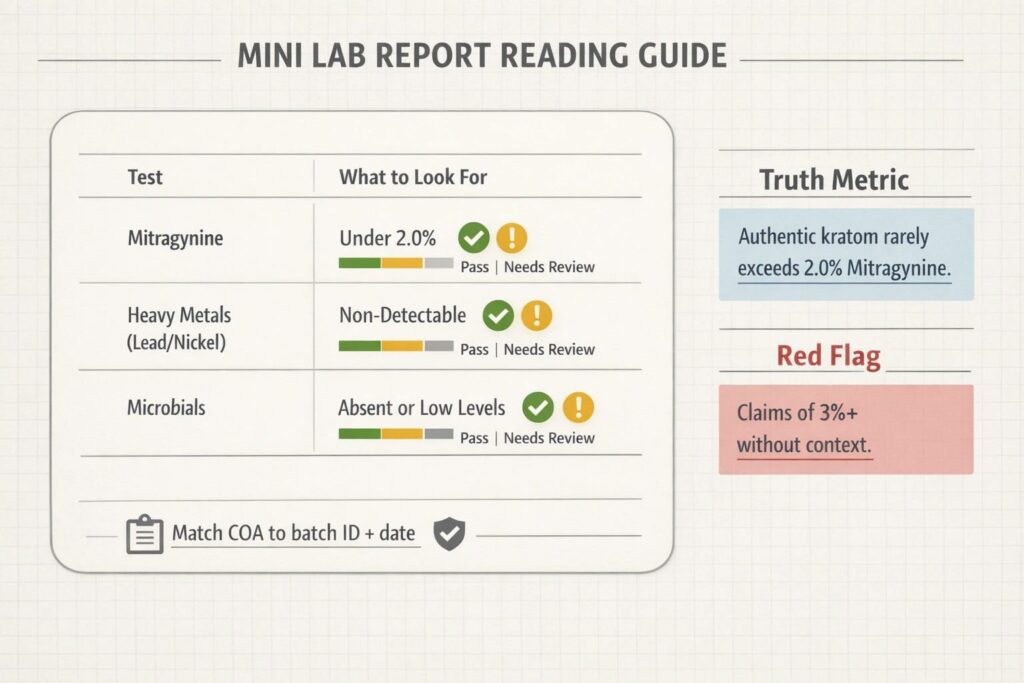
Learn to read a COA like a pro: realistic alkaloid ranges, the heavy-metals panel you should demand, and the quick red flags vendors hope you miss.
Farm-to-Bottle: Sourcing That Elevates the Experience
Whether you are comparing the deeply relaxing properties of maeng da vs bali kratom, or you’re seeking specialized products like gold maeng da kratom for sale, the foundation of your experience comes down to the supply chain.
Many companies are simply “white-labeling” bulk product bought from massive brokers. They have never seen the trees their product comes from. Kratom Online operates differently. Because our products are sourced directly from our own farm, we control the entire lifecycle. From monitoring the organic soil chemistry to the meticulous removal of stems and the clean air-drying process, every step is designed to keep the product unaltered, untouched, and uncompromised.
Frequently Asked Questions (FAQ)
Why is organically grown kratom better?
Organically grown kratom cultivated in rich, volcanic soil produces a broader spectrum of secondary alkaloids. Furthermore, organic farming methods drastically reduce the risk of heavy metal contamination and pesticide residue commonly found in industrially farmed kratom.
Does removing the stems and veins really matter?
Absolutely. Stems and veins contain high amounts of insoluble fiber and very low concentrations of active alkaloids. Mechanical de-veining creates a purer, smoother powder that is significantly less likely to cause stomach upset and nausea.
What is the advantage of indoor air-drying?
Outdoor drying exposes kratom leaves to dust, smoke, animal droppings, and mold. Industrial heat drying degrades the delicate alkaloids. Indoor air-drying is the only method that safely preserves the plant’s potency while ensuring absolutely no environmental pollutants contaminate the final product.
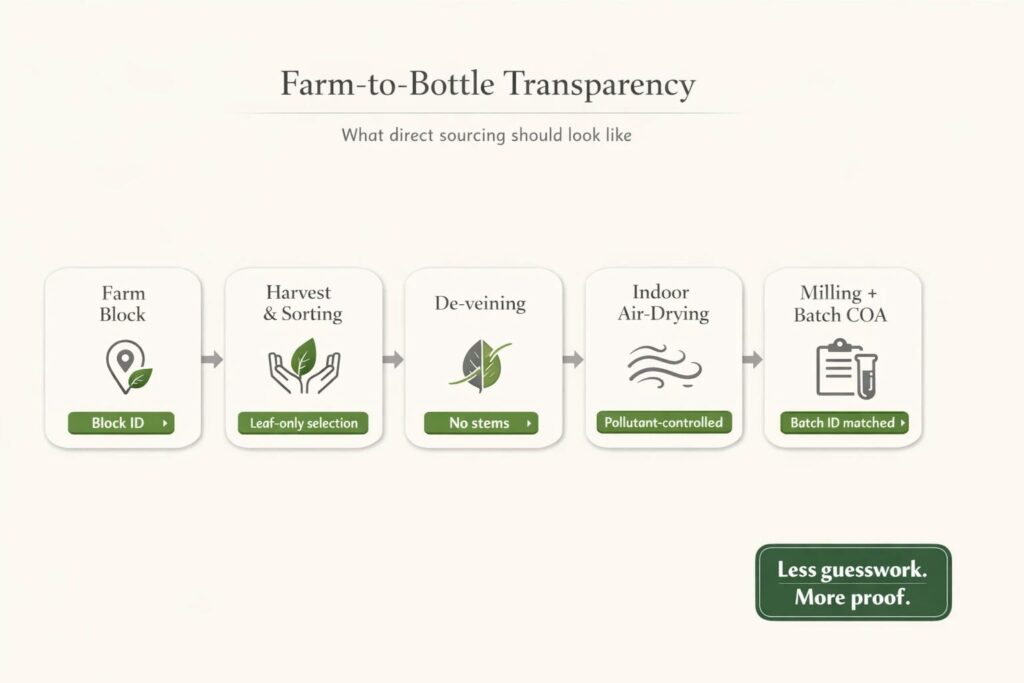
A transparent vendor can show the journey—not just a badge. This process map highlights the specific checkpoints that reduce contamination risk and prove sourcing.
Make a Confident Decision
You deserve to know exactly what goes into your botanical routine. True quality isn’t found in flashy marketing; it’s rooted in organic soil, refined through stem removal, protected by indoor air-drying, and verified through uncompromising transparency.
At Kratom Online, our commitment is simple: unaltered, uncompromised purity sourced straight from our farm to your door. Experience the difference that actual quality control makes. Explore our collection of premium kratom powders, extracts, and capsules today, and discover what a true Gold Standard feels like.