
The Truth About Kratom Strains: How Geographic Terroir Shapes Your Experience
If you’ve spent any time shopping for kratom online, you’ve likely found yourself staring at a wall of vibrant labels—Red Maeng Da, Green Bali, White Sumatra—wondering what actually differentiates them. You aren’t alone. As the kratom market matures into 2026, buyers are becoming increasingly skeptical of arbitrary marketing names and color-coded packaging that fails to deliver a consistent experience.
The reality? The primary differentiator between your favorite kratom batches isn’t just the vein color on the bag. It’s the “alkaloid terroir.”
Much like a fine wine is shaped by the soil and climate of its vineyard, the Mitragyna speciosa tree produces vastly different chemical footprints based on its geographic origin, soil composition, and environmental stressors. When you understand how alluvial riverbanks differ from volcanic soil, you stop relying on marketing fluff and start making highly targeted buying decisions.
Terroir’s Impact on Kratom Alkaloid Expression
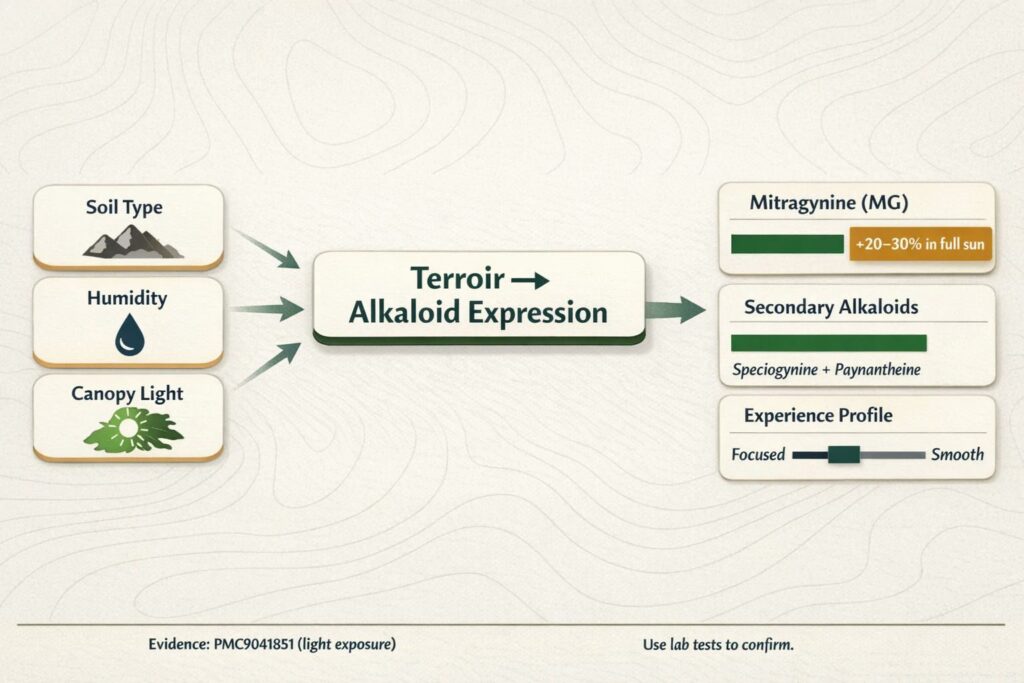
To evaluate regional kratom varietals accurately, we have to look at the environmental drivers that dictate potency.
Recent scientific literature confirms exactly what traditional Southeast Asian farmers have known for generations. For example, a benchmark study (PMC9041851) revealed that light exposure and canopy openness heavily dictate alkaloid yield. Cultivation in full sun can increase Mitragynine (MG) levels by an astonishing 20% to 30% compared to shaded, dense-canopy growth.
Furthermore, the minerals in the soil determine how the plant synthesizes secondary alkaloids. This means the debate over maeng da vs bali kratom is less about a specific “strain” and far more about where those leaves were harvested, how much UV stress they endured, and the specific drying techniques utilized post-harvest.
Here is the industry’s best-kept secret: over 96% of global kratom currently exported comes from Indonesia—specifically Kalimantan (Borneo) and Sumatra. By focusing on these distinct regional sub-sectors rather than marketing titles, you can accurately predict the “smoothness” or “sharpness” of the product you are buying.
Exploring Regional Terroir: A Digital Sommelier’s Guide
When you know what environmental factors to look for, choosing the right kratom shifts from guesswork to an exact science.
Borneo Kratom: Alluvial Soil & The Kapuas River
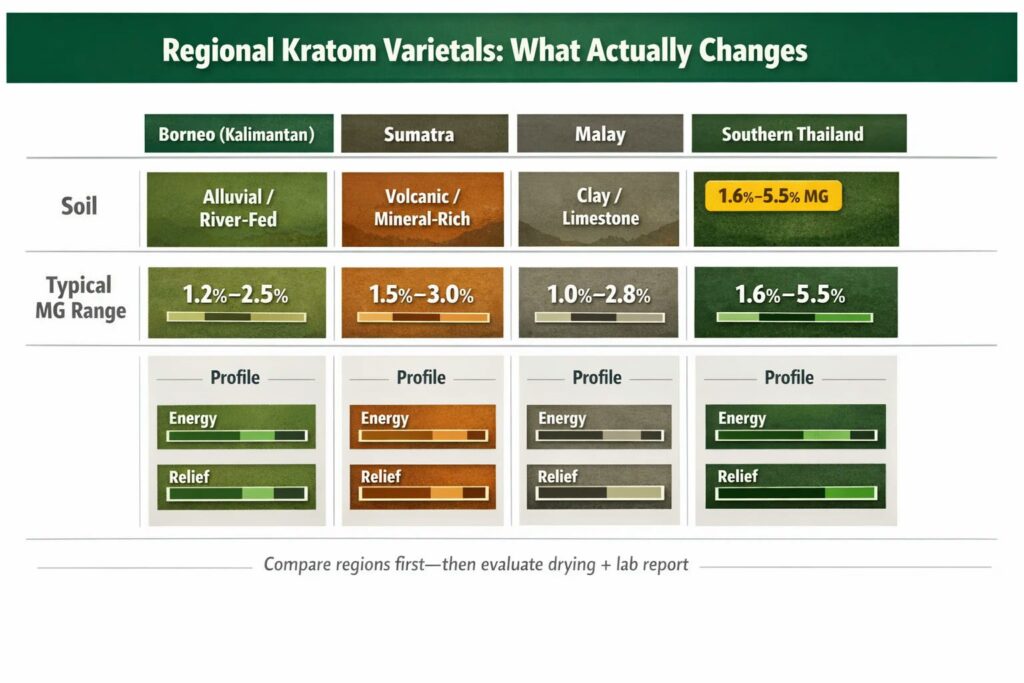
Borneo kratom is globally recognized for its well-rounded, long-lasting profile. The secret lies in the island’s vast river systems, particularly in sub-regions like Hulu Kapuas and JongKong.
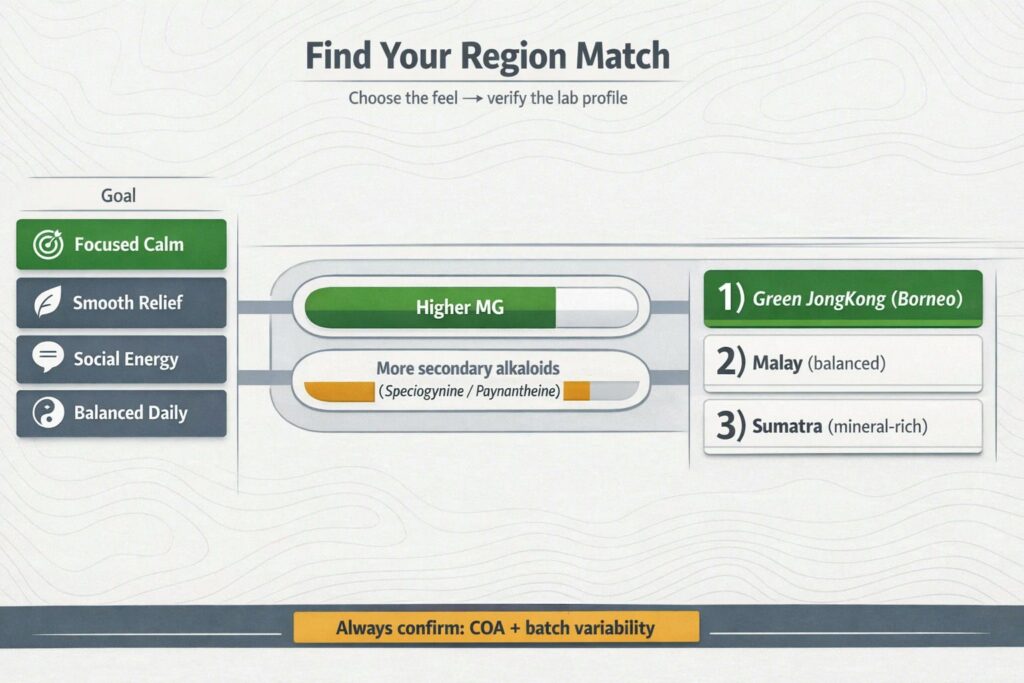
These areas feature deeply saturated, alluvial soils. The wet, nutrient-dense mud of the riverbanks creates specific environmental conditions that boost secondary alkaloid development. While Mitragynine takes the spotlight, Borneo varieties grown in these alluvial deposits express higher concentrations of Speciogynine and Paynantheine. This unique chemical fingerprint is responsible for the “smooth,” sustained characteristics that intermediate and advanced users seek out.
Sumatra Kratom: Volcanic Mineralization & Sharp Potency
Sumatran kratom tells a completely different chemical story. Particularly in the Riau Province, the soil is aggressively volcanic and mineral-rich.
This high-mineral environment, combined with intense local humidity, directly impacts the stability and conversion of 7-Hydroxymitragynine (7-OH). Kratom sourced from true Sumatran volcanic soil tends to have a “sharper,” more immediate onset. If you’ve ever noticed a distinct, earthy bite to a batch of Sumatra compared to a milder Borneo leaf, you were experiencing the difference between volcanic and alluvial terroir.
Thai Kratom: True Genetics vs. Modern Geography
Thailand has a legendary history with Mitragyna speciosa, culminating in data showing immense natural potency. Research analyzing seasonal and geographic variation in Southern Thailand (specifically Surat Thani) recorded staggering peak Mitragynine levels between 1.6% and 5.5% (PMC9966779)—vastly outperforming standard temperate or indoor-grown samples.
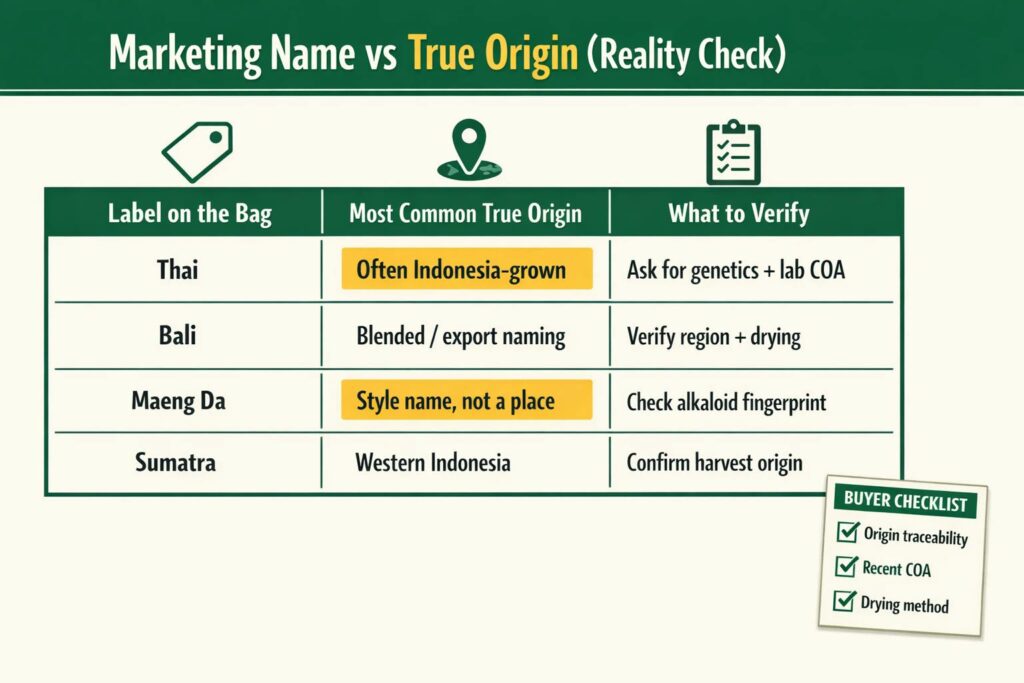
However, because over 96% of the world’s commercial kratom is exported from Indonesia, much of what is labeled “Thai” in today’s market refers to Thai genetics planted in Indonesian soil, or specific post-harvest drying techniques meant to mimic traditional Thai profiles. Knowing this helps you ask transparent vendors the right questions about direct sourcing and actual geographic origin.
Translating Alkaloid Fingerprints to Your Routine
Understanding origin terroir is only useful if it helps you secure the right product for your specific needs. Instead of relying on a generic kratom strain chart, you can now evaluate your purchases through the lens of verifiable plant science.
For example, if you are searching for a high-quality green vein kratom for focus, knowing the source makes a massive difference. You wouldn’t just look for the word “Green” on a label; you would look for a Green JongKong or Hulu Kapuas. Why? Because the alluvial soil and higher canopy openness typical of these riverbank regions yield that specific ratio of Mitragynine to Speciogynine that supports clarity without overwhelming sharpness.
FAQ: Evaluating Regional Kratom Varietals
Why does my “Bali” kratom actually come from Borneo?
Bali is not a primary cultivation region. Historically, Bali was the major shipping port where kratom left Southeast Asia, leading early importers to name the product after the port rather than the farm. Today, “Bali” usually refers to a specific blend or a fermentation and drying style applied to leaves grown in Kalimantan (Borneo).
Does vein color still matter if terroir is more important?
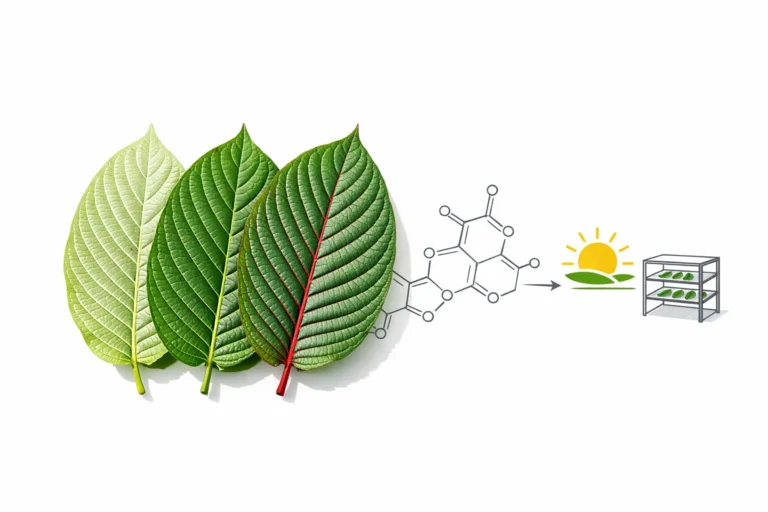
Yes, but in a different way than most think. Vein color in the commercial market is largely dictated by the post-harvest drying process. Red varieties undergo light fermentation and UV exposure (sun drying), which converts some Mitragynine to 7-OH. Whites are dried entirely indoors without light, and Greens are dried indoors before a brief stint in the sun. Think of terroir as the raw material, and vein color as the roasting process.
How can I verify the regional quality of my kratom?
You have to bypass middlemen and buy from vendors who source directly from trusted Southeast Asian farms. A reliable vendor will provide third-party Certificates of Analysis (COAs) that verify the alkaloid percentages. If a farm grows in high-quality alluvial soil but the lab report shows weak alkaloid expression, the terroir was compromised by poor handling.
Making Confident Decisions
The era of buying kratom based purely on flashy names is over. By understanding the profound impact of geography, soil mineralization, and riverbank saturation on alkaloid expression, you elevate your evaluation process from guesswork to precision.
When you prioritize transparent, direct-sourced products, you are no longer just buying a colored powder—you are choosing a verified, regional chemical profile that meets your exact standards. As you compare your options, always look for the crucial combination of stated geographic origin and the third-party lab documentation to back it up.