
The Science of Kratom Vein Colors & Plant Phenotypes
If you are currently evaluating different kratom options, you have likely run into the same simplified narrative over and over: Red is for relaxing, White is for energy, and Green is somewhere in the middle.
While that rule of thumb offers a basic starting point, it barely scratches the surface of what is actually happening at a biological level. As an informed buyer in 2026, you need more than surface-level marketing claims to make the right choice for your body. The kratom industry has evolved, and modern botanical science has revealed a fascinating reality: the effects of your kratom are dictated by a delicate interplay between the leaf’s natural maturity and the post-harvest chemistry used to cure it.
Welcome to the “Great Decoupling.” To find a product that consistently delivers the exact alkaloid profile you are looking for, we have to separate what the leaf is from what the product becomes.
Let’s dive into the botanical origins, chemical transformations, and environmental factors that define true premium kratom.
The Myth of Different Trees: Understanding Botanical Origins
The most common misconception in the kratom community is that Red, White, and Green vein kratom come from entirely different species of trees. They do not. Every commercial kratom product originates from the exact same botanical species: Mitragyna speciosa.
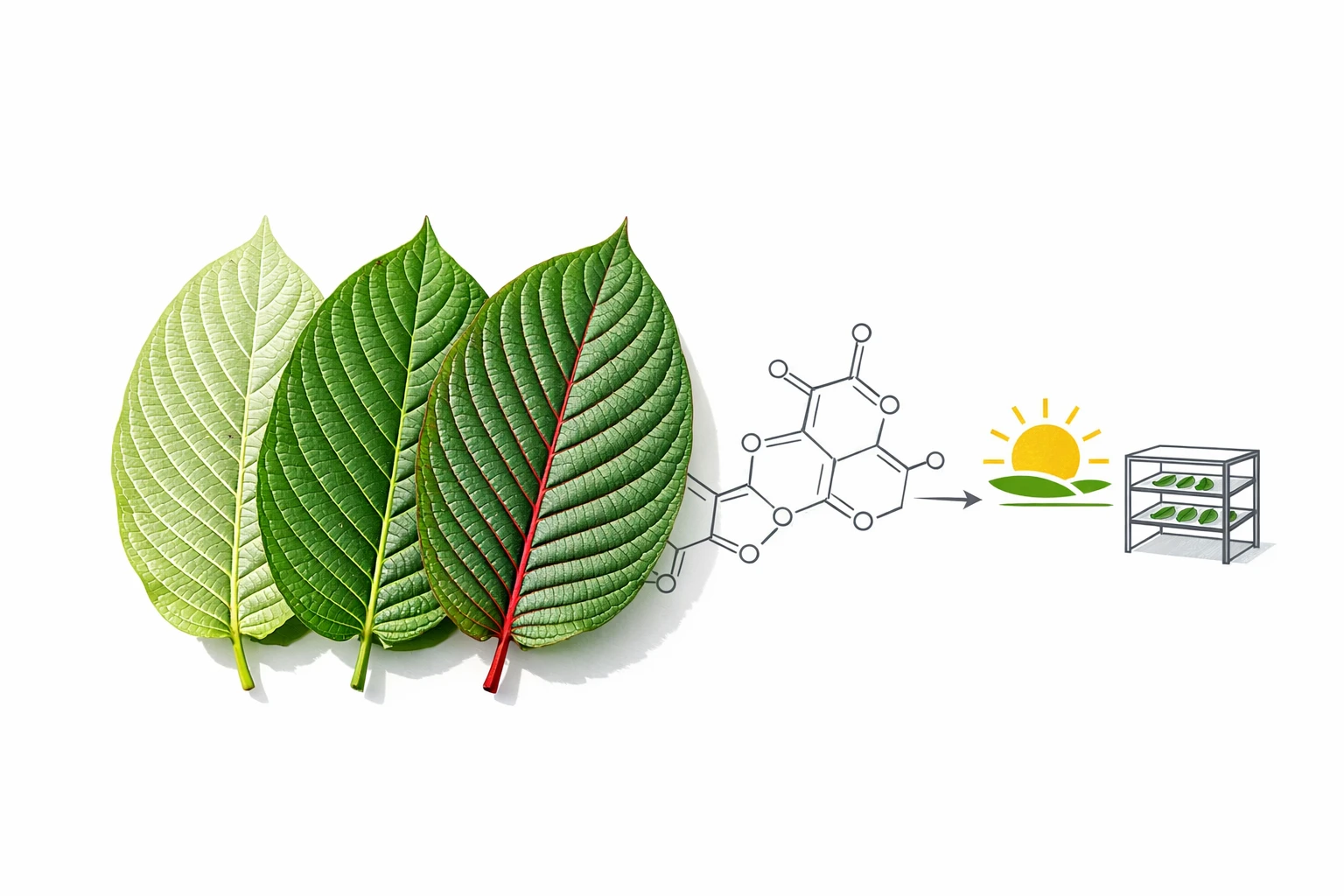
The colors you see referenced on packaging primarily indicate the biological maturity of the leaf at the time of harvest:
- White Vein (Young): Harvested early in the life cycle. The leaves are vibrant, and the central veins are pale. At this stage, the plant is aggressively producing specific defensive alkaloids.
- Green Vein (Middle): Harvested at peak photosynthetic maturity. The veins darken to a rich green, and the alkaloid profile reaches a balanced equilibrium.
- Red Vein (Mature): Harvested late in the cycle. The veins take on a reddish-brown hue, signaling peak maturity and a shift in the leaf’s natural chemical composition.
However, leaf maturity is only half of the story. If a farmer simply picked a red-veined leaf, dried it in the dark, and ground it up, it wouldn’t necessarily produce the classic “red” effects you expect. That brings us to the most critical phase of kratom production: the curing process.
Red vs Green vs White—What Actually Changes?
Think of kratom strains like coffee roasts or tobacco curing. A light roast and a dark roast can come from the exact same coffee bean; the difference in flavor and caffeine content is entirely engineered by the roaster. In kratom, the final alkaloid profile is heavily influenced by how the farmers dry and ferment the leaves after harvest.
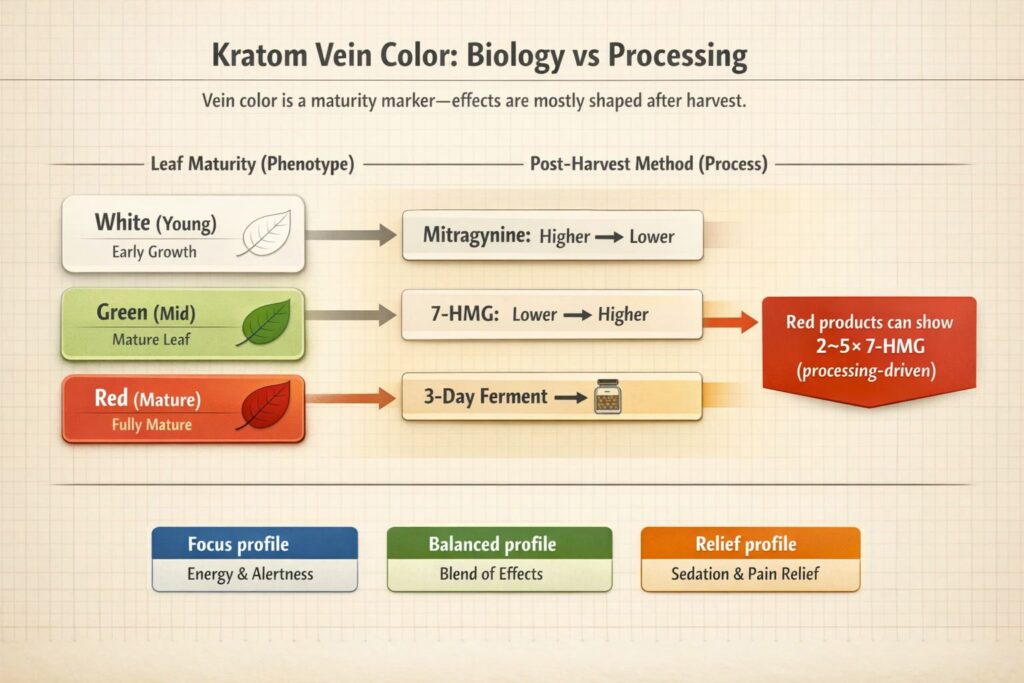
Here is how the processing maps to the effects you feel:
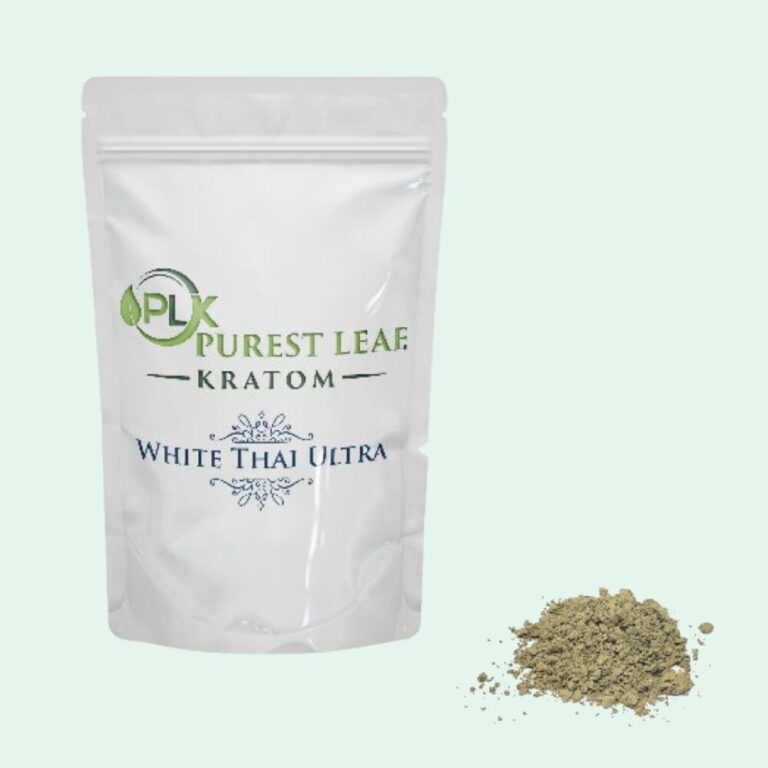
- The Focus Profile (White/Green): To preserve high levels of Mitragynine (the primary alkaloid responsible for stimulation), farmers dry young or mid-maturity leaves strictly indoors in air-conditioned or well-ventilated rooms, away from direct UV light. This prevents the alkaloids from oxidizing. If you are specifically evaluating white vein kratom for focus, you are looking for products that have undergone this strict indoor-drying protocol to keep the alkaloid profile crisp and unoxidized.
- The Relief Profile (Red/Gold): To create the classic relaxing profile of red strains, farmers use a targeted fermentation process. They take mature leaves, place them in trapped-moisture environments (like plastic bags or burlap sacks) for up to three days, and then expose them to direct sunlight. This oxidative stress physically alters the chemistry of the leaf.
If you’ve ever looked at a kratom strain chart and wondered why certain colors align with specific benefits, the answer almost always comes down to these deliberate post-harvest techniques.
The Chemistry of Color (and Curing)
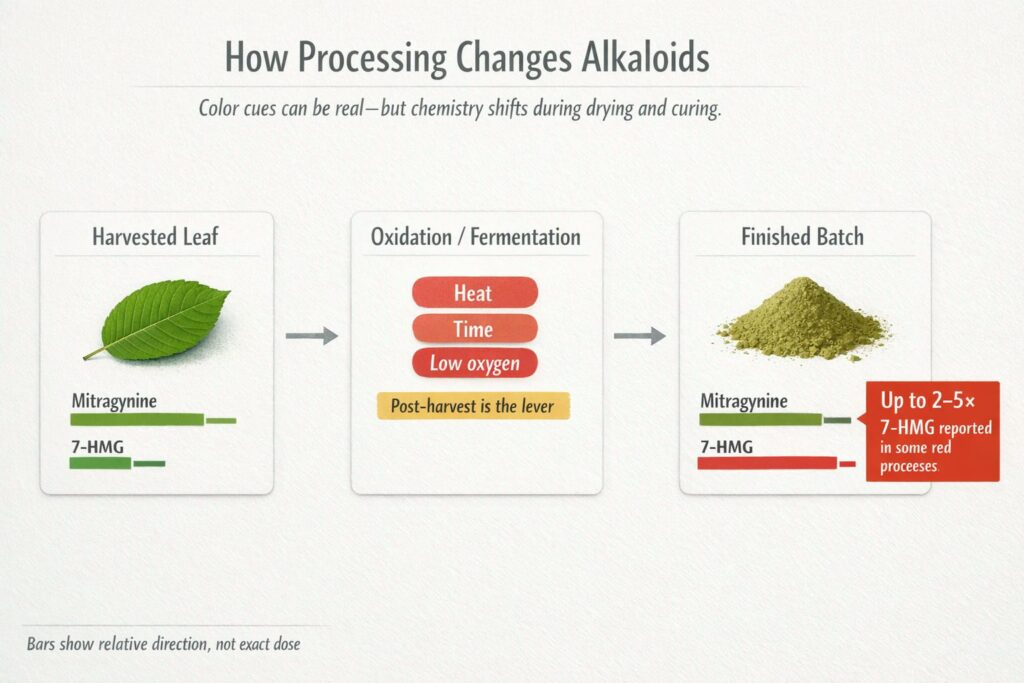
To truly understand what makes a premium product, we need to look at the chemistry of the curing process. In the cannabis industry, raw THCA must be heated (decarboxylated) to become active THC. Kratom undergoes a strikingly similar transformation.
Recent 2023 data from top-tier analytical labs like ACS Laboratory revealed that the fermentation techniques used for Red vein products actually convert standard Mitragynine into a secondary alkaloid called 7-Hydroxymitragynine (7-HMG). In fact, a heavily fermented red kratom can feature 2 to 5 times higher 7-HMG concentrations than an indoor-dried white strain.
This transformation is why paying attention to the mitragynine content in kratom powder percentage is only part of your evaluation. A lower Mitragynine percentage in a Red strain isn’t a sign of poor quality; it often means those alkaloids have been intentionally oxidized into the potent 7-HMG compounds that drive physical relief.
Beyond Mitragynine: The 44+ Alkaloid Factor
Most vendors only test for and talk about two alkaloids: Mitragynine and 7-HMG. But as of 2026, researchers have identified over 44 distinct alkaloids in the Mitragyna speciosa plant.
When you experience “jitter-free” energy or a highly well-rounded sense of calm, you are feeling the “entourage effect” of minor alkaloids like:
- Speciociliatine & Corynoxine: Known for contributing to smooth, prolonged receptor binding.
- Speciogynine & Paynantheine: These act as natural muscle-relaxing agents that smooth out the energetic properties of the primary alkaloids.
Environmental Terroir: Why Phenotypes Vary by Farm
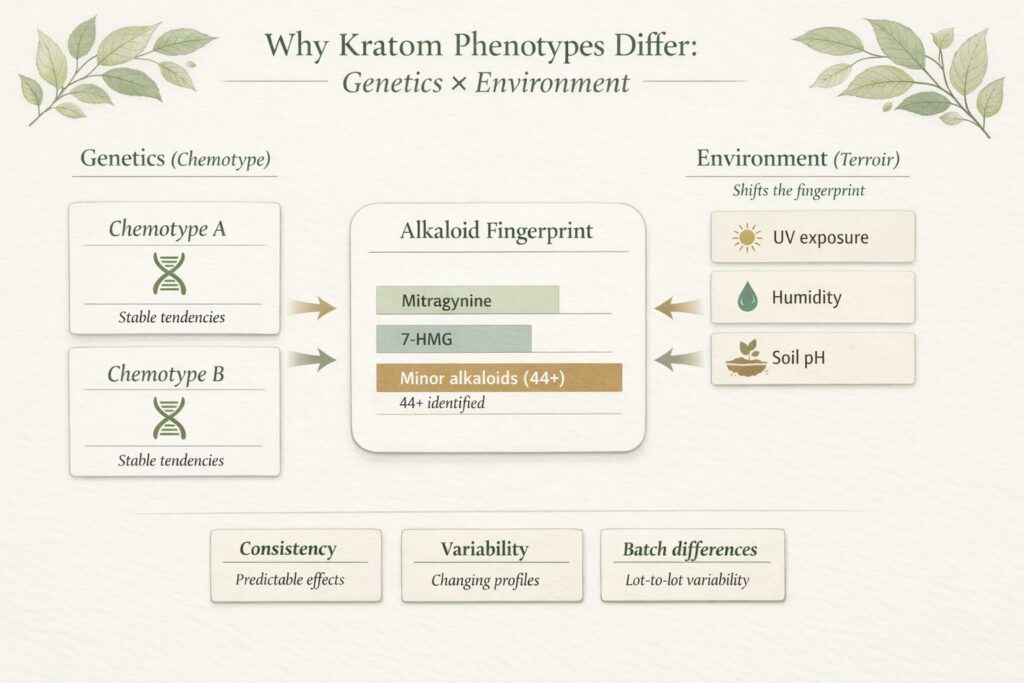
Have you ever wondered why two batches of the exact same strain from different vendors feel different? It all comes down to “Terroir”—the environmental conditions where the kratom was grown.
Just as a grape grown in France produces a fundamentally different wine than the same grape grown in California, Mitragyna speciosa is incredibly sensitive to its environment. Factors that drastically alter the minor alkaloid fingerprint include:
- Soil pH and Mineral Density: Trees grown in the mineral-rich, marshy soils of the Kapuas River in Borneo produce denser alkaloid profiles than trees grown in sandy soil.
- UV Exposure and Humidity: The dense, humid canopy of Southeast Asian jungles triggers the plant’s natural defense mechanisms, forcing it to produce higher concentrations of alkaloids.
Furthermore, landmark 2025 research published in Frontiers in Plant Science confirmed the existence of distinct regional “chemotypes.” This means the genetic blueprint of a tree from the Malaysian region naturally synthesizes alkaloids differently than a tree from a different island. This is why comparing maeng da vs bali kratom isn’t just a matter of marketing—it is often a comparison of vastly different genetic chemotypes grown in specific regional terroirs.
When a brand sources directly from specific, vetted farms rather than buying bulk from anonymous brokers, they are preserving that exact regional chemotype for you.
Lab-Testing Checklist: How to Read a COA
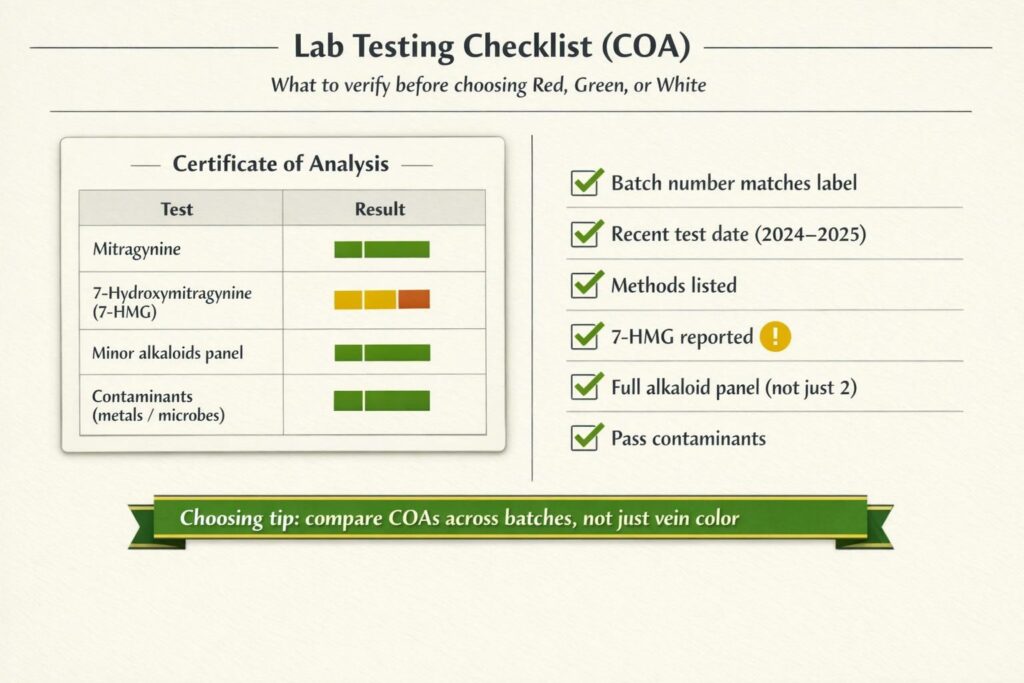
Knowing what factors determine the quality of kratom is what separates a novice buyer from an expert. The ultimate proof of a vendor’s mastery over genetics and curing lies in their Certificate of Analysis (COA).
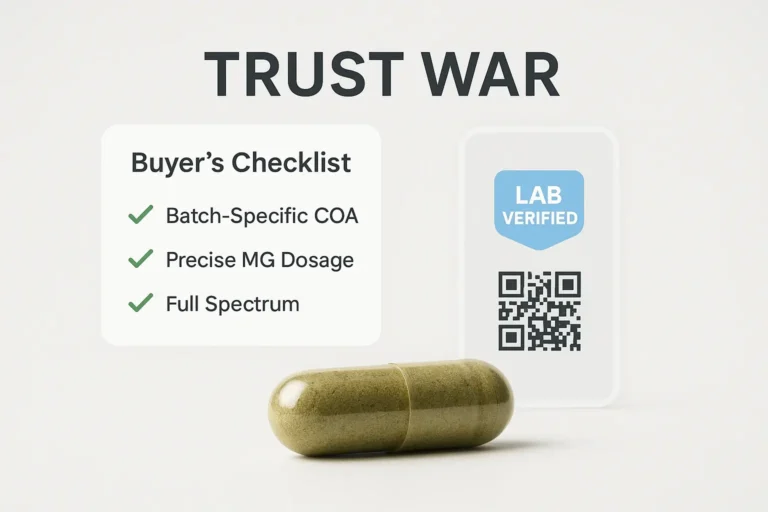
When evaluating a kratom product, don’t just look for a “Lab Tested” badge. Open the COA and check for these three things:
- The Alkaloid Ratio: Does the test show both Mitragynine and 7-Hydroxymitragynine? Remember, a higher 7-HMG level confirms a properly fermented Red/Gold strain, while high Mitragynine with near-zero 7-HMG confirms a cleanly dried White/Green strain.
- Biological Contaminants: Premium kratom is treated with advanced UV or heat-sterilization protocols to eliminate mold, yeast, and coliforms without degrading the alkaloids.
- Heavy Metals: Because kratom trees act as bio-accumulators (meaning they absorb whatever is in the soil), strict limits on lead, arsenic, and cadmium are non-negotiable.
Frequently Asked Questions (Buyer Objections)
Is vein color just a marketing myth?
No, vein color is a real biological indicator of leaf maturity. However, the effects associated with those colors are heavily engineered by post-harvest drying and fermentation processes. The color tells you how old the leaf was; the curing tells you how it will make you feel.
Why do some green vein products make me jittery while others don’t?
This comes down to the minor alkaloid profile and the farm’s environment. A green vein grown in highly specific soil with a robust spectrum of Speciogynine and Paynantheine will feel much smoother. If you experience jitters, it is often due to an unbalanced minor alkaloid profile from cheaply sourced, rushed harvests.
Are enhanced kratom powders structurally different from standard powder?
Yes. Enhanced powders start with a standard leaf (like a Green Thai) but are fortified with concentrated kratom extracts. This drastically elevates the Mitragynine percentage beyond what the plant can naturally produce, making it ideal for experienced users who require a higher threshold of active alkaloids.
Your Next Steps: Making an Informed Choice
Navigating the kratom landscape becomes significantly easier once you understand the science. You no longer have to guess what a strain name means—you now know to look at the leaf maturity, the curing process, and the lab-verified alkaloid data.
At Kratom-Online, we bypass the middlemen to work directly with trusted Southeast Asian farmers who have mastered both the cultivation of distinct chemotypes and the exact science of curing. By preserving the 44+ minor alkaloids and rigorously testing every batch, we ensure that what you see on the label matches the science in the bag.
If you are looking for clean, focused energy, explore our properly indoor-dried White and Green Vein Powders. If you require targeted physical relief, our carefully fermented Red Vein and Enhanced Powders offer the ideal, robust 7-HMG profile you need. Explore our collections today and experience the difference that transparent, scientifically-backed sourcing makes.