
Kratom Extract Safety: Responsible Use, Dosing, and Harm Reduction Guide
Moving from traditional kratom powder to concentrated extracts is a logical step for many experienced users. Extracts offer undeniable convenience, highly precise dosing, and a cleaner experience without the fibrous plant matter that can cause digestive discomfort. But with this increased potency comes a necessary shift in how you approach your routine.
As we navigate the kratom landscape in 2026, the conversation must evolve beyond vague warnings. You aren’t looking for abstinence-only advice; you need practical, harm-reduction strategies to manage your intake. If you’re currently evaluating whether the elevated strength of extracts is worth the potential risk to your tolerance, you are asking exactly the right question.
Let’s walk through a definitive, clinical-lite standard operating procedure for using concentrated kratom safely, effectively, and sustainably.
What Is Kratom Extract Safety?
Kratom extract safety refers to the responsible selection, measurement, and use of concentrated kratom products while considering factors such as alkaloid concentration, serving size, product quality, laboratory verification, and individual tolerance. Rather than focusing solely on potency, extract safety emphasizes understanding how concentrated formulations differ from traditional botanical preparations.
Safe use begins with recognizing that extracts contain concentrated alkaloids and therefore require different dosing strategies than raw powder. Consumers who understand formulation differences, standardized alkaloid reporting, and proper serving calculations are generally better equipped to compare products responsibly.
Kratom extract safety also extends beyond dosing. Manufacturing quality, Certificates of Analysis (COAs), third-party laboratory testing, and transparent product labeling all contribute to informed purchasing decisions and responsible product evaluation.
Why Extracts Require Different Safety Practices
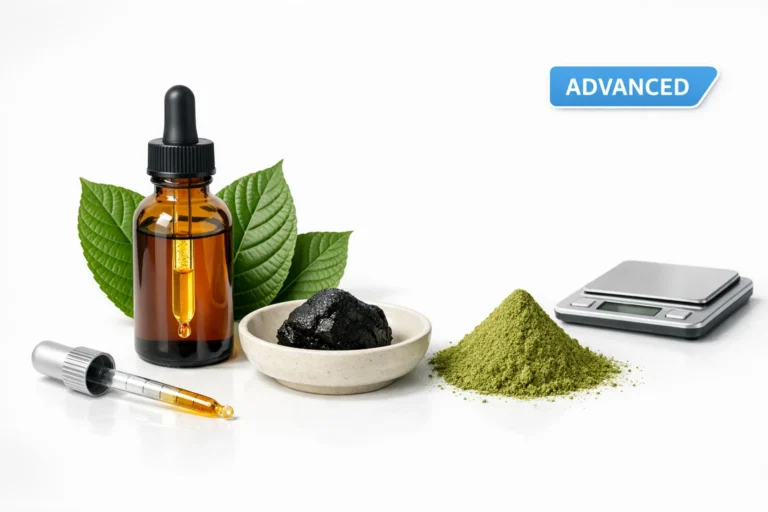
Concentrated extracts differ from traditional kratom powder because the manufacturing process increases alkaloid concentration while reducing the amount of plant material required per serving. This difference makes accurate measurement substantially more important than with conventional leaf powder.
Many standardized extracts report alkaloid concentrations in milligrams rather than grams of plant material. As a result, consumers transitioning from powder should learn to compare products using measurable alkaloid content instead of relying exclusively on familiar scoop sizes or extract ratios.
Understanding these formulation differences helps establish safer habits before concentrated products become part of a regular routine.
Understanding Responsible Kratom Use
Responsible kratom use centers on informed decision-making rather than pursuing maximum potency. This includes selecting transparent manufacturers, reviewing laboratory reports, measuring servings carefully, respecting recommended serving sizes, and allowing sufficient time before considering additional intake.
Responsible use also includes maintaining awareness of changing tolerance, monitoring individual responses to different formulations, and recognizing that concentrated extracts may not be appropriate for every consumer or every situation.
By emphasizing education, moderation, and product transparency, responsible use supports a more sustainable approach to incorporating concentrated kratom into an existing routine.
The Potency Multiplier: Converting Your Powder Dose
The biggest mistake new extract users make is treating concentrates like a slightly stronger powder. They aren’t. They are highly refined products that require calculator-style logic to dose correctly.
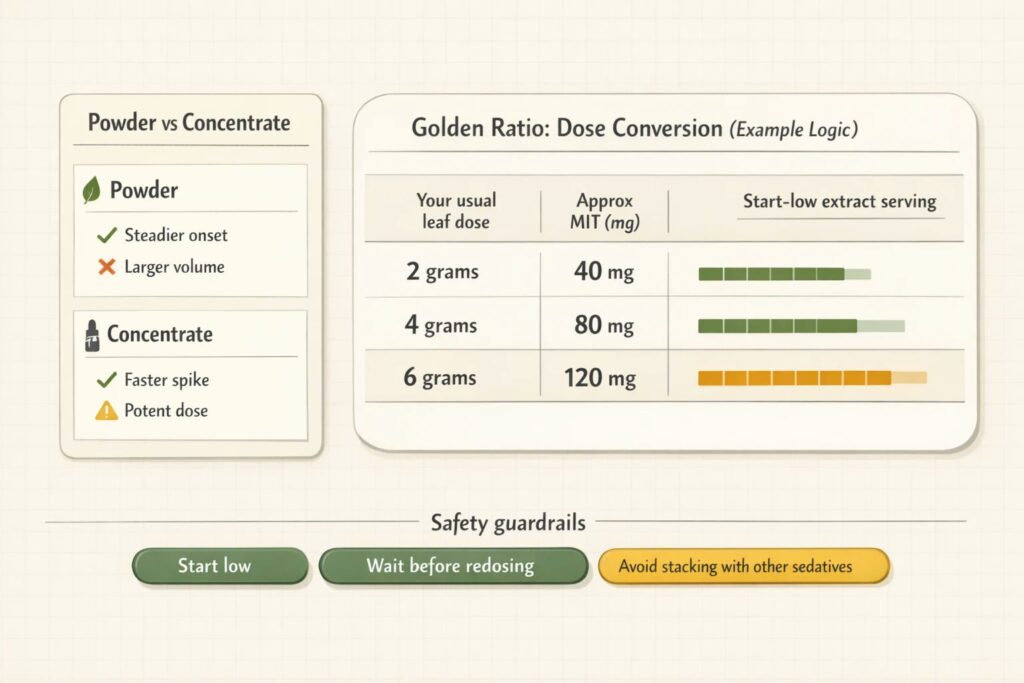
To make a safe transition, you need to understand the “Golden Ratio” of dosing conversion. Instead of measuring by grams or scoops, you must start measuring by total milligrams of Mitragynine (MIT).
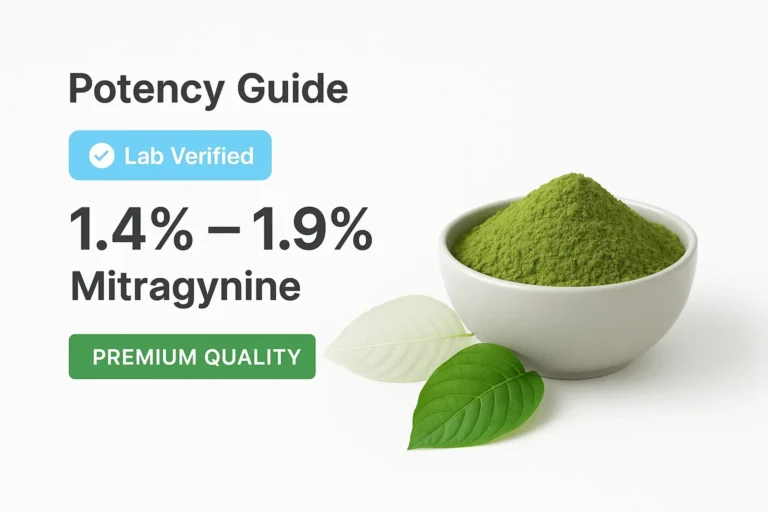
To do this accurately, you first need to understand the typical mitragynine content in kratom powder percentage, which generally hovers around 1% to 1.5% for high-quality leaf.
If your standard powder dose is 4 grams at 1.5% MIT, you are consuming roughly 60mg of Mitragynine. When you purchase an extract, your goal is to find the exact serving size that matches that 60mg target—not exceed it. Treat your established powder dose as your absolute ceiling when calculating your extract serving.
Understanding Mitragynine Content
Mitragynine is the primary alkaloid naturally present in kratom and serves as one of the most commonly reported measurements on standardized extract labels and Certificates of Analysis. Because mitragynine concentrations vary between products, understanding milligram content provides a more accurate basis for comparing serving sizes than relying solely on extract ratios.
Manufacturers that clearly disclose total mitragynine per serving provide consumers with objective information for calculating equivalent doses when transitioning from traditional powder to concentrated extracts.
Safe Dosing Principles
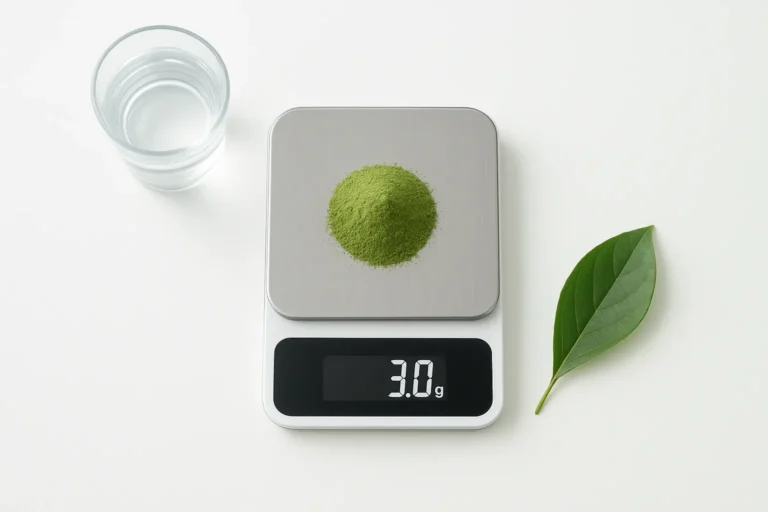
Safe dosing begins with accurate measurement. Consumers should use calibrated digital milligram scales or manufacturer-provided measuring devices rather than estimating serving sizes visually. Even small measurement errors may represent significant differences when working with concentrated formulations.
Another important principle involves avoiding rapid dose escalation. Allowing sufficient time between servings helps consumers better understand how individual products behave before considering additional intake. This measured approach supports more consistent product evaluation while reducing the likelihood of unintended overconsumption.
Metabolic Management: Understanding the 7-OH Shift
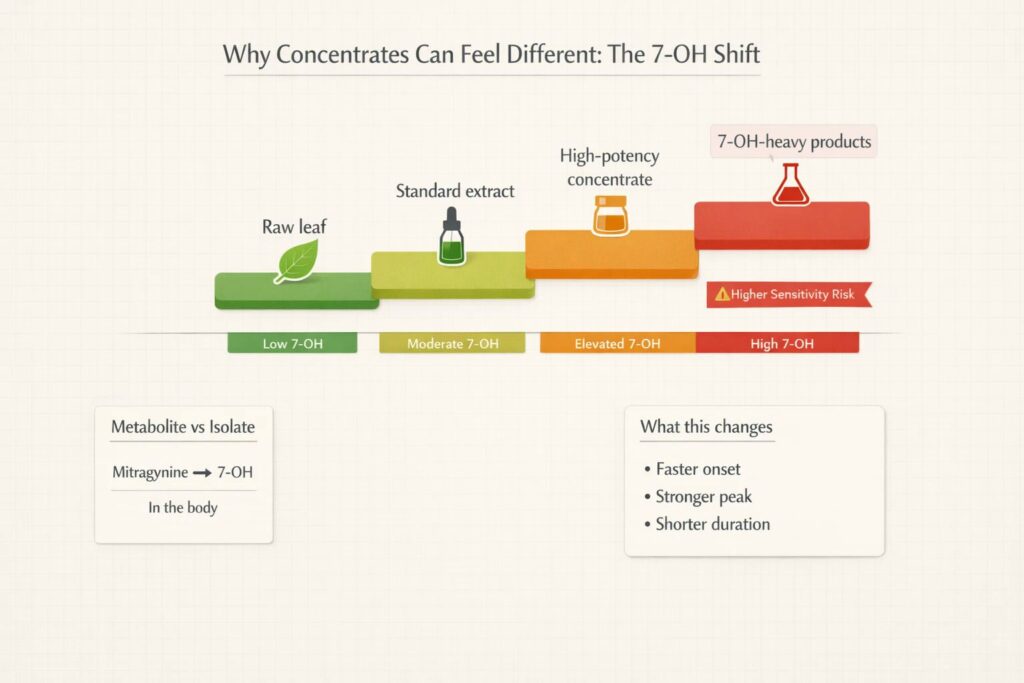
It isn’t just the sheer volume of alkaloids that makes extracts feel different—it’s the ratio.
In raw kratom leaf, the secondary alkaloid 7-Hydroxymitragynine (7-OH) is present in trace amounts, typically less than 0.1%. However, the extraction process often concentrates 7-OH to levels that fundamentally shift the pharmacology of the plant.
Recent clinical pharmacology analyses from 2024 and 2025 show that when 7-OH crosses a certain threshold, the plant’s effects mirror a “full agonist” experience rather than the “partial agonist” profile of raw leaf. This is exactly why a concentrated liquid shot or enhanced powder hits your system significantly faster but fades much sooner than traditional tea.
Understanding this metabolic shift is critical. Because extracts process faster, you might feel the urge to redose sooner than you normally would. Resist this urge. The alkaloids are still active in your system, and stacking doses is the fastest route to negative side effects.
The 21-Day Cycling Protocol: Protecting Your Receptors
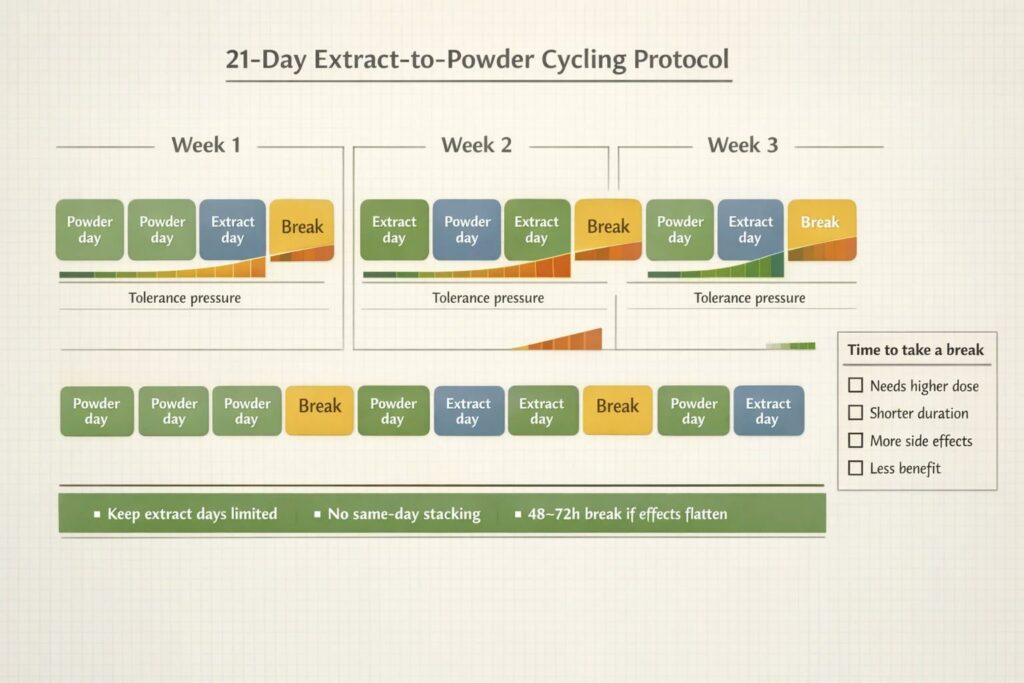
Research indicates that the high-density alkaloid spikes from liquid shots and extracts saturate your receptors much faster than fibrous leaf. If you use concentrates daily, you will rapidly encounter “Stagnant Strain Syndrome,” where the kratom seemingly stops working entirely.
To maintain efficacy, you need to implement structured “Receptor Holidays.” We recommend the 21-Day Extract-to-Powder Cycling Protocol:
- Days 1-7 (Extract Phase): Use your calculated extract dose strictly once per day. Do not redose.
- Days 8-14 (Transition Phase): Alternate days. Monday is extract, Tuesday is raw powder, Wednesday is extract, and so on. This prevents your body from adjusting strictly to the high 7-OH profile.
- Days 15-21 (Reset Phase): Return exclusively to standard raw powder, or ideally, take a 48 to 72-hour complete break.
This rotation plan ensures you get the convenience and power of extracts without destroying your baseline tolerance.
Tolerance Management Beyond Cycling
Tolerance management involves more than periodically switching between extracts and traditional powder. Maintaining consistent serving sizes, avoiding unnecessary dose escalation, allowing sufficient time between servings, and monitoring changes in product response all contribute to more sustainable long-term use.
Consumers should recognize that increasing serving sizes simply to recreate previous experiences may accelerate tolerance development. Instead, maintaining consistent measurement practices and periodically reassessing consumption habits supports a more balanced approach to concentrated products.
Understanding tolerance as a gradual biological adaptation rather than an immediate event helps consumers make more informed decisions regarding serving frequency and formulation selection.
Understanding Half-Life and Redosing
One of the most important concepts in kratom extract safety is recognizing that noticeable effects and biological elimination are not identical processes. Although consumers may no longer perceive the primary effects of a serving, alkaloids may still be present within the body as they continue through normal metabolic pathways.
For this reason, immediately taking another serving simply because noticeable effects have diminished may result in unintended cumulative exposure. Allowing adequate time before considering additional servings supports more consistent product evaluation while helping reduce unnecessary overconsumption.
Understanding this distinction encourages consumers to make decisions based on responsible serving practices rather than subjective perceptions alone.
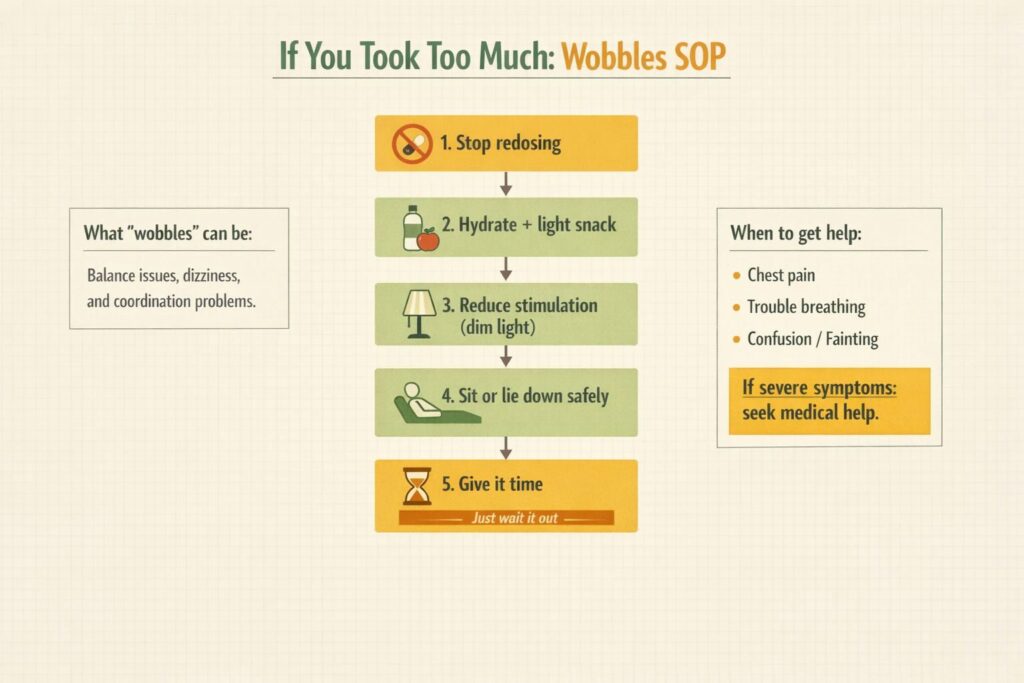
Emergency Protocol: Managing Overconsumption and “The Wobbles”
Even the most careful users can occasionally misjudge a dose. In the kratom community, overconsumption usually leads to a highly specific set of side effects affectionately but frustratingly known as “the wobbles.” Symptoms include nausea, dizziness, a lack of motor coordination, and difficulty focusing your eyes.
Why does this happen? User-reported data and emerging medical literature point to vestibular (inner ear) sensitivity. When you overload your system with concentrated alkaloids, it temporarily interferes with your motor coordination centers.
If you find yourself in this situation, do not panic. Follow this step-by-step mitigation protocol:
- Hydration is paramount: Drink a large glass of water immediately, ideally with an electrolyte packet. Kratom acts as a diuretic, and severe dehydration amplifies vestibular dizziness.
- Sensory reduction: The wobbles are heavily tied to eye-tracking and inner-ear balance. Lie down in a dark, quiet room and close your eyes. Removing visual stimuli calms the vestibular nerve.
- Time and digestion: If you realize you’ve taken too much within the first 30 minutes, a light snack (like crackers or toast) can slow digestion. Otherwise, simply give it time. The peak of the wobbles typically passes within 90 to 120 minutes.
Recognizing Signs of Overconsumption
Overconsumption may present differently among individuals, but commonly reported symptoms include nausea, dizziness, sweating, difficulty focusing, reduced coordination, eye discomfort, and feelings of imbalance commonly referred to as “the wobbles.” These symptoms generally reflect that the serving exceeded the individual’s comfortable level rather than indicating that additional product should be consumed.
Learning to recognize these early warning signs encourages consumers to pause, recover, and avoid unnecessary redosing. Keeping personal notes regarding serving sizes and product responses may also help identify consistent patterns over time.
Hydration and Recovery Strategies
Hydration plays an important role in overall wellbeing and may become especially valuable when recovering from uncomfortable experiences associated with concentrated products. Drinking water, replenishing electrolytes when appropriate, consuming light food if tolerated, and resting in a calm environment may help support recovery while allowing time for normal metabolic processes to continue.
Recovery strategies should focus on patience rather than attempting to offset discomfort through additional servings or unnecessary experimentation. Allowing the body adequate time to recover supports a more responsible approach to kratom extract safety.
Common Mistakes with Kratom Extracts
Many avoidable problems result from simple measurement or decision-making errors rather than product defects. Common examples include estimating serving sizes without a milligram scale, rapidly increasing doses, stacking multiple servings before previous alkaloids have been metabolized, switching between products without recalculating alkaloid content, or overlooking laboratory documentation when purchasing concentrated extracts.
Avoiding these common mistakes helps consumers develop more consistent routines while reducing unnecessary variability in serving calculations and product evaluation.
The Trust Filter: Vetting Your Kratom Concentrates
When you decide to add concentrates to your wellness routine, vendor selection becomes a matter of health and safety. Because the extraction process is highly technical, the margin for error is steep.
When you are evaluating a potent kratom extract powder or liquid shot, run the vendor through this three-question trust filter:
- Do they offer alkaloid transparency? The label must explicitly state the total milligrams of Mitragynine and 7-Hydroxymitragynine per serving. “Proprietary blends” are a major red flag in 2026.
- Are they using clean extraction methods? Look for solvent-free, water-based, or food-grade CO2 extraction processes. You do not want residual chemical solvents in your concentrated products.
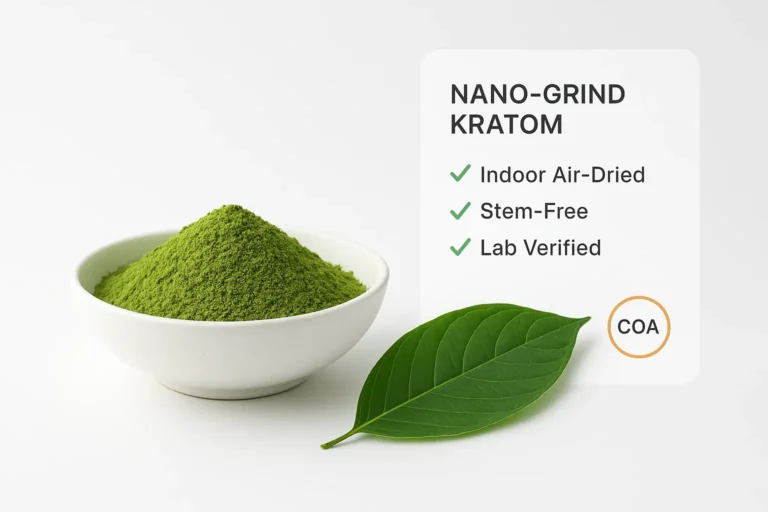
- Is the batch explicitly lab-tested? A trustworthy brand relies on current, batch-specific Certificates of Analysis (COAs) from independent third-party labs to prove purity and potency.
Product Safety Matters
Product safety extends beyond potency. Manufacturing quality, raw material sourcing, extraction techniques, batch consistency, contaminant screening, and laboratory verification all contribute to the overall quality of concentrated kratom products.
Consumers evaluating kratom extract safety should prioritize manufacturers that provide comprehensive Certificates of Analysis covering alkaloid concentrations, heavy metals, microbial testing, and residual solvent analysis where appropriate. Together, these quality assurance measures create a stronger foundation for informed purchasing decisions.
Choosing Safe Kratom Extracts
Choosing a concentrated extract involves evaluating both the product and the manufacturer. Standardized alkaloid reporting, transparent ingredient labeling, publicly available laboratory reports, batch traceability, and clearly identified extraction methods all support more informed product comparisons.
Products that provide complete analytical documentation allow consumers to compare formulations using objective laboratory data instead of generalized extract ratios or promotional terminology. This transparency aligns closely with modern harm-reduction principles and responsible product selection.
Who Should Use Extra Caution with Concentrated Extracts?
Concentrated kratom extracts may not represent the most appropriate starting point for every consumer. Individuals unfamiliar with standardized alkaloid concentrations, consumers transitioning directly from traditional powder, or anyone uncertain about serving calculations should approach concentrated formulations carefully and prioritize accurate measurement.
Because individual responses vary based on physiology, product formulation, and previous experience, understanding personal tolerance and carefully reviewing product labeling remain important components of responsible extract safety.
Frequently Asked Questions
Is it safe to take kratom extracts every day?
We highly advise against daily extract use. Because extracts saturate your receptors rapidly, daily use leads to fast tolerance buildup. Following a protocol like the 21-Day Cycle mentioned above is the best way to enjoy extracts responsibly while preserving their efficacy.
How do I measure a powdered extract safely?
Never eyeball a powdered extract. Because some enhanced powders can be 10 to 50 times stronger than standard leaf, you must use a digital milligram scale. Start by calculating your standard Mitragynine intake in milligrams, and weigh out the exact equivalent in extract powder.
Why do extracts make me feel jittery when traditional tea doesn’t?
This is usually due to the 7-OH shift and the rapid onset of liquid or highly refined powder concentrates. They hit your bloodstream much faster than fibrous plant material. If you experience jitters, you have likely taken too much. Cut your dose by 30% during your next serving.
Can I mix extracts with raw powder?
Yes, and this is actually a preferred harm-reduction strategy for many. By taking a smaller dose of raw powder and a fraction of an extract dose, you get the robust, full-spectrum alkaloid profile of the whole leaf alongside the targeted boost of the extract.
Making Confident Choices
At Kratom-Online, we believe that education is the ultimate harm-reduction tool. By sourcing directly from trusted Southeast Asian farms and prioritizing complete product transparency, our goal is to take the guesswork out of your routine.
Concentrated kratom is a powerful, effective tool when respected. By calculating your exact milligram doses, understanding the pharmacology behind the products, and implementing strict cycling breaks, you can safely elevate your kratom experience without compromising your long-term tolerance.