
Kratom Extract Lab Tests: How to Read COAs, Verify Purity, and Evaluate Safety
The high-potency kratom market in 2026 is currently navigating a significant trust crisis. As concentrates and liquid shots dominate the shelves, an unsettling reality has emerged: a simple “lab tested” badge is no longer enough to guarantee safety.
While raw leaf powder has well-established testing norms, extracts are under intense regulatory and consumer scrutiny. Between synthetic 7-Hydroxymitragynine (7-OH) enrichment and undisclosed residual solvents, advanced users are realizing that reading a Certificate of Analysis (CoA) for an extract requires an entirely different skill set than checking a powder report.
If you are evaluating high-potency options, you need more than a generic “passed” checkmark. You need to know how to interpret complex lab reports, spot synthetic additives, and calculate real-world exposure limits. Let’s break down the exact quality assurance frameworks you should use to evaluate your next kratom extract purchase.
What Are Kratom Extract Lab Tests?
Kratom extract lab tests are analytical laboratory procedures designed to evaluate the chemical composition, purity, safety, and consistency of concentrated kratom products. These tests measure alkaloid concentrations while simultaneously screening for contaminants that may arise from cultivation, harvesting, manufacturing, extraction, or packaging processes.
Unlike raw botanical materials, concentrated extracts require broader analytical evaluation because the extraction process itself introduces additional quality considerations. Depending on the manufacturing method, laboratories may assess heavy metals, microbial contamination, residual solvents, alkaloid profiles, moisture content, and product identity to ensure the finished extract meets established quality specifications.
For consumers, kratom extract lab tests provide measurable evidence that supports informed purchasing decisions by verifying product quality through independent scientific analysis rather than promotional descriptions.
Why Laboratory Testing Matters for Kratom Extracts
Laboratory testing serves as the foundation of quality assurance for modern kratom extracts. Because concentration increases the relative amount of naturally occurring alkaloids, it can also increase the concentration of unwanted contaminants if proper sourcing and manufacturing controls are not maintained.
Independent testing helps verify that extraction processes have been properly performed, contaminants remain within acceptable analytical limits, and alkaloid concentrations accurately reflect product labeling. This transparency benefits consumers by creating a measurable standard for evaluating competing products.
Rather than viewing laboratory reports as marketing materials, experienced consumers increasingly recognize them as technical documents that demonstrate manufacturing quality, analytical accuracy, and commitment to product consistency.
Why Extract CoAs Can’t Be Read Like Leaf Powder CoAs
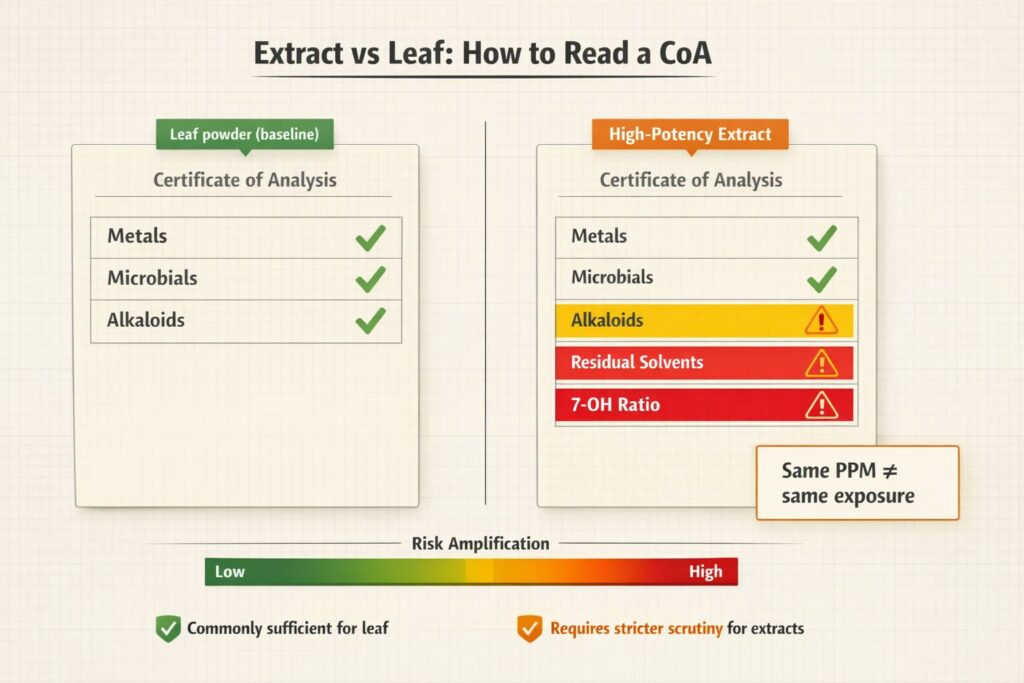
When analyzing kratom powder vs extract options, the fundamental chemistry—and therefore the testing requirements—completely shift.
A standard leaf CoA looks at raw plant material. It measures naturally occurring alkaloids and checks for ground-level contaminants like E. coli or salmonella. However, the extraction process fundamentally changes the product’s structure. When you concentrate the desirable alkaloids, you also risk exponentially concentrating any heavy metals present in the raw leaf. Furthermore, the extraction process itself introduces new variables, primarily the chemical solvents used to strip the alkaloids from the plant fiber.
You cannot read a 50x extract report through the lens of a raw leaf report. An extract CoA must feature an expanded testing panel that accounts for concentrated heavy metals, extraction solvent residues, and specific alkaloid ratios to verify the product hasn’t been synthetically altered.
What Is a Certificate of Analysis (COA)?
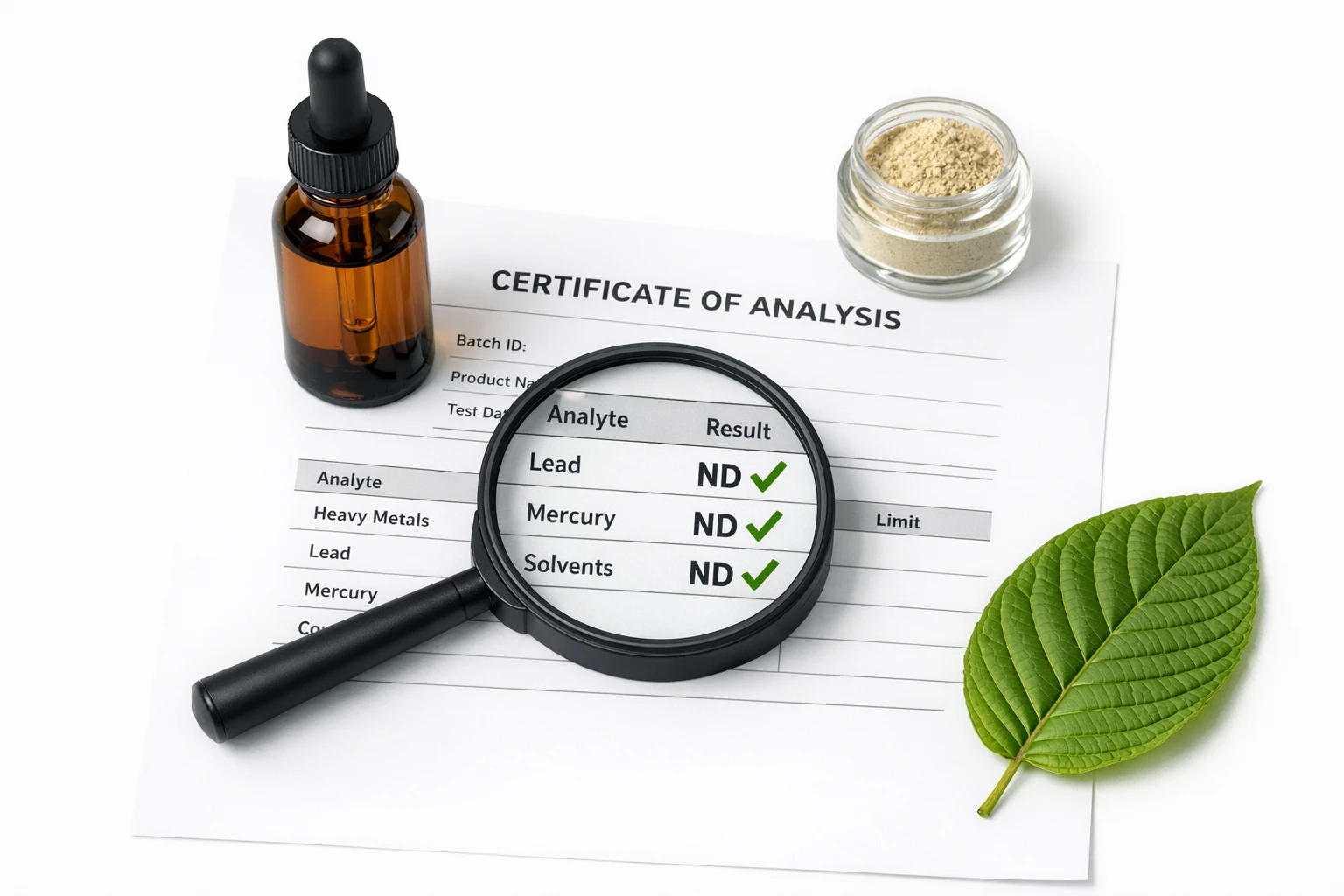
A Certificate of Analysis (COA) is an official laboratory document summarizing the analytical results for a specific production batch. Rather than functioning as a marketing brochure, a COA provides measurable laboratory data generated through standardized testing procedures performed by qualified analytical laboratories.
A complete COA typically includes the product name, batch or lot number, testing laboratory, analytical methods, testing dates, sample identification, and individual laboratory results for each parameter examined. Depending on the manufacturer, reports may also include laboratory accreditation information and analyst verification.
Understanding how to interpret a COA allows consumers to independently evaluate kratom extract lab tests rather than relying exclusively on simplified “Pass” graphics or promotional statements.
How Third-Party Laboratory Testing Works
Independent third-party laboratories analyze product samples using validated analytical methods that are separate from the manufacturer’s own quality control process. This separation helps reduce conflicts of interest by allowing an independent organization to verify product composition objectively.
Laboratory scientists evaluate submitted samples using specialized analytical equipment capable of measuring alkaloid concentrations, detecting contaminants, identifying microbial organisms, and quantifying trace compounds at extremely low concentrations. Upon completion, the laboratory issues a Certificate of Analysis documenting the results for that specific production batch.
Third-party verification has become one of the strongest indicators of manufacturing transparency because it provides consumers with independently generated analytical data rather than internally produced quality claims.
Understanding Batch Testing and Traceability
Quality assurance extends beyond a single laboratory report. Reliable manufacturers perform batch-specific testing so that each production lot receives independent verification before distribution.
Batch numbers allow consumers to connect the product they purchase with the exact laboratory report generated for that manufacturing run. This traceability supports product consistency while allowing manufacturers to investigate quality concerns should they arise.
When reviewing kratom extract lab tests, consumers should confirm that the batch number printed on the product packaging matches the Certificate of Analysis provided by the manufacturer. This simple verification step strengthens confidence that the published laboratory results correspond to the purchased product.
The Safety Verification Panel: Heavy Metals and Microbials
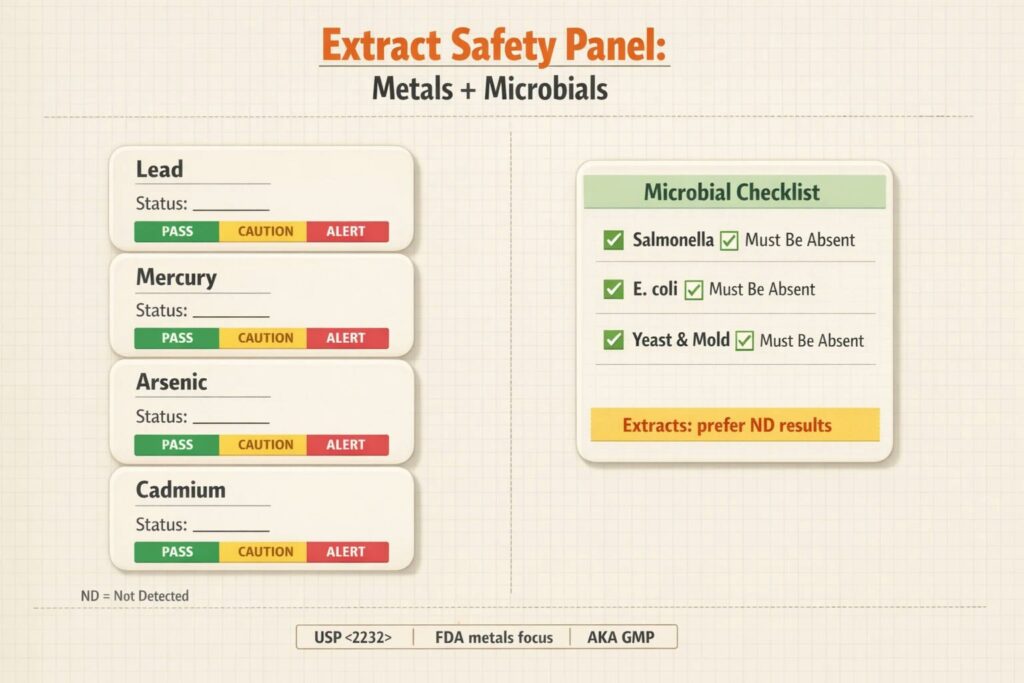
When assessing what factors determine the quality of kratom, heavy metal testing is universally recognized as the most critical safety metric. However, the way we calculate risk changes dramatically with high-potency products.
According to FDA findings and industry-standard labs, acceptable heavy metal thresholds for raw leaf generally sit at <1.2 PPM (Parts Per Million) for Lead and <0.41 PPM for Mercury. In raw leaf, these numbers are acceptable because the volume of powder you consume keeps you well under the daily limit.
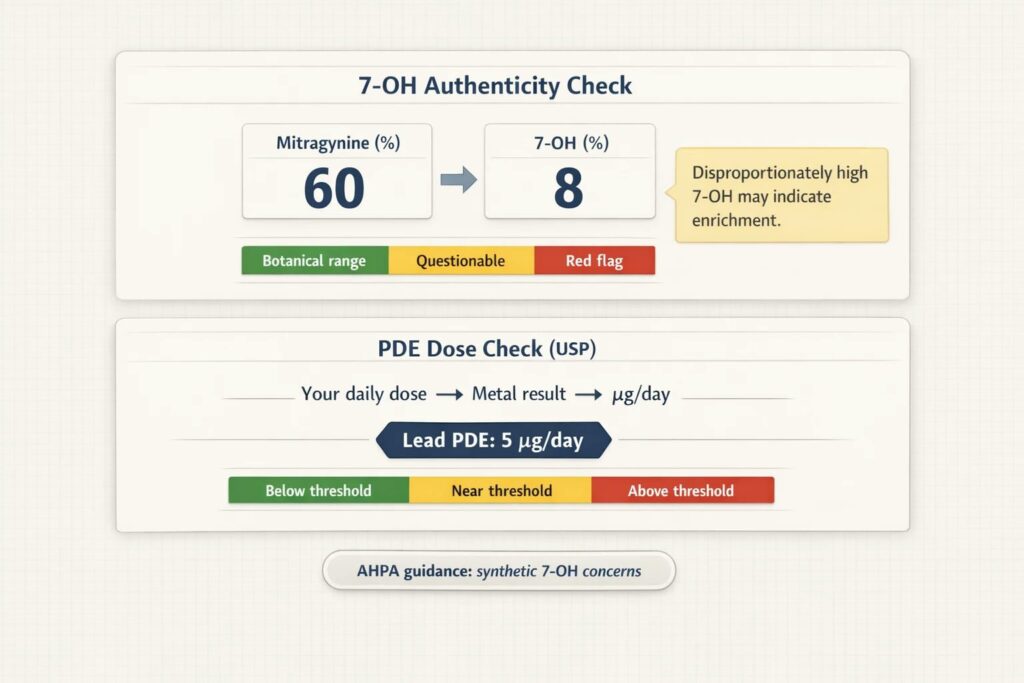
But with extracts, we must look at the Permissible Daily Exposure (PDE). The U.S. Pharmacopeia (USP) guidelines state that lead exposure should not exceed 5 µg/day. If an extract shows 1.0 PPM of lead, that might look like a “Pass” based on leaf standards. But because it’s a concentrated dose, consuming just a few grams or milliliters could push you past the safe daily limit.
For high-potency extracts, you want to see “ND” (Not Detected) on heavy metal panels. If trace amounts are present, the vendor should provide clear dosing guidelines that ensure your total daily intake stays well below the 5 µg/day PDE threshold. Reputable brands are transparent about this math, while less credible vendors hide behind generic “Pass” graphics without explaining the concentration risk.
Heavy Metal Testing Explained
Heavy metal testing measures trace concentrations of naturally occurring elements that may accumulate within botanical materials from soil, water, or environmental exposure. Although these elements occur naturally, analytical testing helps ensure that concentrations remain within accepted quality limits.
Lead, arsenic, cadmium, and mercury receive particular attention because they are the metals most commonly evaluated during botanical quality assurance programs. Modern analytical laboratories utilize highly sensitive instrumentation capable of detecting these elements at extremely low concentrations, supporting more accurate safety evaluations for concentrated extracts.
Microbial Testing Explained
Microbial analysis evaluates whether finished kratom extracts contain microorganisms that could indicate contamination during cultivation, processing, manufacturing, or storage. Depending on the analytical panel, laboratories may screen for Salmonella, E. coli, yeast, mold, total aerobic microbial counts, and additional microbiological indicators.
Successful microbial testing demonstrates that appropriate manufacturing controls, sanitation procedures, and storage practices have been maintained throughout production. For consumers evaluating kratom extract lab tests, microbial analysis represents another important indicator of overall product quality and manufacturing reliability.
The Solvent Gap: Residual Solvent Testing
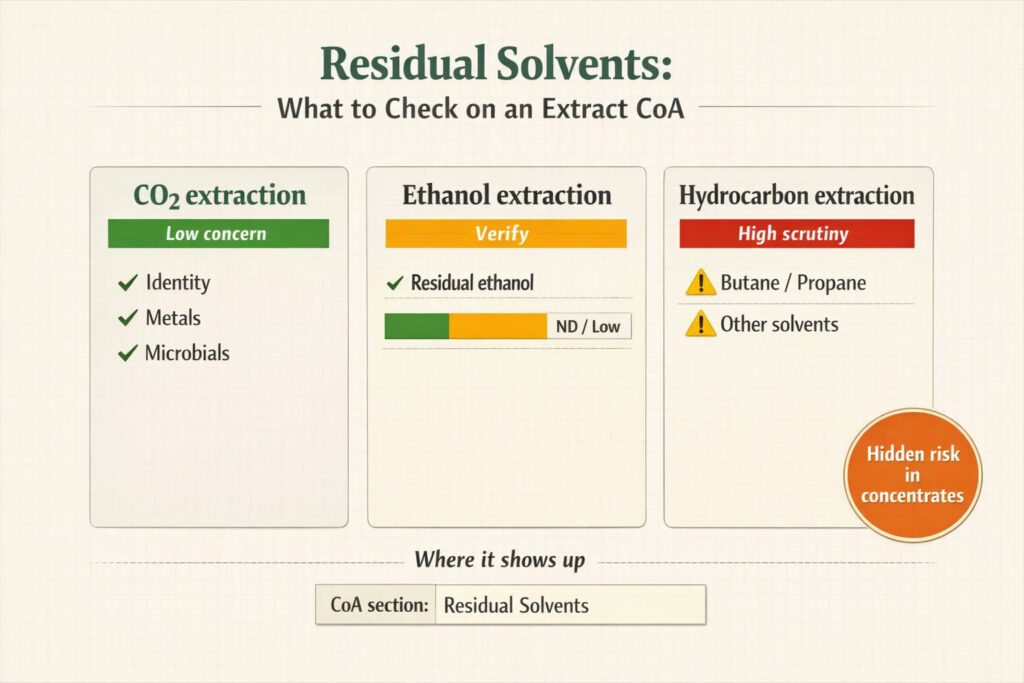
This is the massive blind spot in the current kratom market. Many large vendors offer comprehensive guides on reading a leaf CoA but conveniently ignore the one test unique to concentrates: the Residual Solvent Panel.
To create an extract, manufacturers use solvents like ethanol, butane, or even harsh industrial chemicals to pull the alkaloids from the plant material. The mixture is then purged to remove the solvent, leaving only the concentrated kratom. But if the purging process is rushed or utilizes inferior technology, harmful chemical residues are left behind.
When evaluating an extract, you must look for a specific residual solvent test from an ISO-accredited laboratory. If a brand offers extracts but only provides heavy metal and microbial testing, they are omitting a critical piece of the safety puzzle. The cleanest products on the market utilize solvent-free methods (like advanced CO2 extraction) or provide precise lab data proving that any food-grade ethanol used has been completely purged to safe, undetectable levels.
Residual Solvent Testing Explained
Residual solvent testing measures trace amounts of chemical solvents that may remain after botanical extraction has been completed. Modern analytical laboratories utilize highly sensitive instrumentation capable of detecting solvents at extremely low concentrations, helping manufacturers demonstrate that purification processes have been successfully completed.
Depending on the extraction process, laboratory reports may evaluate ethanol, acetone, hexane, butane, isopropanol, or other processing solvents where appropriate. Products manufactured using solvent-free technologies may not require the same analytical emphasis, although manufacturers should still explain their extraction methodology to promote transparency.
For consumers, residual solvent analysis provides another important layer of confidence by confirming that manufacturing processes have been properly validated rather than relying solely on product marketing.
How to Read a Kratom Extract COA
Reading a Certificate of Analysis involves more than checking whether the report displays a “Pass” result. A comprehensive COA should identify the testing laboratory, batch number, testing date, analytical methods, and the individual results for each parameter examined.
Consumers should verify that the batch number on the product packaging matches the Certificate of Analysis and confirm that the report includes analytical results for heavy metals, microbial screening, alkaloid content, and residual solvents when appropriate. Reports missing essential analytical categories or lacking batch traceability should be evaluated carefully before purchase.
By understanding how to interpret these laboratory reports, consumers can use kratom extract lab tests as objective quality assurance documents rather than marketing materials.
The 7-OH Red Flag: Potency vs. Authenticity
The biggest controversy in the 2026 kratom landscape is synthetic enrichment. Many advanced users are unknowingly purchasing extracts that have been chemically altered to inflate potency, leading to entirely different safety and tolerance profiles.
Mitragynine is the primary alkaloid in the kratom plant. 7-Hydroxymitragynine (7-OH) is a secondary, much more potent alkaloid that naturally occurs in very trace amounts. To spot a synthetically altered extract, you need to understand natural botanical ratios.
In natural plant material, the mitragynine content in kratom powder percentage usually dictates the ceiling of the secondary alkaloids. According to guidelines from the American Herbal Products Association (AHPA) and the American Kratom Association’s (AKA) Version 3.0 GMP standards, 7-OH should not exceed 2% of the total alkaloid fraction (which typically equates to <0.04% of the total product volume in raw leaf).
If you are reviewing an extract CoA and see 7-OH levels that are disproportionately massive compared to the typical mitragynine content in kratom powder percentage, it is a major red flag for synthetic fortification. Authentic, high-quality extracts concentrate the full-spectrum botanical profile as it exists in nature. They do not chemically oxidize Mitragynine into 7-OH in a lab to artificially spike the kick.
Understanding Alkaloid Profile Testing
An alkaloid profile measures the concentration of biologically active compounds naturally present within kratom. While mitragynine receives the greatest attention because it is the predominant alkaloid, comprehensive laboratory analysis may also identify 7-hydroxymitragynine and additional naturally occurring minor alkaloids depending on the testing methodology.
Comparing alkaloid profiles between production batches helps manufacturers monitor consistency while allowing consumers to evaluate standardized extracts using measurable laboratory data. This analytical approach supports greater transparency throughout the manufacturing process.
Botanical Authenticity and Natural Alkaloid Ratios
Botanical authenticity refers to preserving the naturally occurring chemical characteristics of kratom throughout cultivation, extraction, and manufacturing. Rather than artificially modifying alkaloid concentrations, reputable manufacturers seek to maintain a chemical profile that accurately reflects the source botanical material.
Natural alkaloid ratios have therefore become an important consideration when interpreting kratom extract lab tests. Although extraction concentrates active compounds, consumers increasingly evaluate whether finished products remain representative of naturally occurring botanical chemistry instead of chemically altered formulations.
This emphasis on authenticity complements laboratory verification by encouraging manufacturers to provide transparent analytical data that supports confidence in both product composition and manufacturing integrity.
Evaluating Vendor Transparency in 2026
The days of blind trust are over. As an advanced consumer, your evaluation process should heavily weigh how a brand treats its lab data. We are seeing a distinct divide in the industry between brands that prioritize education and those that obscure data.
Many prominent vendors have begun hiding their lab results behind locked batch-lookup tools or difficult-to-navigate QR codes, forcing you to buy the product before you can actually verify its safety. Furthermore, aggregator sites like Reddit—while helpful for peer reviews—often feature inconsistent, unscientific data charts that shouldn’t serve as your primary safety check.
True quality assurance means open-book transparency before the point of purchase. This direct, transparent approach is exactly why operations like krtmonline have cut out middlemen to source directly from Southeast Asian farms. By maintaining strict oversight from the farm level through to ISO-accredited third-party testing, vendors can provide clear, comprehensive CoAs that address solvents, heavy metals, and natural alkaloid ratios without relying on industry gimmicks.
Vendor Transparency and Batch Verification
Reliable manufacturers typically provide batch-specific Certificates of Analysis that correspond directly to individual production lots. This traceability enables consumers to compare the product they receive with the laboratory report generated for that exact manufacturing batch.
Batch verification commonly includes lot numbers, production dates, testing dates, laboratory identification, and analytical results. Matching this information helps confirm that the published laboratory report accurately represents the purchased product rather than a generic or outdated sample.
Companies that maintain easily accessible laboratory reports, clear batch verification systems, and transparent manufacturing information generally provide consumers with greater confidence throughout the purchasing process.
Questions to Ask Before Purchasing an Extract
Before purchasing any concentrated kratom product, consumers should evaluate whether the manufacturer provides sufficient laboratory transparency to support informed decision-making. Important considerations include whether every production batch receives independent laboratory testing, whether residual solvent analysis is included when appropriate, and whether Certificates of Analysis remain publicly accessible before purchase.
Consumers may also wish to verify that testing is performed by ISO 17025-accredited laboratories, confirm that batch numbers match laboratory reports, review heavy metal and microbial screening results, and determine whether standardized alkaloid analysis is included. Asking these questions encourages manufacturers to maintain higher quality assurance standards while helping consumers compare products using objective analytical information.
Frequently Asked Questions
How do I calculate heavy metal exposure from an extract CoA?
Look at the PPM (Parts Per Million) for lead on the CoA. One PPM equals one microgram (µg) per gram of product. If an extract has 1.0 PPM of lead and your dose is 2 grams, your exposure is 2 µg. The USP standard dictates keeping daily lead exposure under 5 µg. Always calculate your specific serving size against the PPM limit.
Is a high 7-Hydroxymitragynine (7-OH) level bad?
7-OH is naturally occurring, but disproportionately high levels (anything artificially pushed past natural botanical ratios) usually indicate chemical oxidation rather than natural extraction. Synthetically enriched 7-OH products carry significantly different tolerance and safety profiles than natural full-spectrum extracts. Reputable vendors adhere to AHPA guidelines, keeping 7-OH fractions natural.
What is the difference between GMP compliance and ISO-accredited lab testing?
GMP (Good Manufacturing Practices) refers to the facility standards where the kratom is handled, packaged, and stored to prevent cross-contamination. ISO accreditation refers specifically to the third-party laboratory conducting the chemical analysis. A trustworthy brand must have both: GMP-compliant facilities and testing verified by an ISO 17025-accredited laboratory.
Why do some extracts not show residual solvent testing?
If a brand uses advanced extraction techniques like Supercritical CO2, no toxic chemical solvents are used, meaning there is zero risk of chemical residue. However, if a brand uses ethanol or other solvents and fails to provide a residual solvent panel, they are likely cutting corners on quality assurance. Always ask how the extract was made if the CoA is incomplete.
Make Your Next Decision with Confidence
Navigating the world of high-potency kratom doesn’t have to be a guessing game. By demanding clear heavy metal reporting, verifying the absence of residual solvents, and checking alkaloid ratios to ensure botanical authenticity, you protect your wellbeing and ensure you get the exact quality you are paying for. Demand transparency, read the data, and only partner with vendors who treat quality assurance as an open book rather than a marketing buzzword.