
Kratom Entourage Effect: How Minor & Trace Alkaloids May Work Together
If you have spent any time researching kratom products, you have likely run into a wall of marketing focused entirely on one number: the mitragynine percentage. Vendors constantly push higher mitragynine concentrations as the ultimate benchmark of quality. But mitragynine percentage alone does not describe the complete alkaloid profile of Mitragyna speciosa, nor does it explain how the plant’s minor and trace alkaloids may contribute to its overall pharmacology.
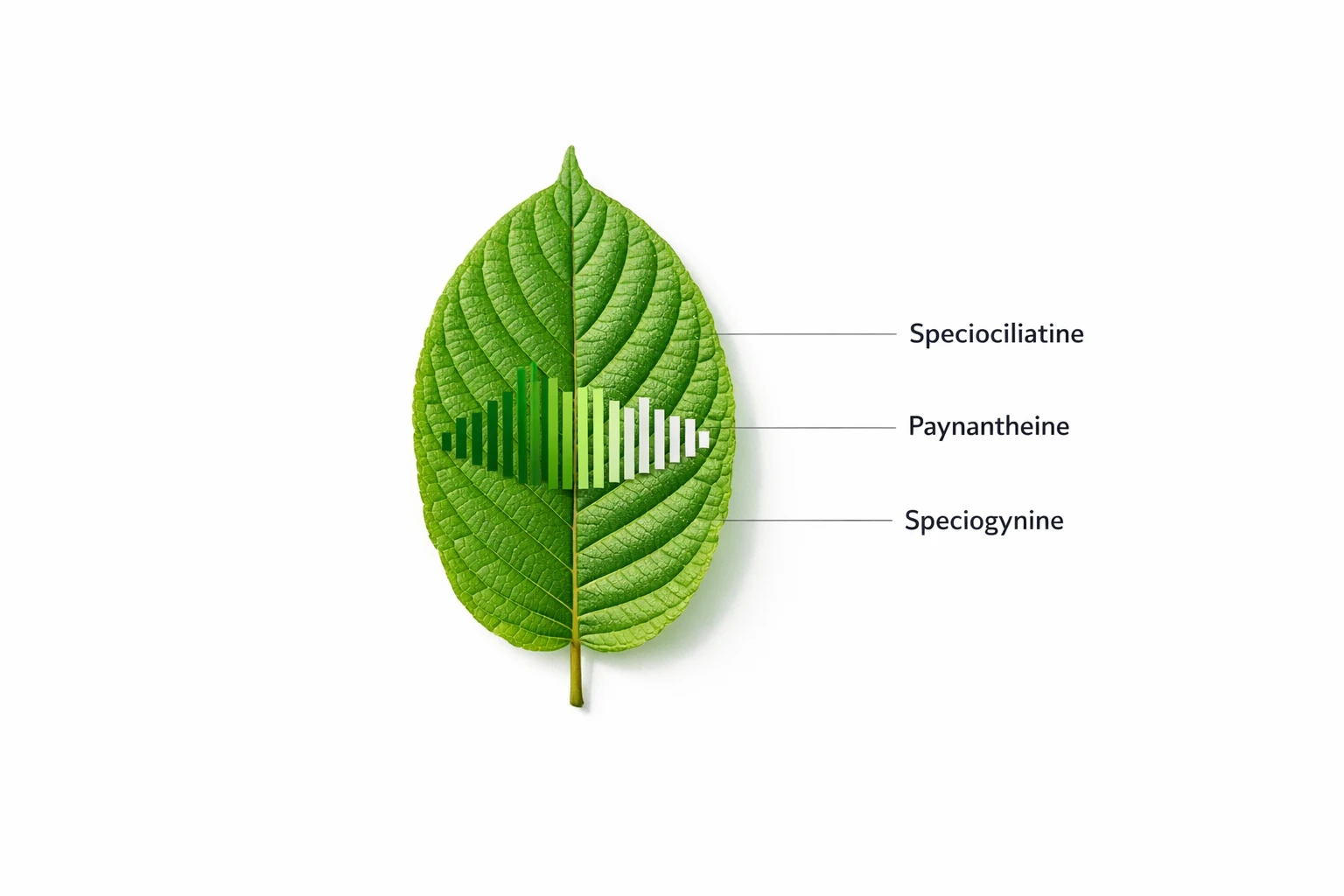
This is where the proposed kratom entourage effect becomes relevant. Rather than treating kratom as if it were a single-compound product, the entourage-effect hypothesis asks whether mitragynine, 7-hydroxymitragynine (7-OH), speciociliatine, paynantheine, speciogynine, and other naturally occurring compounds may interact to create a combined pharmacological profile different from mitragynine alone.
The important word is “proposed.” Multiple kratom alkaloids clearly have pharmacological activity, but robust human evidence has not yet established a predictable clinical entourage effect or proven that a full-spectrum product produces superior outcomes to an isolate. Understanding that distinction lets you separate measurable chemistry from marketing claims.
What Is the Kratom Entourage Effect?
The kratom entourage effect is a pharmacological hypothesis in which multiple alkaloids found in Mitragyna speciosa may interact to influence the overall biological response.
In simple terms, the theory asks whether whole-leaf kratom is pharmacologically more complex than the effects of its dominant alkaloid, mitragynine, considered in isolation.
Kratom contains a chemically diverse mixture of compounds. Different alkaloids may bind to different receptors, have different levels of efficacy, remain in the body for different lengths of time, or influence the effects of other compounds through additive, synergistic, antagonistic, or pharmacokinetic interactions.
That provides a plausible scientific basis for investigating an entourage effect. However, plausibility is not the same as proof. Human research has not yet established which combinations of alkaloids create a clinically meaningful entourage effect, whether such an effect is consistent between products, or whether full-spectrum kratom is inherently more effective or safer than purified formulations.
What Are Minor and Trace Kratom Alkaloids?
Minor and trace kratom alkaloids are naturally occurring compounds present at lower concentrations than mitragynine, which is generally the dominant alkaloid in traditional kratom leaf.
Examples include speciociliatine, paynantheine, speciogynine, mitraciliatine, corynantheidine, and numerous other constituents identified through phytochemical analysis. 7-OH also deserves separate attention because it may be present at low levels in plant material and can additionally be formed through metabolism of mitragynine.
The term “minor” refers primarily to relative abundance. It does not mean an alkaloid is pharmacologically irrelevant. Some minor compounds have demonstrated distinct receptor activity or pharmacokinetic behavior in laboratory and preclinical studies, making them important targets for ongoing research.
This distinction also explains why two kratom products containing similar mitragynine percentages can still have different chemical profiles. Alkaloid ratios may vary with plant material, geography, maturity, processing, storage, extraction method, and product formulation.
Major vs. Minor Kratom Alkaloids
| Alkaloid | Role in the Alkaloid Profile | Research Relevance |
|---|---|---|
| Mitragynine | Predominant alkaloid in traditional kratom leaf | Major focus of opioid and non-opioid pharmacology; metabolic precursor to 7-OH |
| 7-Hydroxymitragynine (7-OH) | Typically present at much lower levels in traditional leaf and also formed metabolically | Strong mu-opioid receptor activity in experimental research |
| Speciociliatine | Minor alkaloid and stereoisomer related to mitragynine | Distinct receptor and pharmacokinetic properties under investigation |
| Paynantheine | Common minor alkaloid | Non-opioid receptor activity investigated experimentally |
| Speciogynine | Common minor alkaloid | Potential receptor-modulating activity under investigation |
| Corynantheidine and other trace alkaloids | Lower-abundance constituents | Potential contribution to the wider pharmacological profile remains under study |
This table should not be read as a ranking of which compound is “best.” Abundance, receptor affinity, intrinsic efficacy, metabolism, and actual tissue exposure all contribute to pharmacological activity.
How Could the Kratom Entourage Effect Work?
If a kratom entourage effect exists, it could arise through several mechanisms rather than one simple form of synergy.
Different alkaloids may interact with different receptor systems, meaning the overall effect of the mixture could reflect multiple signaling pathways at once. Other compounds may compete at the same receptor, alter receptor activation, or have different pharmacokinetic properties that change how long they remain available in the body.
Metabolism introduces another layer. Mitragynine can be converted into 7-OH, meaning the pharmacological profile after ingestion is not necessarily identical to the alkaloid profile originally present in the product.
The possible interactions can therefore be understood in four broad categories: additive effects, where two compounds contribute independently; synergistic effects, where their combined activity is greater than expected; antagonistic effects, where one compound reduces another’s action; and pharmacokinetic interactions, where one compound changes the exposure or metabolism of another.
Current research does not establish that one of these mechanisms universally dominates in whole-leaf kratom. The entourage effect is better treated as a research framework for understanding chemical complexity than as a guaranteed product benefit.
Full-Spectrum Kratom vs. Mitragynine Isolates: What Changes?
A full-spectrum kratom product and a mitragynine isolate differ most fundamentally in chemical complexity. An isolate intentionally concentrates a narrow set of compounds, while a full-spectrum product aims to retain a broader portion of the naturally occurring alkaloid profile.
That difference may matter pharmacologically because individual kratom alkaloids do not all share identical receptor activity or pharmacokinetics. However, it is not scientifically established that full-spectrum products consistently produce a smoother onset, softer comedown, longer duration, or lower tolerance than isolates in humans.
Those experiences may be reported by users, but they should not be presented as universal effects caused by the entourage mechanism.
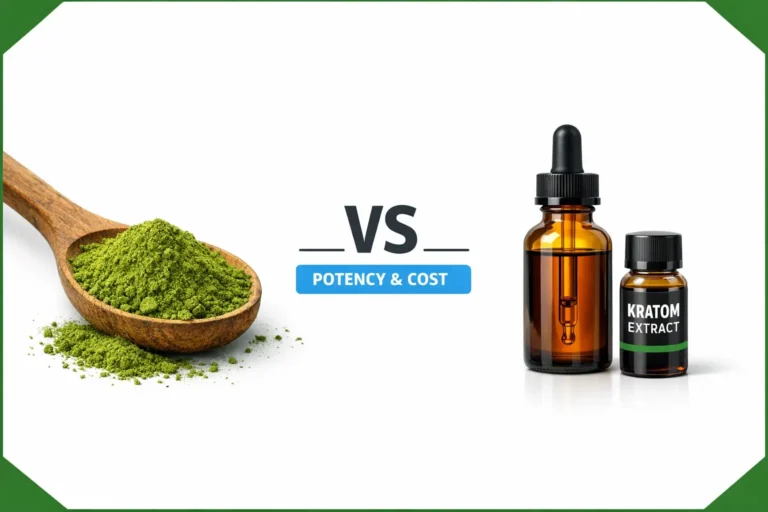
When comparing kratom powder vs extract, the more useful questions are: Which alkaloids are present? At what concentrations? How was the product standardized? Is the laboratory report batch-specific? And does the product contain unusually elevated 7-OH or other concentrated constituents?
An isolate is not automatically inferior because it is chemically simpler, just as “full spectrum” is not automatically superior simply because it contains more compounds. The scientific question is whether the resulting composition produces a reproducible and clinically meaningful difference.
Meet the “Minor” Powerhouses
Minor kratom alkaloids are scientifically interesting precisely because they may behave differently from mitragynine. However, their individual roles should be described according to the strength of the evidence rather than assigned specific human effects prematurely.
Speciociliatine: The Durable Diastereomer
Often overshadowed by its famous sibling, speciociliatine has attracted attention because preclinical research indicates pharmacokinetic and receptor properties that differ from mitragynine.
Some studies suggest speciociliatine may achieve different systemic exposure and clearance characteristics under experimental conditions. That makes it a useful compound for investigating whether minor alkaloids can influence the duration or shape of a mixed-alkaloid pharmacological profile.
What has not been established is that speciociliatine reliably acts as an “anchor,” prevents a comedown, or extends relief in human consumers. Those conclusions go beyond the available evidence.
Paynantheine & Speciogynine: The Serotonergic Balancers
Paynantheine and speciogynine are also important because experimental research has identified activity involving non-opioid receptor systems, including serotonergic targets.
These findings support the broader idea that kratom polypharmacology extends beyond opioid receptors. They do not, however, prove that paynantheine or speciogynine directly produce mood stabilization, anxiety reduction, relaxation, or a particular “fuller” subjective experience in humans.
Receptor affinity demonstrates that an interaction is biologically plausible. It does not establish that the compound reaches sufficient exposure in humans to create a specific clinical or subjective effect.
Corynantheidine and Other Trace Alkaloids
Corynantheidine, mitraciliatine, and numerous lower-abundance alkaloids add another layer of complexity to the kratom alkaloid profile. Some have demonstrated receptor activity in experimental systems, while others remain much less characterized.
These compounds matter semantically and scientifically because they show why “kratom alkaloids” should not be treated as synonymous with mitragynine alone. At the same time, limited data means they should not be assigned specific therapeutic roles without stronger evidence.
Is the Kratom Entourage Effect Scientifically Proven?
Not yet.
There is good evidence that Mitragyna speciosa contains multiple pharmacologically active alkaloids and that individual compounds can differ in receptor activity, intrinsic efficacy, and pharmacokinetic behavior. That provides a plausible scientific foundation for investigating interactions among them.
What has not yet been established through robust human clinical trials is whether whole-leaf kratom consistently produces a distinct entourage effect, which compounds are necessary for that effect, which ratios matter, or whether a full-spectrum formulation reliably outperforms an isolate.
This distinction is critical: evidence for multiple active alkaloids exists. Proof of a predictable, clinically meaningful kratom entourage effect remains limited.
For consumers, that means “full spectrum” should be treated as a description of product composition rather than an automatic promise of superior performance.
Do Minor Kratom Alkaloids Affect Tolerance?
Whether minor alkaloids meaningfully slow, prevent, or reverse tolerance in humans is currently unclear.
Tolerance is a complex biological adaptation influenced by dose, frequency, receptor exposure, duration of use, pharmacokinetics, individual biology, and the specific compounds involved. Repeated exposure to receptor-active alkaloids can alter signaling and responsiveness over time, but the contribution of kratom’s minor alkaloids has not been established well enough to support a specific tolerance-management protocol.
A broader alkaloid profile could theoretically distribute activity across multiple receptor systems, but that does not prove that full-spectrum products prevent mu-opioid receptor tolerance or “reset” receptors more effectively than isolates.
For this reason, claims that an every-other-day schedule is biologically guaranteed to restore receptor sensitivity, or that speciociliatine prevents withdrawal-like effects between servings, should be treated cautiously.
Does the Entourage Effect Make Kratom Safer?
There is currently insufficient evidence to conclude that a full-spectrum alkaloid profile makes kratom inherently safer than an isolate.
Safety depends on far more than whether a product contains minor alkaloids. Relevant factors include total alkaloid exposure, the concentration of specific constituents, adulteration, contaminants, product consistency, co-use with alcohol or medications, individual health variables, and differences between traditional leaf and highly concentrated products.
Animal toxicology studies are useful for identifying biological hazards and dose-response relationships, but their mg/kg findings cannot be converted directly into a human “safe dose” or a guaranteed safety margin without appropriate toxicological modelling and clinical evidence.
The earlier practice of comparing animal toxicity thresholds directly with a typical human serving can therefore create false reassurance. A much more defensible safety framework is to focus on product identity, batch-specific laboratory testing, disclosed alkaloid concentrations, contaminant screening, and avoidance of unsupported claims about a natural safety ceiling.
How Processing Changes the Kratom Alkaloid Profile
The alkaloid profile in a finished kratom product does not depend solely on the tree from which the leaves were harvested. Drying, oxidation, storage, extraction, concentration, and formulation can all change the chemical composition that ultimately reaches the consumer.
Whole-leaf powders generally preserve a broader portion of the plant matrix, while extraction concentrates selected compounds to varying degrees. A broad-spectrum extract, mitragynine-rich extract, and high-7-OH formulation may therefore have substantially different pharmacological profiles even though all three are marketed as kratom products.
Storage conditions also matter because chemical constituents can degrade or transform over time. This is another reason current, batch-specific laboratory testing provides more meaningful information than a generic certificate issued for an older production lot.
How to Identify a Full-Spectrum Kratom Alkaloid Profile
The term “full spectrum” has limited value if it is not supported by analytical evidence. A vendor should ideally be able to show what the product contains rather than relying on the label alone.
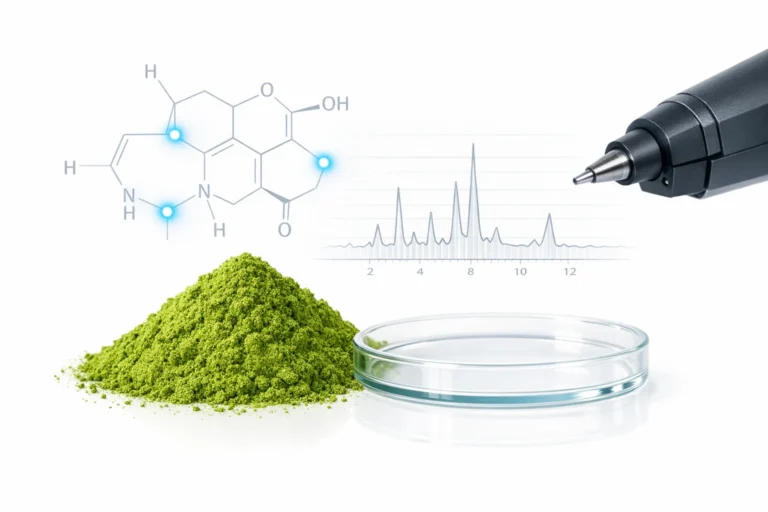
A batch-specific Certificate of Analysis should identify mitragynine and 7-OH at minimum. More advanced alkaloid profiling may also report speciociliatine, speciogynine, paynantheine, and other constituents, giving consumers a clearer picture of the chemical profile.
The report should also be traceable to the product batch and include relevant contaminant screening. When comparing a potent kratom extract powder, measured milligrams and percentages of specific alkaloids are more useful than vague labels such as “extra strength,” “premium,” or “full spectrum.”
Likewise, direct sourcing from Southeast Asian farms may provide useful supply-chain transparency, but sourcing claims alone do not prove alkaloid balance or product consistency. Laboratory analysis remains the stronger evidence for chemical composition.
Does a Higher Mitragynine Percentage Mean Better Kratom?
Not necessarily. A higher mitragynine concentration tells you that more mitragynine is present; it does not automatically establish superior quality, safety, consistency, or overall pharmacological performance.
A useful product assessment should consider alkaloid composition together with contaminant testing, batch identity, formulation, manufacturing quality, and whether concentrations are clearly disclosed.
For a user specifically seeking a mitragynine-rich product, high mitragynine content may be a relevant specification. But it should not be treated as a universal quality score for every kratom formulation.
Frequently Asked Questions (FAQ)
What is the kratom entourage effect?
The kratom entourage effect is the hypothesis that multiple alkaloids in Mitragyna speciosa may interact to create a combined pharmacological profile different from mitragynine alone. Human research has not yet established a predictable clinical entourage effect.
Which alkaloids may contribute to the kratom entourage effect?
Potential contributors include mitragynine, 7-OH, speciociliatine, paynantheine, speciogynine, corynantheidine, and other minor or trace alkaloids. Their individual and combined human effects remain incompletely characterized.
What are the main minor alkaloids in kratom?
Frequently discussed minor alkaloids include speciociliatine, paynantheine, speciogynine, corynantheidine, and mitraciliatine. Their abundance varies among plant material and finished products.
Is the kratom entourage effect scientifically proven?
No. Multiple active alkaloids have been identified, and several have distinct receptor or pharmacokinetic properties, but robust human evidence proving a clinically meaningful kratom entourage effect remains limited.
What is the difference between full-spectrum kratom and a mitragynine isolate?
A full-spectrum product aims to retain a broader range of naturally occurring kratom constituents. A mitragynine isolate concentrates primarily mitragynine. Their chemical complexity therefore differs, but current evidence does not establish that one format is universally better.
Does full-spectrum kratom prevent tolerance?
There is not enough human evidence to conclude that full-spectrum kratom prevents tolerance. Tolerance depends on repeated exposure, dose, frequency, receptor biology, pharmacokinetics, and other variables.
Does a higher mitragynine percentage mean a better product?
No. It indicates greater mitragynine concentration but does not by itself establish product quality, safety, or a superior effect profile.
How can a lab report show a kratom alkaloid profile?
A detailed COA can report concentrations of mitragynine, 7-OH, and potentially additional minor alkaloids. Batch-specific testing provides the strongest evidence that the reported chemical profile corresponds to the product being purchased.
Making an Informed Choice
Evaluating kratom shouldn’t feel like a guessing game. Understanding mitragynine, 7-OH, speciociliatine, paynantheine, speciogynine, and other trace constituents provides a more complete framework for comparing products than focusing on one headline percentage.
The most important scientific takeaway is not that the kratom entourage effect has been proven, but that kratom is chemically and pharmacologically more complex than a single mitragynine molecule. Individual alkaloids can differ in receptor activity and pharmacokinetics, making their potential interactions a legitimate area of research.
For consumers, this means prioritizing composition and evidence over marketing language. Look for batch-specific testing, clearly disclosed alkaloid concentrations, contaminant screening, and accurate distinctions between whole leaf, full-spectrum extracts, mitragynine-rich extracts, and products containing elevated 7-OH.
At Kratom-Online, the strongest basis for product transparency is verifiable chemistry. Direct sourcing can provide useful provenance, but laboratory documentation is what allows consumers to see whether a product’s measured alkaloid profile actually supports the claims made about it.
When you move beyond “highest mitragynine wins” and start evaluating the complete alkaloid profile, you gain a much more scientifically grounded way to compare Mitragyna speciosa products—without treating an interesting pharmacological hypothesis as a proven clinical guarantee.